1C86 | pdb_00001c86

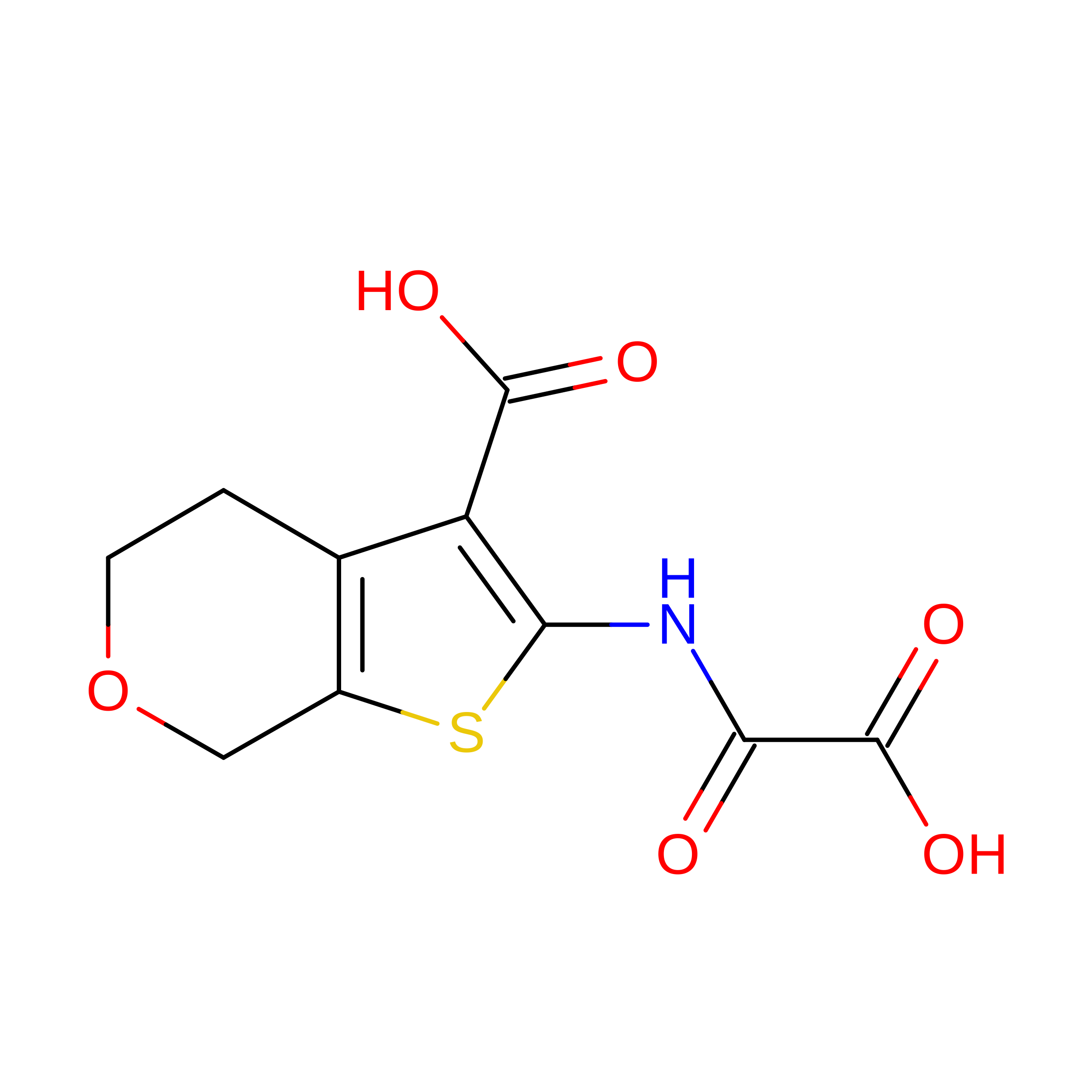
CRYSTAL STRUCTURE OF PROTEIN TYROSINE PHOSPHATASE 1B (R47V,D48N) COMPLEXED WITH 2-(OXALYL-AMINO-4,7-DIHYDRO-5H-THIENO[2,3-C]PYRAN-3-CARBOXYLIC ACID


Experimental Data Snapshot

  • Method: X-RAY DIFFRACTION
  • Resolution: 2.30 Å
  • R-Value Free: 
    0.262 (Depositor) 
  • R-Value Work: 
    0.194 (Depositor) 
  • R-Value Observed: 
    0.194 (Depositor) 

Starting Model: experimental
View more details

wwPDB Validation 3D Report Full Report

Validation slider image for 1C86

This is version 1.5 of the entry. See complete history

Literature

Structure-based design of a low molecular weight, nonphosphorus, nonpeptide, and highly selective inhibitor of protein-tyrosine phosphatase 1B.

Iversen, L.F.Andersen, H.S.Branner, S.Mortensen, S.B.Peters, G.H.Norris, K.Olsen, O.H.Jeppesen, C.B.Lundt, B.F.Ripka, W.Moller, K.B.Moller, N.P.

(2000) J Biological Chem 275: 10300-10307

  • DOI: https://doi.org/10.1074/jbc.275.14.10300
  • Primary Citation Related Structures: 
    1C86, 1C87, 1C88

  • PubMed Abstract: 

    Several protein-tyrosine phosphatases (PTPs) have been proposed to act as negative regulators of insulin signaling. Recent studies have shown increased insulin sensitivity and resistance to obesity in PTP1B knockout mice, thus pointing to this enzyme as a potential drug target in diabetes. Structure-based design, guided by PTP mutants and x-ray protein crystallography, was used to optimize a relatively weak, nonphosphorus, nonpeptide general PTP inhibitor (2-(oxalyl-amino)-benzoic acid) into a highly selective PTP1B inhibitor. This was achieved by addressing residue 48 as a selectivity determining residue. By introducing a basic nitrogen in the core structure of the inhibitor, a salt bridge was formed to Asp-48 in PTP1B. In contrast, the basic nitrogen causes repulsion in other PTPs containing an asparagine in the equivalent position resulting in a remarkable selectivity for PTP1B. Importantly, this was accomplished while retaining the molecular weight of the inhibitor below 300 g/mol.


  • Organizational Affiliation
    • Protein Chemistry, Novo Nordisk, DK-2880 Bagsvaerd, Denmark. lfiv@novo.dk

Macromolecule Content 

  • Total Structure Weight: 34.93 kDa 
  • Atom Count: 2,560 
  • Modeled Residue Count: 296 
  • Deposited Residue Count: 298 
  • Unique protein chains: 1

Macromolecules

Find similar proteins by:|  3D Structure
Entity ID: 1
MoleculeChains  Sequence LengthOrganismDetailsImage
PROTEIN (PROTEIN-TYROSINE PHOSPHATASE 1B)298Homo sapiensMutation(s): 2 
EC: 3.1.3.48
UniProt & NIH Common Fund Data Resources
Find proteins for P18031 (Homo sapiens)
Explore P18031 
Go to UniProtKB:  P18031
PHAROS:  P18031
GTEx:  ENSG00000196396 
Entity Groups
Sequence Clusters30% Identity50% Identity70% Identity90% Identity95% Identity100% Identity
UniProt GroupP18031
Sequence Annotations
Expand
Reference Sequence

Small Molecules

Ligands 1 Unique
IDChains Name / Formula / InChI Key2D Diagram3D Interactions
OPA

Query on OPA


Download:Ideal Coordinates CCD File
B [auth A]2-(OXALYL-AMINO)-4,7-DIHYDRO-5H-THIENO[2,3-C]PYRAN-3-CARBOXYLIC ACID
C10 H9 N O6 S
SNNOZMNTPOIDSI-UHFFFAOYSA-N
Binding Affinity Annotations 
IDSourceBinding Affinity
OPA BindingDB:  1C86 Ki: min: 1.39e+4, max: 1.41e+4 (nM) from 3 assay(s)

Experimental Data & Validation

Experimental Data

  • Method: X-RAY DIFFRACTION
  • Resolution: 2.30 Å
  • R-Value Free:  0.262 (Depositor) 
  • R-Value Work:  0.194 (Depositor) 
  • R-Value Observed: 0.194 (Depositor) 
Space Group: P 31 2 1
Unit Cell:
Length ( Å )Angle ( ˚ )
a = 88.274α = 90
b = 88.274β = 90
c = 104.501γ = 120
Software Package:
Software NamePurpose
AMoREphasing
X-PLORrefinement
DENZOdata reduction
SCALEPACKdata scaling

Structure Validation

View Full Validation Report


Entry History 

Deposition Data

Revision History  (Full details and data files)

  • Version 1.0: 2000-05-03
    Type: Initial release
  • Version 1.1: 2008-04-26
    Changes: Version format compliance
  • Version 1.2: 2011-07-13
    Changes: Version format compliance
  • Version 1.3: 2018-03-07
    Changes: Data collection
  • Version 1.4: 2021-11-03
    Changes: Database references, Derived calculations
  • Version 1.5: 2023-08-09
    Changes: Data collection, Refinement description