1C82 | pdb_00001c82

MECHANISM OF HYALURONAN BINDING AND DEGRADATION: STRUCTURE OF STREPTOCOCCUS PNEUMONIAE HYALURONATE LYASE IN COMPLEX WITH HYALURONIC ACID DISACCHARIDE AT 1.7 A RESOLUTION


Experimental Data Snapshot

  • Method: X-RAY DIFFRACTION
  • Resolution: 1.70 Å
  • R-Value Free: 
    0.257 (Depositor), 0.238 (DCC) 
  • R-Value Work: 
    0.215 (Depositor), 0.203 (DCC) 

wwPDB Validation 3D Report Full Report

Validation slider image for 1C82

This is version 2.1 of the entry. See complete history

Literature

Mechanism of hyaluronan binding and degradation: structure of Streptococcus pneumoniae hyaluronate lyase in complex with hyaluronic acid disaccharide at 1.7 A resolution.

Ponnuraj, K.Jedrzejas, M.J.

(2000) J Mol Biology 299: 885-895

  • DOI: https://doi.org/10.1006/jmbi.2000.3817
  • Primary Citation Related Structures: 
    1C82

  • PubMed Abstract: 

    Hyaluronic acid (HA) is an important constituent of the extracellular matrix; its bacterial degradation has been postulated to contribute to the spread of certain streptococci through tissue. Pneumococci and other streptococci produce hyaluronate lyase, an enzyme which depolymerizes HA, thus hyaluronate lyase might contribute directly to bacterial invasion. Although two different mechanisms for lyase action have been proposed, there was no crystallographic evidence to support those mechanisms. Here, we report the high-resolution crystal structure of Streptococcus pneumoniae hyaluronate lyase in the presence of HA disaccharide product, which ultimately provides the first crystallographic evidence for the binding of HA to hyaluronate lyase. This structural complex revealed a key interaction between the Streptococcus peneumoniae hyaluronate lyase protein and the product, and supports our previously proposed novel catalytic mechanism for HA degradation based on the native Streptococcus peneumoniae hyaluronate lyase structure. The information provided by this complex structure will likely be useful in the development of antimicrobial pharmaceutical agents.


  • Organizational Affiliation
    • Department of Microbiology, University of Alabama at Birmingham, Birmingham, AL, 35294, USA.

Macromolecule Content 

  • Total Structure Weight: 84.64 kDa 
  • Atom Count: 6,407 
  • Modeled Residue Count: 719 
  • Deposited Residue Count: 731 
  • Unique protein chains: 1

Macromolecules

Find similar proteins by:|  3D Structure
Entity ID: 1
MoleculeChains  Sequence LengthOrganismDetailsImage
HYALURONATE LYASE731Streptococcus pneumoniaeMutation(s): 0 
EC: 4.2.2.1
UniProt
Find proteins for Q54873 (Streptococcus pneumoniae serotype 4 (strain ATCC BAA-334 / TIGR4))
Explore Q54873 
Go to UniProtKB:  Q54873
Entity Groups
Sequence Clusters30% Identity50% Identity70% Identity90% Identity95% Identity100% Identity
UniProt GroupQ54873
Sequence Annotations
Expand
Reference Sequence

Oligosaccharides

Help  
Entity ID: 2
MoleculeChains Length2D Diagram GlycosylationD Interactions
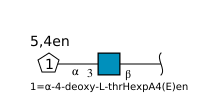
4-deoxy-alpha-L-threo-hex-4-enopyranuronic acid-(1-3)-2-acetamido-2-deoxy-beta-D-glucopyranose
B, C
2N/A
Glycosylation Resources
GlyTouCan: G14110BE
GlyCosmos: G14110BE

Experimental Data & Validation

Experimental Data

  • Method: X-RAY DIFFRACTION
  • Resolution: 1.70 Å
  • R-Value Free:  0.257 (Depositor), 0.238 (DCC) 
  • R-Value Work:  0.215 (Depositor), 0.203 (DCC) 
Space Group: P 21 21 21
Unit Cell:
Length ( Å )Angle ( ˚ )
a = 83.55α = 90
b = 104.19β = 90
c = 99.88γ = 90
Software Package:
Software NamePurpose
X-PLORmodel building
X-PLORrefinement
DENZOdata reduction
SCALEPACKdata scaling
X-PLORphasing

Structure Validation

View Full Validation Report


Entry History 

Deposition Data

Revision History  (Full details and data files)

  • Version 1.0: 2001-04-05
    Type: Initial release
  • Version 1.1: 2008-04-26
    Changes: Version format compliance
  • Version 1.2: 2011-07-13
    Changes: Non-polymer description, Version format compliance
  • Version 1.3: 2013-01-23
    Changes: Non-polymer description
  • Version 2.0: 2020-07-29
    Type: Remediation
    Reason: Carbohydrate remediation
    Changes: Atomic model, Data collection, Database references, Derived calculations, Structure summary
  • Version 2.1: 2023-12-27
    Changes: Data collection, Database references, Structure summary