1C0E | pdb_00001c0e

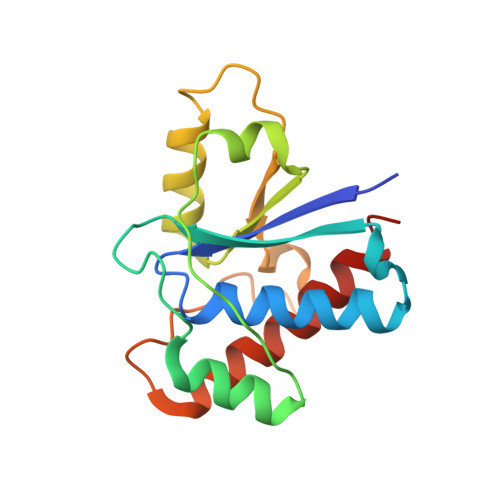
Active Site S19A Mutant of Bovine Heart Phosphotyrosyl Phosphatase


Experimental Data Snapshot

  • Method: X-RAY DIFFRACTION
  • Resolution: 2.20 Å
  • R-Value Free: 
    0.244 (Depositor) 
  • R-Value Work: 
    0.191 (Depositor) 
  • R-Value Observed: 
    0.191 (Depositor) 

wwPDB Validation 3D Report Full Report

Validation slider image for 1C0E

This is version 1.4 of the entry. See complete history

Literature

The structure of the bovine protein tyrosine phosphatase dimer reveals a potential self-regulation mechanism.

Tabernero, L.Evans, B.N.Tishmack, P.A.Van Etten, R.L.Stauffacher, C.V.

(1999) Biochemistry 38: 11651-11658

  • DOI: https://doi.org/10.1021/bi990381x
  • Primary Citation Related Structures: 
    1C0E

  • PubMed Abstract: 

    The bovine protein tyrosine phosphatase (BPTP) is a member of the class of low-molecular weight protein tyrosine phosphatases (PTPases) found to be ubiquitous in mammalian cells. The catalytic site of BPTP contains a CX(5)R(S/T) phosphate-binding motif or P-loop (residues 12-19) which is the signature sequence for all PTPases. Ser19, the final residue of the P-loop motif, interacts with the catalytic Cys12 and participates in stabilizing the conformation of the active site through interactions with Asn15, also in the P-loop. Mutations at Ser19 result in an enzyme with altered kinetic properties with changes in the pK(a) of the neighboring His72. The X-ray structure of the S19A mutant enzyme shows that the general conformation of the P-loop is preserved. However, changes in the loop containing His72 result in a displacement of the His72 side chain that may explain the shift in the pK(a). In addition, it was found that in the crystal, the protein forms a dimer in which Tyr131 and Tyr132 from one monomer insert into the active site of the other monomer, suggesting a dual-tyrosine motif on target sites for this enzyme. Since the activity of this PTPase is reportedly regulated by phosphorylation at Tyr131 and Tyr132, the structure of this dimer may provide a model of a self-regulation mechanism for the low-molecular weight PTPases.


  • Organizational Affiliation
    • Department of Biological Sciences, Purdue University, West Lafayette, Indiana 47907, USA.

Macromolecule Content 

  • Total Structure Weight: 36.05 kDa 
  • Atom Count: 2,572 
  • Modeled Residue Count: 308 
  • Deposited Residue Count: 314 
  • Unique protein chains: 1

Macromolecules

Find similar proteins by:|  3D Structure
Entity ID: 1
MoleculeChains  Sequence LengthOrganismDetailsImage
PROTEIN (TYROSINE PHOSPHATASE (ORTHOPHOSPHORIC MONOESTER PHOSPHOHYDROLASE))
A, B
157Bos taurusMutation(s): 1 
EC: 3.1.3.2 (PDB Primary Data), 3.1.3.48 (UniProt)
UniProt
Find proteins for P11064 (Bos taurus)
Explore P11064 
Go to UniProtKB:  P11064
Entity Groups
Sequence Clusters30% Identity50% Identity70% Identity90% Identity95% Identity100% Identity
UniProt GroupP11064
Sequence Annotations
Expand
Reference Sequence

Small Molecules

Experimental Data & Validation

Experimental Data

  • Method: X-RAY DIFFRACTION
  • Resolution: 2.20 Å
  • R-Value Free:  0.244 (Depositor) 
  • R-Value Work:  0.191 (Depositor) 
  • R-Value Observed: 0.191 (Depositor) 
Space Group: P 21 21 21
Unit Cell:
Length ( Å )Angle ( ˚ )
a = 43.32α = 90
b = 55.47β = 90
c = 131.45γ = 90
Software Package:
Software NamePurpose
AMoREphasing
CNSrefinement
DENZOdata reduction
SCALEPACKdata scaling

Structure Validation

View Full Validation Report


Entry History 

Deposition Data

Revision History  (Full details and data files)

  • Version 1.0: 1999-09-28
    Type: Initial release
  • Version 1.1: 2007-10-21
    Changes: Version format compliance
  • Version 1.2: 2011-07-13
    Changes: Version format compliance
  • Version 1.3: 2021-11-03
    Changes: Database references, Derived calculations
  • Version 1.4: 2024-02-07
    Changes: Data collection