1BUB | pdb_00001bub

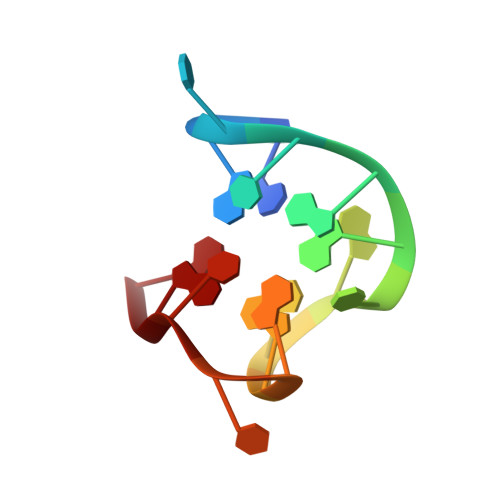
DETERMINATION OF INTERNUCLEAR ANGLES OF DNA USING PARAMAGNETIC ASSISTED MAGNETIC ALIGNMENT


Experimental Data Snapshot

  • Method: SOLUTION NMR
  • Conformers Submitted: 
  • Selection Criteria: MINIMIZED AVERAGE 

wwPDB Validation 3D Report Full Report

Validation slider image for 1BUB

This is version 1.4 of the entry. See complete history

Literature

Determination of internuclear angles of DNA using paramagnetic-assisted magnetic alignment.

Beger, R.D.Marathias, V.M.Volkman, B.F.Bolton, P.H.

(1998) J Magn Reson (1969 135: 256-259

  • DOI: https://doi.org/10.1006/jmre.1998.1527
  • Primary Citation Related Structures: 
    1BUB

  • PubMed Abstract: 

    Paramagnetic ions have been used to assist the magnetic alignment of DNA. The anisotropy of the binding sites is sufficient to give rise to significant alignment of the DNA with the observed proton-carbon dipolar couplings spanning a 70-Hz range. The dipolar couplings have been used to determine the positions of the axial and rhombic alignment axes. The positions of the alignment axes relative to the positions of the binding sites of the paramagnetic europium ions have also been determined.


  • Organizational Affiliation
    • Chemistry Department, Wesleyan University, Middletown, Connecticut, 06459, USA.

Macromolecule Content 

  • Total Structure Weight: 5.05 kDa 
  • Atom Count: 317 
  • Modeled Residue Count: 15 
  • Deposited Residue Count: 15 
  • Unique nucleic acid chains: 1

Macromolecules

Find similar nucleic acids by:  Sequence
Entity ID: 1
MoleculeChains LengthOrganismImage
DNA (5'-D(*GP*GP*TP*TP*GP*GP*TP*GP*TP*GP*GP*TP*TP*GP*G)-3')15N/A
Sequence Annotations
Expand
Reference Sequence

Small Molecules

Experimental Data & Validation

Experimental Data

  • Method: SOLUTION NMR
  • Conformers Submitted: 
  • Selection Criteria: MINIMIZED AVERAGE 

Structure Validation

View Full Validation Report


Entry History 

Deposition Data

Revision History  (Full details and data files)

  • Version 1.0: 1998-09-09
    Type: Initial release
  • Version 1.1: 2008-04-27
    Changes: Version format compliance
  • Version 1.2: 2011-07-13
    Changes: Version format compliance
  • Version 1.3: 2022-02-16
    Changes: Database references, Derived calculations, Experimental preparation
  • Version 1.4: 2024-05-22
    Changes: Data collection