1BSK | pdb_00001bsk

ZINC DEFORMYLASE INHIBITOR COMPLEX FROM E.COLI


Experimental Data Snapshot

  • Method: X-RAY DIFFRACTION
  • Resolution: 3.00 Å
  • R-Value Free: 
    0.221 (Depositor) 
  • R-Value Work: 
    0.167 (Depositor) 
  • R-Value Observed: 
    0.167 (Depositor) 

Starting Model: experimental
View more details

wwPDB Validation 3D Report Full Report

Validation slider image for 1BSK

This is version 1.4 of the entry. See complete history

Literature

Structural basis for the design of antibiotics targeting peptide deformylase.

Hao, B.Gong, W.Rajagopalan, P.T.Zhou, Y.Pei, D.Chan, M.K.

(1999) Biochemistry 38: 4712-4719

  • DOI: https://doi.org/10.1021/bi982594c
  • Primary Citation Related Structures: 
    1BSJ, 1BSK

  • PubMed Abstract: 

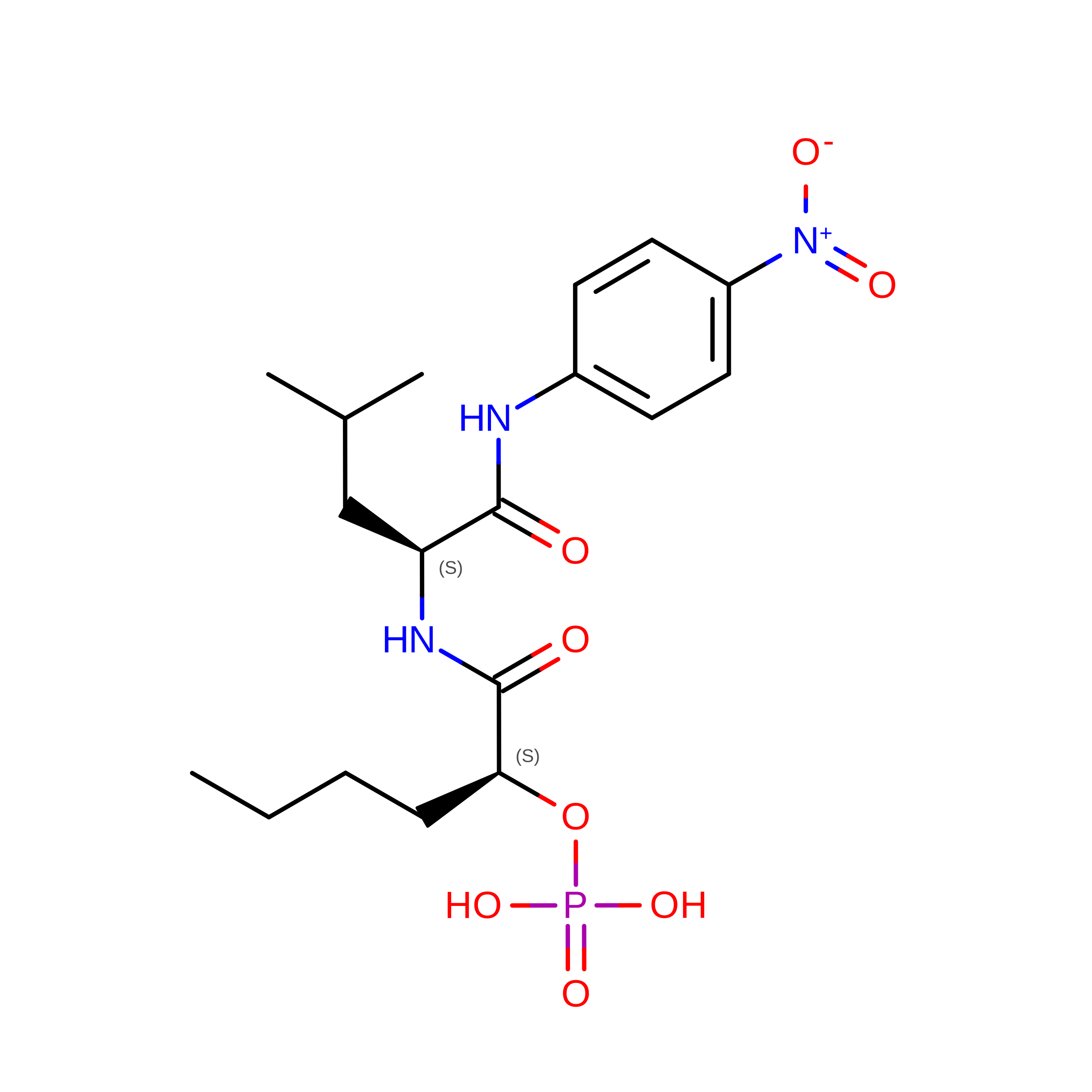
    While protein synthesis in bacteria begins with a formylated methionine, the formyl group of the nascent polypeptide is removed by peptide deformylase. Since eukaryotic protein synthesis does not involve formylation and deformylation at the N-terminus, there has been increasing interest in peptide deformylase as a potential target for antibacterial chemotherapy. Toward this end and to aid in the design of effective antibiotics targeting peptide deformylase, the structures of the protein-inhibitor complexes of both the cobalt and the zinc containing Escherichia coli peptide deformylase bound to the transition-state analogue, (S)-2-O-(H-phosphonoxy)-L-caproyl-L-leucyl-p-nitroanilide (PCLNA), have been determined. The proteins for both deformylase-inhibitor complexes show basically the same fold as for the native enzyme. The PCLNA inhibitor adopts an extended conformation and fits nicely into a hydrophobic cavity located near the metal site. On the basis of these structures, guidelines for the design of high-affinity deformylase inhibitors are suggested. As our results show that the protein residues which interact with the PCLNA inhibitor are conserved over a wide variety of species, we suggest that antibiotics targeting deformylase could have wide applicability.


  • Organizational Affiliation
    • Departments of Biochemistry and Chemistry, The Ohio State University, 484 West 12th Avenue, Columbus, Ohio 43210, USA.

Macromolecule Content 

  • Total Structure Weight: 19.83 kDa 
  • Atom Count: 1,377 
  • Modeled Residue Count: 166 
  • Deposited Residue Count: 168 
  • Unique protein chains: 1

Macromolecules

Find similar proteins by:|  3D Structure
Entity ID: 1
MoleculeChains  Sequence LengthOrganismDetailsImage
PROTEIN (PEPTIDE DEFORMYLASE)168Escherichia coliMutation(s): 0 
EC: 3.5.1.27 (PDB Primary Data), 3.5.1.88 (UniProt)
UniProt
Find proteins for P0A6K3 (Escherichia coli (strain K12))
Explore P0A6K3 
Go to UniProtKB:  P0A6K3
Entity Groups
Sequence Clusters30% Identity50% Identity70% Identity90% Identity95% Identity100% Identity
UniProt GroupP0A6K3
Sequence Annotations
Expand
Reference Sequence

Small Molecules

Ligands 3 Unique
IDChains Name / Formula / InChI Key2D Diagram3D Interactions
MLN

Query on MLN


Download:Ideal Coordinates CCD File
D [auth A](S)-2-(PHOSPHONOXY)CAPROYL-L-LEUCYL-P-NITROANILIDE
C18 H28 N3 O8 P
HARXAJAHMRMERT-HOTGVXAUSA-N
PO4

Query on PO4


Download:Ideal Coordinates CCD File
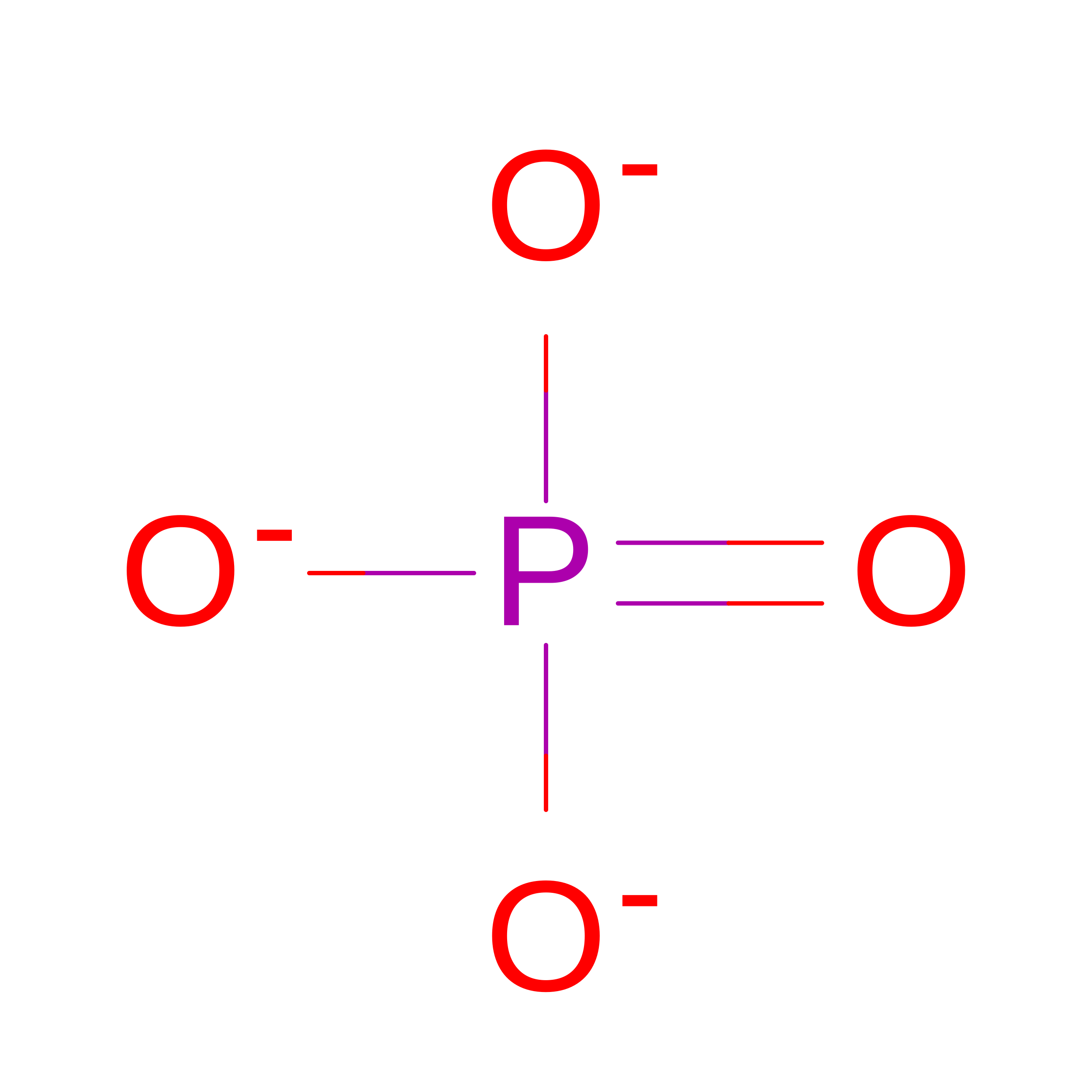
C [auth A]PHOSPHATE ION
O4 P
NBIIXXVUZAFLBC-UHFFFAOYSA-K
ZN

Query on ZN


Download:Ideal Coordinates CCD File
B [auth A]ZINC ION
Zn
PTFCDOFLOPIGGS-UHFFFAOYSA-N

Experimental Data & Validation

Experimental Data

  • Method: X-RAY DIFFRACTION
  • Resolution: 3.00 Å
  • R-Value Free:  0.221 (Depositor) 
  • R-Value Work:  0.167 (Depositor) 
  • R-Value Observed: 0.167 (Depositor) 
Space Group: P 65 2 2
Unit Cell:
Length ( Å )Angle ( ˚ )
a = 99.17α = 90
b = 99.17β = 90
c = 110.755γ = 120
Software Package:
Software NamePurpose
X-PLORmodel building
X-PLORrefinement
DENZOdata reduction
SCALEPACKdata scaling
X-PLORphasing

Structure Validation

View Full Validation Report


Entry History 

Deposition Data

Revision History  (Full details and data files)

  • Version 1.0: 2000-04-15
    Type: Initial release
  • Version 1.1: 2007-10-16
    Changes: Version format compliance
  • Version 1.2: 2011-07-13
    Changes: Version format compliance
  • Version 1.3: 2017-10-04
    Changes: Refinement description
  • Version 1.4: 2023-08-09
    Changes: Data collection, Database references, Derived calculations, Refinement description