1BIJ | pdb_00001bij

CROSSLINKED, DEOXY HUMAN HEMOGLOBIN A


Experimental Data Snapshot

  • Method: X-RAY DIFFRACTION
  • Resolution: 2.30 Å
  • R-Value Free: 
    0.263 (Depositor) 
  • R-Value Work: 
    0.190 (Depositor) 
  • R-Value Observed: 
    0.190 (Depositor) 

Starting Model: experimental
View more details

wwPDB Validation 3D Report Full Report

Validation slider image for 1BIJ

This is version 1.4 of the entry. See complete history

Literature

Crystal structure of Lysbeta(1)82-Lysbeta(2)82 crosslinked hemoglobin: a possible allosteric intermediate

Fernandez, E.J.Abad-Zapatero, C.Olsen, K.W.

(2000) J Mol Biology 296: 1245-1256

  • DOI: https://doi.org/10.1006/jmbi.2000.3525
  • Primary Citation Related Structures: 
    1BIJ

  • PubMed Abstract: 

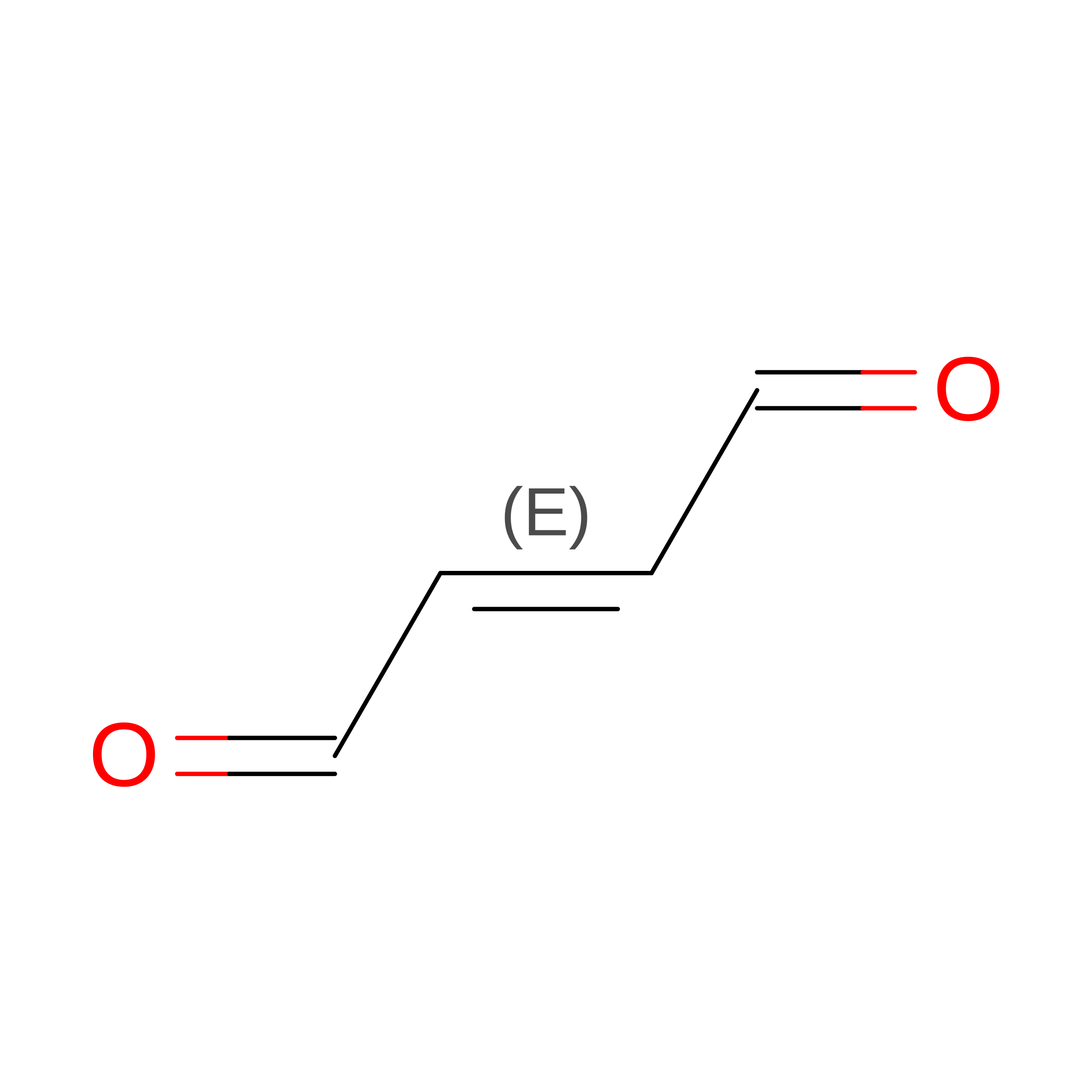
    The crystal structure of human hemoglobin crosslinked between the Lysbeta82 residues has been determined at 2.30 A resolution. The crosslinking reaction was performed under oxy conditions using bis(3, 5-dibromosalicyl) fumarate; the modified hemoglobin has increased oxygen affinity and lacks cooperativity. Since the crystallization occurred under deoxy conditions, the resulting structure displays conformational characteristics of both the (oxy) R and the (deoxy) T-states. beta82XLHbA does not fully reach its T-state conformation due to the presence of the crosslink. The R-state-like characteristics of deoxy beta82XLHbA include the position of the distal Hisbeta63 (E7) residue, indicating a possible reason for the high oxygen affinity of this derivative. Other areas of the molecule, particularly those thought to be important in the allosteric transition, such as Tyrbeta145 (HC2) and the switch region involving Proalpha(1)44 (CD2), Thralpha(1)41 (C6) and Hisbeta(2)97 (FG4), are in intermediate positions between the R and T-states. Thus, the structure may represent a stabilized intermediate in the allosteric transition of hemoglobin.


  • Organizational Affiliation
    • Department of Chemistry, Loyola University Chicago, Chicago, IL 60626, USA.

Macromolecule Content 

  • Total Structure Weight: 64.63 kDa 
  • Atom Count: 4,749 
  • Modeled Residue Count: 574 
  • Deposited Residue Count: 574 
  • Unique protein chains: 2

Macromolecules

Find similar proteins by:|  3D Structure
Entity ID: 1
MoleculeChains  Sequence LengthOrganismDetailsImage
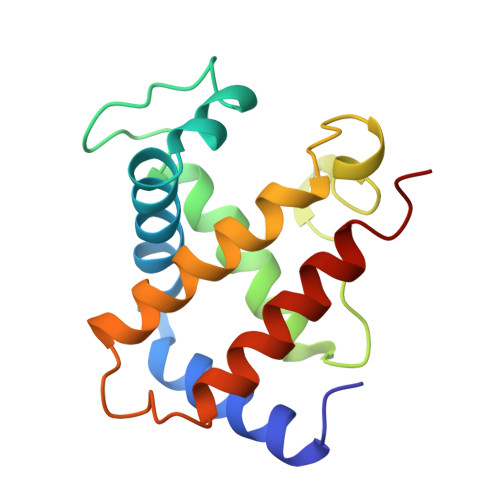
HEMOGLOBIN A
A, C
141Homo sapiensMutation(s): 0 
UniProt & NIH Common Fund Data Resources
Find proteins for P69905 (Homo sapiens)
Explore P69905 
Go to UniProtKB:  P69905
Entity Groups
Sequence Clusters30% Identity50% Identity70% Identity90% Identity95% Identity100% Identity
UniProt GroupP69905
Sequence Annotations
Expand
Reference Sequence
Find similar proteins by:|  3D Structure
Entity ID: 2
MoleculeChains  Sequence LengthOrganismDetailsImage
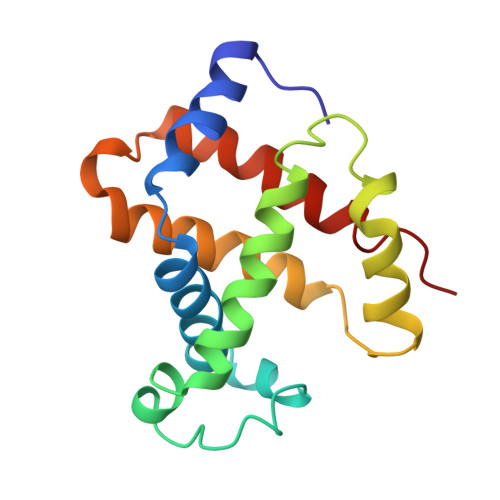
HEMOGLOBIN A
B, D
146Homo sapiensMutation(s): 0 
UniProt & NIH Common Fund Data Resources
Find proteins for P68871 (Homo sapiens)
Explore P68871 
Go to UniProtKB:  P68871
PHAROS:  P68871
GTEx:  ENSG00000244734 
Entity Groups
Sequence Clusters30% Identity50% Identity70% Identity90% Identity95% Identity100% Identity
UniProt GroupP68871
Sequence Annotations
Expand
Reference Sequence

Experimental Data & Validation

Experimental Data

  • Method: X-RAY DIFFRACTION
  • Resolution: 2.30 Å
  • R-Value Free:  0.263 (Depositor) 
  • R-Value Work:  0.190 (Depositor) 
  • R-Value Observed: 0.190 (Depositor) 
Space Group: P 1 21 1
Unit Cell:
Length ( Å )Angle ( ˚ )
a = 65.3α = 90
b = 96β = 101.5
c = 101.5γ = 90
Software Package:
Software NamePurpose
X-PLORmodel building
X-PLORrefinement
R-AXISdata reduction
X-PLORphasing

Structure Validation

View Full Validation Report


Entry History 

Deposition Data

Revision History  (Full details and data files)

  • Version 1.0: 1999-03-30
    Type: Initial release
  • Version 1.1: 2008-03-03
    Changes: Version format compliance
  • Version 1.2: 2011-07-13
    Changes: Version format compliance
  • Version 1.3: 2023-08-02
    Changes: Database references, Derived calculations, Other, Refinement description
  • Version 1.4: 2024-12-25
    Changes: Advisory, Data collection, Derived calculations, Structure summary