1B5F | pdb_00001b5f

NATIVE CARDOSIN A FROM CYNARA CARDUNCULUS L.


Experimental Data Snapshot

  • Method: X-RAY DIFFRACTION
  • Resolution: 1.72 Å
  • R-Value Free: 
    0.256 (Depositor) 
  • R-Value Work: 
    0.196 (DCC) 
  • R-Value Observed: 
    0.205 (Depositor) 

Starting Model: experimental
View more details

wwPDB Validation 3D Report Full Report

Validation slider image for 1B5F

This is version 3.2 of the entry. See complete history

Literature

Crystal structure of cardosin A, a glycosylated and Arg-Gly-Asp-containing aspartic proteinase from the flowers of Cynara cardunculus L.

Frazao, C.Bento, I.Costa, J.Soares, C.M.Verissimo, P.Faro, C.Pires, E.Cooper, J.Carrondo, M.A.

(1999) J Biological Chem 274: 27694-27701

  • DOI: https://doi.org/10.1074/jbc.274.39.27694
  • Primary Citation Related Structures: 
    1B5F

  • PubMed Abstract: 

    Aspartic proteinases (AP) have been widely studied within the living world, but so far no plant AP have been structurally characterized. The refined cardosin A crystallographic structure includes two molecules, built up by two glycosylated peptide chains (31 and 15 kDa each). The fold of cardosin A is typical within the AP family. The glycosyl content is described by 19 sugar rings attached to Asn-67 and Asn-257. They are localized on the molecular surface away from the conserved active site and show a new glycan of the plant complex type. A hydrogen bond between Gln-126 and Manbeta4 renders the monosaccharide oxygen O-2 sterically inaccessible to accept a xylosyl residue, therefore explaining the new type of the identified plant glycan. The Arg-Gly-Asp sequence, which has been shown to be involved in recognition of a putative cardosin A receptor, was found in a loop between two beta-strands on the molecular surface opposite the active site cleft. Based on the crystal structure, a possible mechanism whereby cardosin A might be orientated at the cell surface of the style to interact with its putative receptor from pollen is proposed. The biological implications of these findings are also discussed.


  • Organizational Affiliation
    • Instituto de Tecnologia Química e Biológica, Universidade Nova de Lisboa, Apartado 127, 2780-Oeiras, Portugal.

Macromolecule Content 

  • Total Structure Weight: 74.39 kDa 
  • Atom Count: 5,842 
  • Modeled Residue Count: 651 
  • Deposited Residue Count: 652 
  • Unique protein chains: 2

Macromolecules

Find similar proteins by:|  3D Structure
Entity ID: 1
MoleculeChains  Sequence LengthOrganismDetailsImage
PROTEIN (CARDOSIN A)
A, C
239Cynara cardunculusMutation(s): 0 
EC: 3.4.23
UniProt
Find proteins for Q9XFX3 (Cynara cardunculus)
Explore Q9XFX3 
Go to UniProtKB:  Q9XFX3
Entity Groups
Sequence Clusters30% Identity50% Identity70% Identity90% Identity95% Identity100% Identity
UniProt GroupQ9XFX3
Glycosylation
Glycosylation Sites: 1
Sequence Annotations
Expand
Reference Sequence
Find similar proteins by:|  3D Structure
Entity ID: 2
MoleculeChains  Sequence LengthOrganismDetailsImage
PROTEIN (CARDOSIN A)
B, D
87Cynara cardunculusMutation(s): 0 
EC: 3.4.23
UniProt
Find proteins for Q9XFX3 (Cynara cardunculus)
Explore Q9XFX3 
Go to UniProtKB:  Q9XFX3
Entity Groups
Sequence Clusters30% Identity50% Identity70% Identity90% Identity95% Identity100% Identity
UniProt GroupQ9XFX3
Glycosylation
Glycosylation Sites: 1
Sequence Annotations
Expand
Reference Sequence

Oligosaccharides

Help  
Entity ID: 3
MoleculeChains Length2D Diagram GlycosylationD Interactions
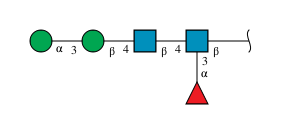
alpha-D-mannopyranose-(1-3)-beta-D-mannopyranose-(1-4)-2-acetamido-2-deoxy-beta-D-glucopyranose-(1-4)-[alpha-L-fucopyranose-(1-3)]2-acetamido-2-deoxy-beta-D-glucopyranose
E
5N-Glycosylation
Glycosylation Resources
GlyTouCan: G17689EW
GlyCosmos: G17689EW
GlyGen: G17689EW
Entity ID: 4
MoleculeChains Length2D Diagram GlycosylationD Interactions
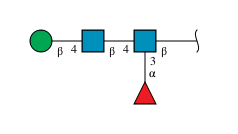
beta-D-mannopyranose-(1-4)-2-acetamido-2-deoxy-beta-D-glucopyranose-(1-4)-[alpha-L-fucopyranose-(1-3)]2-acetamido-2-deoxy-beta-D-glucopyranose
F, H
4N-Glycosylation
Glycosylation Resources
GlyTouCan: G18638YB
GlyCosmos: G18638YB
GlyGen: G18638YB
Entity ID: 5
MoleculeChains Length2D Diagram GlycosylationD Interactions
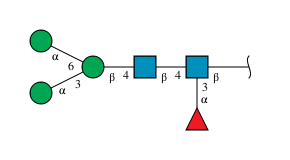
alpha-D-mannopyranose-(1-3)-[alpha-D-mannopyranose-(1-6)]beta-D-mannopyranose-(1-4)-2-acetamido-2-deoxy-beta-D-glucopyranose-(1-4)-[alpha-L-fucopyranose-(1-3)]2-acetamido-2-deoxy-beta-D-glucopyranose
G
6N-Glycosylation
Glycosylation Resources
GlyTouCan: G43648DB
GlyCosmos: G43648DB
GlyGen: G43648DB

Experimental Data & Validation

Experimental Data

  • Method: X-RAY DIFFRACTION
  • Resolution: 1.72 Å
  • R-Value Free:  0.256 (Depositor) 
  • R-Value Work:  0.196 (DCC) 
  • R-Value Observed: 0.205 (Depositor) 
Space Group: C 1 2 1
Unit Cell:
Length ( Å )Angle ( ˚ )
a = 116.964α = 90
b = 87.186β = 104.43
c = 81.303γ = 90
Software Package:
Software NamePurpose
DENZOdata reduction
SCALEPACKdata scaling
AMoREphasing
SHELXL-97refinement

Structure Validation

View Full Validation Report


Entry History 

Deposition Data

Revision History  (Full details and data files)

  • Version 1.0: 1999-01-13
    Type: Initial release
  • Version 1.1: 2007-10-16
    Changes: Version format compliance
  • Version 1.2: 2011-07-13
    Changes: Derived calculations, Version format compliance
  • Version 2.0: 2020-07-29
    Type: Remediation
    Reason: Carbohydrate remediation
    Changes: Atomic model, Data collection, Derived calculations, Structure summary
  • Version 3.0: 2020-09-23
    Changes: Advisory, Atomic model, Data collection, Derived calculations, Structure summary
  • Version 3.1: 2023-08-09
    Changes: Data collection, Database references, Refinement description
  • Version 3.2: 2024-10-30
    Changes: Structure summary