1AYW | pdb_00001ayw

CRYSTAL STRUCTURE OF CYSTEINE PROTEASE HUMAN CATHEPSIN K IN COMPLEX WITH A COVALENT BENZYLOXYBENZOYLCARBOHYDRAZIDE INHIBITOR


Experimental Data Snapshot

  • Method: X-RAY DIFFRACTION
  • Resolution: 2.40 Å
  • R-Value Free: 
    0.379 (Depositor) 
  • R-Value Work: 
    0.237 (Depositor) 
  • R-Value Observed: 
    0.237 (Depositor) 

Starting Model: experimental
View more details

wwPDB Validation 3D Report Full Report

Validation slider image for 1AYW

This is version 1.6 of the entry. See complete history

Literature

Design of potent and selective human cathepsin K inhibitors that span the active site.

Thompson, S.K.Halbert, S.M.Bossard, M.J.Tomaszek, T.A.Levy, M.A.Zhao, B.Smith, W.W.Abdel-Meguid, S.S.Janson, C.A.D'Alessio, K.J.McQueney, M.S.Amegadzie, B.Y.Hanning, C.R.DesJarlais, R.L.Briand, J.Sarkar, S.K.Huddleston, M.J.Ijames, C.F.Carr, S.A.Garnes, K.T.Shu, A.Heys, J.R.Bradbeer, J.Zembryki, D.Lee-Rykaczewski, L.James, I.E.Lark, M.W.Drake, F.H.Gowen, M.Gleason, J.G.Veber, D.F.

(1997) Proc Natl Acad Sci U S A 94: 14249-14254

  • DOI: https://doi.org/10.1073/pnas.94.26.14249
  • Primary Citation Related Structures: 
    1AYU, 1AYV, 1AYW

  • PubMed Abstract: 

    Potent and selective active-site-spanning inhibitors have been designed for cathepsin K, a cysteine protease unique to osteoclasts. They act by mechanisms that involve tight binding intermediates, potentially on a hydrolytic pathway. X-ray crystallographic, MS, NMR spectroscopic, and kinetic studies of the mechanisms of inhibition indicate that different intermediates or transition states are being represented that are dependent on the conditions of measurement and the specific groups flanking the carbonyl in the inhibitor. The species observed crystallographically are most consistent with tetrahedral intermediates that may be close approximations of those that occur during substrate hydrolysis. Initial kinetic studies suggest the possibility of irreversible and reversible active-site modification. Representative inhibitors have demonstrated antiresorptive activity both in vitro and in vivo and therefore are promising leads for therapeutic agents for the treatment of osteoporosis. Expansion of these inhibitor concepts can be envisioned for the many other cysteine proteases implicated for therapeutic intervention.


  • Organizational Affiliation
    • Department of Medicinal Chemistry, SmithKline Beecham Pharmaceuticals, King of Prussia, PA 19406, USA.

Macromolecule Content 

  • Total Structure Weight: 24.07 kDa 
  • Atom Count: 1,751 
  • Modeled Residue Count: 215 
  • Deposited Residue Count: 215 
  • Unique protein chains: 1

Macromolecules

Find similar proteins by:|  3D Structure
Entity ID: 1
MoleculeChains  Sequence LengthOrganismDetailsImage
CATHEPSIN K215Homo sapiensMutation(s): 0 
EC: 3.4.22.38
UniProt & NIH Common Fund Data Resources
Find proteins for P43235 (Homo sapiens)
Explore P43235 
Go to UniProtKB:  P43235
PHAROS:  P43235
GTEx:  ENSG00000143387 
Entity Groups
Sequence Clusters30% Identity50% Identity70% Identity90% Identity95% Identity100% Identity
UniProt GroupP43235
Sequence Annotations
Expand
Reference Sequence

Small Molecules

Ligands 1 Unique
IDChains Name / Formula / InChI Key2D Diagram3D Interactions
IN3

Query on IN3


Download:Ideal Coordinates CCD File
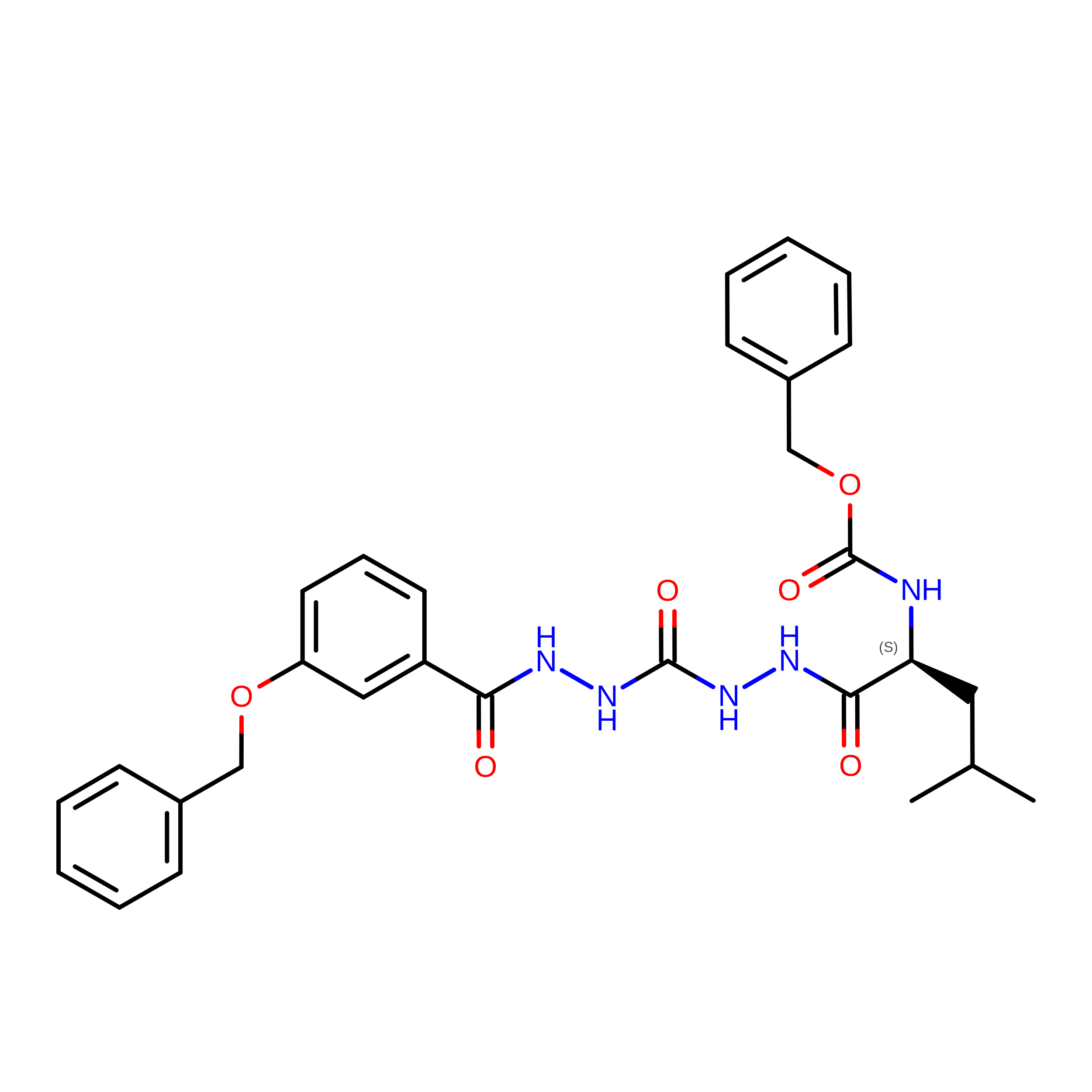
B [auth A]1-(N-BENZYLOXYCARBONYL-L-LEUCINYL)-5-(3-BENZYLOXY BENZOYL)CARBOHYDRAZIDE
C29 H33 N5 O6
CEXWCIXCWCFUSI-VWLOTQADSA-N

Experimental Data & Validation

Experimental Data

  • Method: X-RAY DIFFRACTION
  • Resolution: 2.40 Å
  • R-Value Free:  0.379 (Depositor) 
  • R-Value Work:  0.237 (Depositor) 
  • R-Value Observed: 0.237 (Depositor) 
Space Group: P 43 21 2
Unit Cell:
Length ( Å )Angle ( ˚ )
a = 57.68α = 90
b = 57.68β = 90
c = 131.12γ = 90
Software Package:
Software NamePurpose
XENGENdata collection
XENGENdata reduction
X-PLORmodel building
X-PLORrefinement
XENGENdata scaling
X-PLORphasing

Structure Validation

View Full Validation Report


Entry History 

Deposition Data

Revision History  (Full details and data files)

  • Version 1.0: 1998-11-25
    Type: Initial release
  • Version 1.1: 2008-03-24
    Changes: Version format compliance
  • Version 1.2: 2011-07-13
    Changes: Version format compliance
  • Version 1.3: 2012-02-29
    Changes: Database references
  • Version 1.4: 2018-03-07
    Changes: Data collection, Other
  • Version 1.5: 2023-08-02
    Changes: Database references, Derived calculations, Refinement description
  • Version 1.6: 2024-11-20
    Changes: Data collection, Structure summary