1AUK | pdb_00001auk

HUMAN ARYLSULFATASE A


Experimental Data Snapshot

  • Method: X-RAY DIFFRACTION
  • Resolution: 2.10 Å
  • R-Value Free: 
    0.273 (Depositor), 0.228 (DCC) 
  • R-Value Work: 
    0.232 (Depositor), 0.197 (DCC) 
  • R-Value Observed: 
    0.248 (Depositor) 

wwPDB Validation 3D Report Full Report

Validation slider image for 1AUK

This is version 2.1 of the entry. See complete history

Literature

Crystal structure of human arylsulfatase A: the aldehyde function and the metal ion at the active site suggest a novel mechanism for sulfate ester hydrolysis.

Lukatela, G.Krauss, N.Theis, K.Selmer, T.Gieselmann, V.von Figura, K.Saenger, W.

(1998) Biochemistry 37: 3654-3664

  • DOI: https://doi.org/10.1021/bi9714924
  • Primary Citation Related Structures: 
    1AUK

  • PubMed Abstract: 

    Human lysosomal arylsulfatase A (ASA) is a prototype member of the sulfatase family. These enzymes require the posttranslational oxidation of the -CH2SH group of a conserved cysteine to an aldehyde, yielding a formylglycine. Without this modification sulfatases are catalytically inactive, as revealed by a lysosomal storage disorder known as multiple sulfatase deficiency. The 2.1 A resolution X-ray crystal structure shows an ASA homooctamer composed of a tetramer of dimers, (alpha 2)4. The alpha/beta fold of the monomer has significant structural analogy to another hydrolytic enzyme, the alkaline phosphatase, and superposition of these two structures shows that the active centers are located in largely identical positions. The functionally essential formylglycine is located in a positively charged pocket and acts as ligand to an octahedrally coordinated metal ion interpreted as Mg2+. The electron density at the formylglycine suggests the presence of a 2-fold disordered aldehyde group with the possible contribution of an aldehyde hydrate, -CH(OH)2, with gem-hydroxyl groups. In the proposed catalytic mechanism, the aldehyde accepts a water molecule to form a hydrate. One of the two hydroxyl groups hydrolyzes the substrate sulfate ester via a transesterification step, resulting in a covalent intermediate. The second hydroxyl serves to eliminate sulfate under inversion of configuration through C-O cleavage and reformation of the aldehyde. This study provides the structural basis for understanding a novel mechanism of ester hydrolysis and explains the functional importance of the unusually modified amino acid.


  • Organizational Affiliation
    • Institut für Kristallographie, Freie Universität Berlin, Germany.

Macromolecule Content 

  • Total Structure Weight: 52.41 kDa 
  • Atom Count: 3,785 
  • Modeled Residue Count: 481 
  • Deposited Residue Count: 489 
  • Unique protein chains: 1

Macromolecules

Find similar proteins by:|  3D Structure
Entity ID: 1
MoleculeChains  Sequence LengthOrganismDetailsImage
ARYLSULFATASE A489Homo sapiensMutation(s): 1 
Gene Names: ARSA
EC: 3.1.6.8
UniProt & NIH Common Fund Data Resources
Find proteins for P15289 (Homo sapiens)
Explore P15289 
Go to UniProtKB:  P15289
PHAROS:  P15289
GTEx:  ENSG00000100299 
Entity Groups
Sequence Clusters30% Identity50% Identity70% Identity90% Identity95% Identity100% Identity
UniProt GroupP15289
Glycosylation
Glycosylation Sites: 1Go to GlyGen: P15289-1
Sequence Annotations
Expand
Reference Sequence

Oligosaccharides

Help  
Entity ID: 2
MoleculeChains Length2D Diagram GlycosylationD Interactions
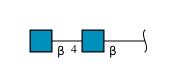
2-acetamido-2-deoxy-beta-D-glucopyranose-(1-4)-2-acetamido-2-deoxy-beta-D-glucopyranose
B
2N-Glycosylation
Glycosylation Resources
GlyTouCan: G42666HT
GlyCosmos: G42666HT
GlyGen: G42666HT

Small Molecules

Ligands 1 Unique
IDChains Name / Formula / InChI Key2D Diagram3D Interactions
MG

Query on MG


Download:Ideal Coordinates CCD File
C [auth A]MAGNESIUM ION
Mg
JLVVSXFLKOJNIY-UHFFFAOYSA-N
Modified Residues  1 Unique
IDChains TypeFormula2D DiagramParent
FGL
Query on FGL
A
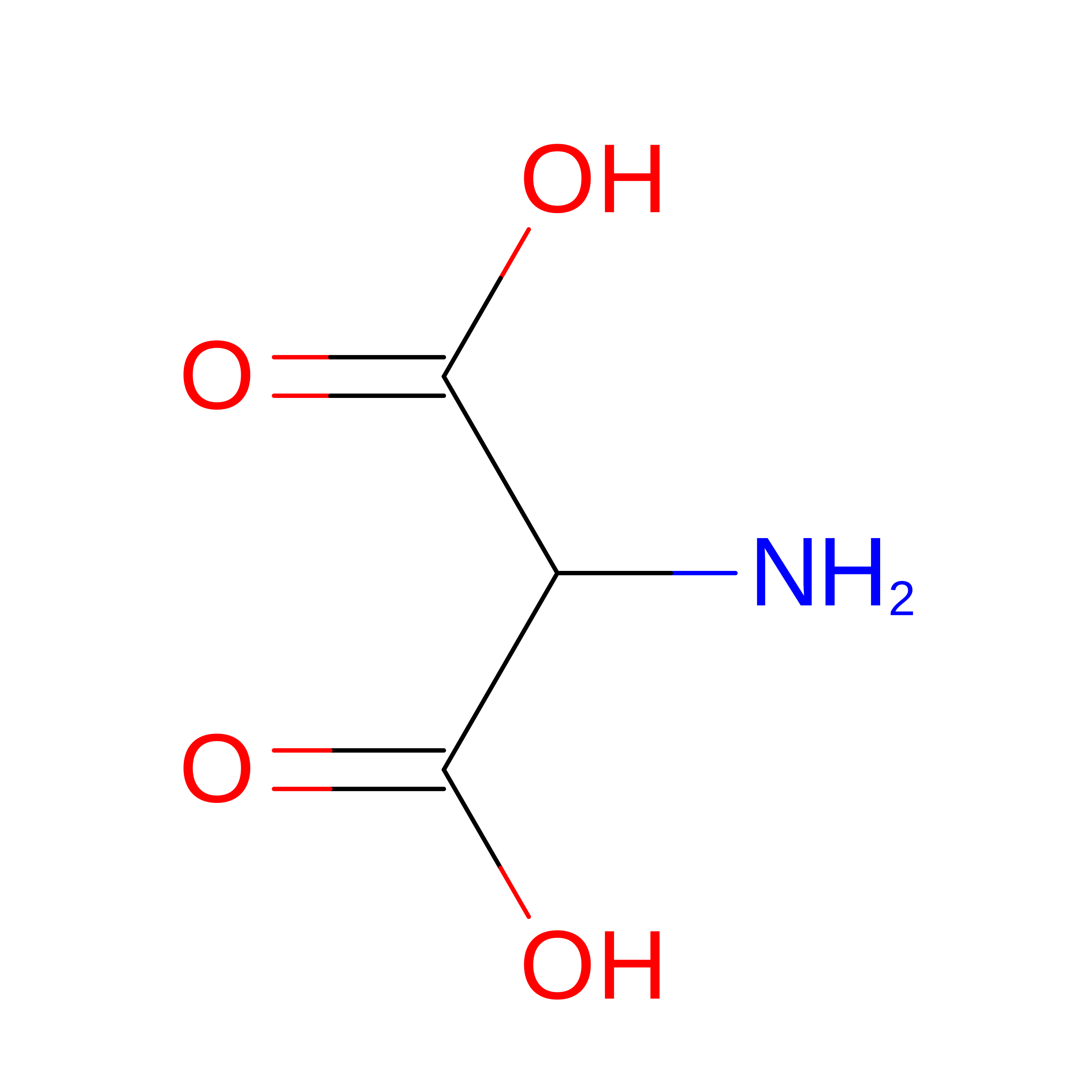
L-PEPTIDE LINKINGC3 H5 N O4GLY

Experimental Data & Validation

Experimental Data

  • Method: X-RAY DIFFRACTION
  • Resolution: 2.10 Å
  • R-Value Free:  0.273 (Depositor), 0.228 (DCC) 
  • R-Value Work:  0.232 (Depositor), 0.197 (DCC) 
  • R-Value Observed: 0.248 (Depositor) 
Space Group: I 4 2 2
Unit Cell:
Length ( Å )Angle ( ˚ )
a = 132.63α = 90
b = 132.63β = 90
c = 192.06γ = 90
Software Package:
Software NamePurpose
DENZOdata reduction
SCALEPACKdata scaling
X-PLORmodel building
REFMACrefinement
X-PLORrefinement
X-PLORphasing

Structure Validation

View Full Validation Report


Entry History 

Deposition Data

Revision History  (Full details and data files)

  • Version 1.0: 1998-03-04
    Type: Initial release
  • Version 1.1: 2008-03-24
    Changes: Version format compliance
  • Version 1.2: 2011-07-13
    Changes: Non-polymer description, Version format compliance
  • Version 1.3: 2012-01-25
    Changes: Derived calculations
  • Version 2.0: 2020-07-29
    Type: Remediation
    Reason: Carbohydrate remediation
    Changes: Advisory, Atomic model, Data collection, Database references, Derived calculations, Non-polymer description, Structure summary
  • Version 2.1: 2025-03-26
    Changes: Data collection, Database references, Structure summary