1AGL | pdb_00001agl

STRUCTURE OF A DNA-BISDAUNOMYCIN COMPLEX


Experimental Data Snapshot

  • Method: X-RAY DIFFRACTION
  • Resolution: 2.20 Å
  • R-Value Free: 
    0.314 (Depositor) 
  • R-Value Work: 
    0.199 (Depositor) 
  • R-Value Observed: 
    0.199 (Depositor) 

Starting Model: experimental
View more details

wwPDB Validation 3D Report Full Report

Validation slider image for 1AGL

This is version 1.4 of the entry. See complete history

Literature

Structure of a DNA-bisdaunomycin complex.

Hu, G.G.Shui, X.Leng, F.Priebe, W.Chaires, J.B.Williams, L.D.

(1997) Biochemistry 36: 5940-5946

  • DOI: https://doi.org/10.1021/bi9705218
  • Primary Citation Related Structures: 
    1AGL

  • PubMed Abstract: 

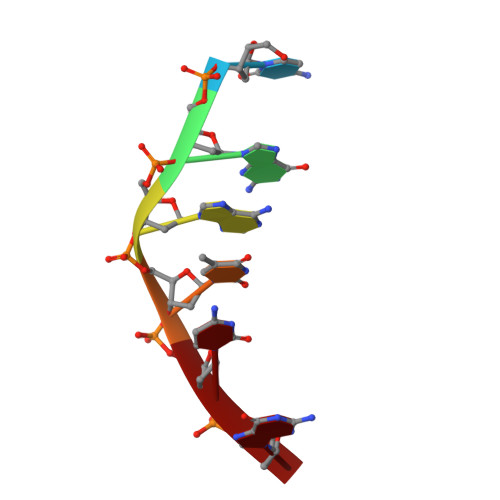
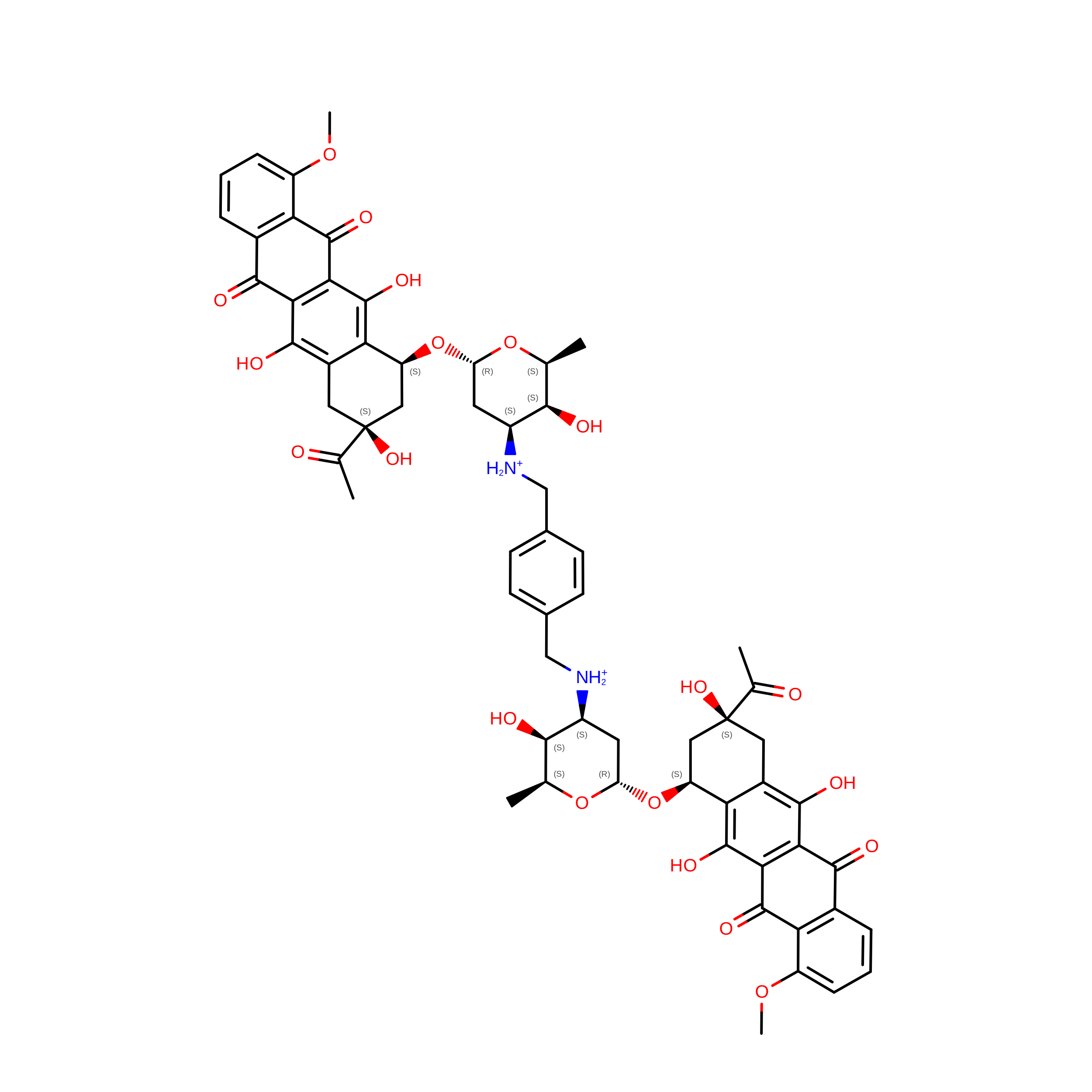
    The application of detailed structural data bases has now culminated in the successful design of a new generation of bisanthracyclines that form ultratight DNA complexes [Chaires, J. B., Leng, F., Przewloka, T., Fokt, I., Ling, Y. H., Perez-Soler, R., & Priebe, W. (1997) J. Med. Chem. 40, 261-266]. Daunomycin dimers were designed to bind to DNA in complexes resembling those of monomers intercalated at adjacent sites. The goal of the work described here was to determine, with X-ray crystallography, if a potent member of this newly designed and synthesized class of bisanthracyclines (WP631) binds as intended. WP631 is composed of two daunomycin molecules, linked N3' to N3' by a xylyl group. We have solved the 2.2 A X-ray crystal structure of a complex of WP631 bound to [d(CGATCG)]2. We demonstrate, on a detailed molecular level, that the WP631 design strategy is a success. The structures of WP631 and two daunomycin molecules bound to [d(CGATCG)]2 provide the unprecedented opportunity for detailed comparison of mono- and bis-intercalated complexes of the same chromophore, allowing us to distinguish effects of mono-intercalation from those of bis-intercalation. Differences are focused primarily in the centers of the complexes. DNA unwinding and other helical distortions propagate more efficiently to the center of the WP631 complex than to the center of the daunomycin complex.


  • Organizational Affiliation
    • School of Chemistry & Biochemistry, Georgia Institute of Technology, Atlanta 30332-0400, USA.

Macromolecule Content 

  • Total Structure Weight: 2.97 kDa 
  • Atom Count: 170 
  • Modeled Residue Count: 6 
  • Deposited Residue Count: 6 
  • Unique nucleic acid chains: 1

Macromolecules

Find similar nucleic acids by:  Sequence
Entity ID: 1
MoleculeChains LengthOrganismImage
DNA (5'-D(*CP*GP*AP*TP*CP*G)-3')6N/A
Sequence Annotations
Expand
Reference Sequence

Small Molecules

Ligands 1 Unique
IDChains Name / Formula / InChI Key2D Diagram3D Interactions
BDA

Query on BDA


Download:Ideal Coordinates CCD File
B [auth A]4-METHYLBENZYL-N-BIS[DAUNOMYCIN]
C62 H66 N2 O20
HTOLWQNKVYAHLB-MJSRGEEMSA-P

Experimental Data & Validation

Experimental Data

  • Method: X-RAY DIFFRACTION
  • Resolution: 2.20 Å
  • R-Value Free:  0.314 (Depositor) 
  • R-Value Work:  0.199 (Depositor) 
  • R-Value Observed: 0.199 (Depositor) 
Space Group: P 41 21 2
Unit Cell:
Length ( Å )Angle ( ˚ )
a = 28.27α = 90
b = 28.27β = 90
c = 53.77γ = 90
Software Package:
Software NamePurpose
X-PLORrefinement
ADSCdata collection

Structure Validation

View Full Validation Report


Entry History 

Deposition Data

Revision History  (Full details and data files)

  • Version 1.0: 1997-04-29
    Type: Initial release
  • Version 1.1: 2008-05-22
    Changes: Version format compliance
  • Version 1.2: 2011-07-13
    Changes: Version format compliance
  • Version 1.3: 2024-02-07
    Changes: Advisory, Data collection, Database references, Derived calculations
  • Version 1.4: 2024-04-03
    Changes: Refinement description