Download Mendeley
Role of the 6-20 disulfide bridge in the structure and activity of epidermal growth factor.
Barnham, K.J., Torres, A.M., Alewood, D., Alewood, P.F., Domagala, T., Nice, E.C., Norton, R.S.(1998) Protein Sci 7: 1738-1749
- PubMed: 10082370 Search on PubMedSearch on PubMed Central
- DOI: https://doi.org/10.1002/pro.5560070808
- Primary Citation Related Structures:
1A3P - PubMed Abstract:
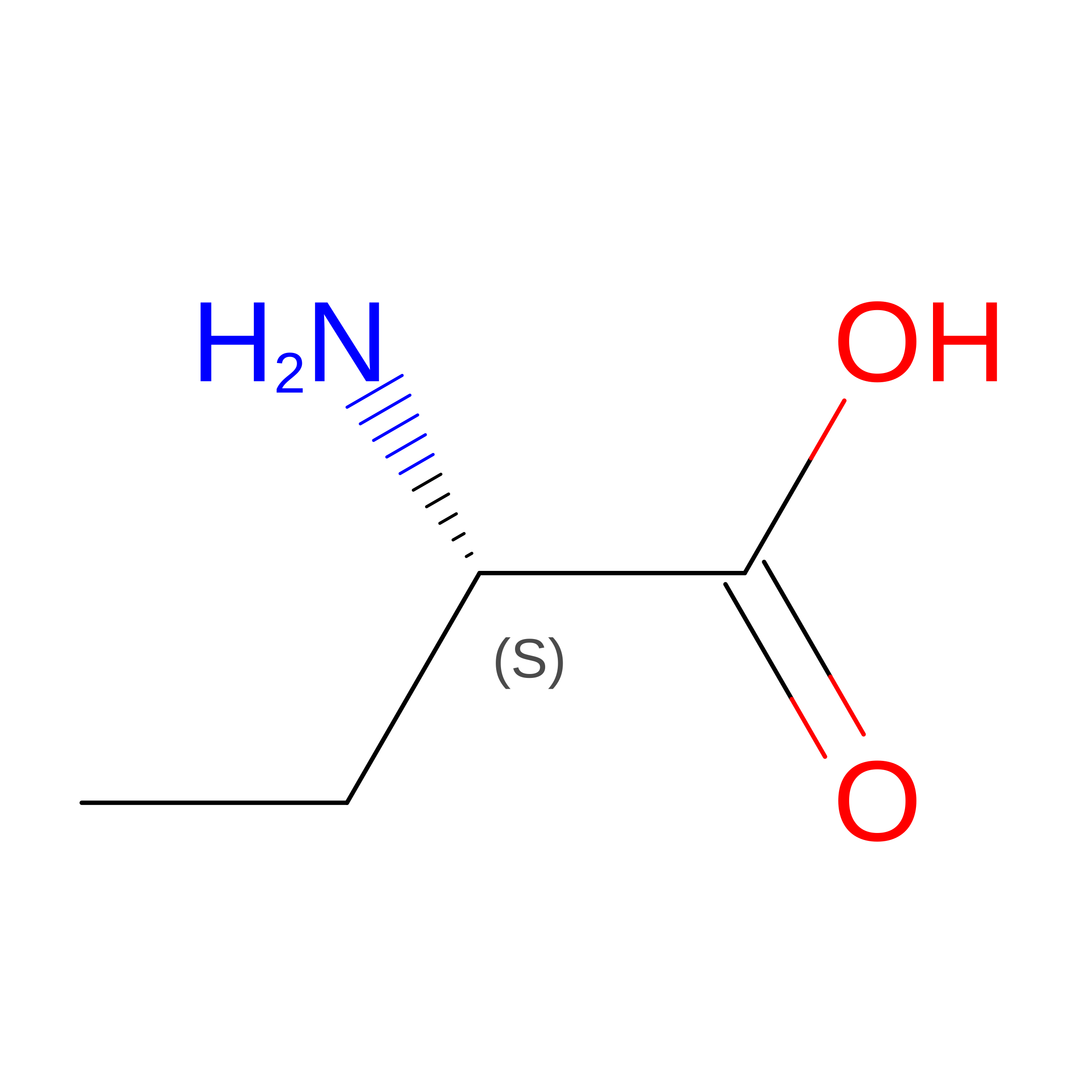
Two synthetic analogues of murine epidermal growth factor, [Abu6, 20] mEGF4-48 (where Abu denotes amino-butyric acid) and [G1, M3, K21, H40] mEGF1-48, have been investigated by NMR spectroscopy. [Abu6, 20] mEGF4-48 was designed to determine the contribution of the 6-20 disulfide bridge to the structure and function of mEGF. The overall structure of this analogue was similar to that of native mEGF, indicating that the loss of the 6-20 disulfide bridge did not affect the global fold of the molecule. Significant structural differences were observed near the N-terminus, however, with the direction of the polypeptide chain between residues four and nine being altered such that these residues were now located on the opposite face of the main beta-sheet from their position in native mEGF. Thermal denaturation experiments also showed that the structure of [Abu6, 20] mEGF4-48 was less stable than that of mEGF. Removal of this disulfide bridge resulted in a significant loss of both mitogenic activity in Balb/c 3T3 cells and receptor binding on A431 cells compared with native mEGF and mEGF4-48, implying that the structural changes in [Abu6, 20] mEGF4-48, although limited to the N-terminus, were sufficient to interfere with receptor binding. The loss of binding affinity probably arose mainly from steric interactions of the dislocated N-terminal region with part of the receptor binding surface of EGF. [G1, M3, K21, H40] mEGF1-48 was also synthesized in order to compare the synthetic polypeptide with the corresponding product of recombinant expression. Its mitogenic activity in Balb/c 3T3 cells was similar to that of native mEGF and analysis of its 1H chemical shifts suggested that its structure was also very similar to native.
- Biomolecular Research Institute, Parkville, Victoria, Australia.
Organizational Affiliation: