Download Mendeley
A bisubstrate analog induces unexpected conformational changes in phosphoglycerate kinase from Trypanosoma brucei.
Bernstein, B.E., Williams, D.M., Bressi, J.C., Kuhn, P., Gelb, M.H., Blackburn, G.M., Hol, W.G.(1998) J Mol Biol 279: 1137-1148
- PubMed: 9642090 Search on PubMed
- DOI: https://doi.org/10.1006/jmbi.1998.1835
- Primary Citation Related Structures:
16PK - PubMed Abstract:
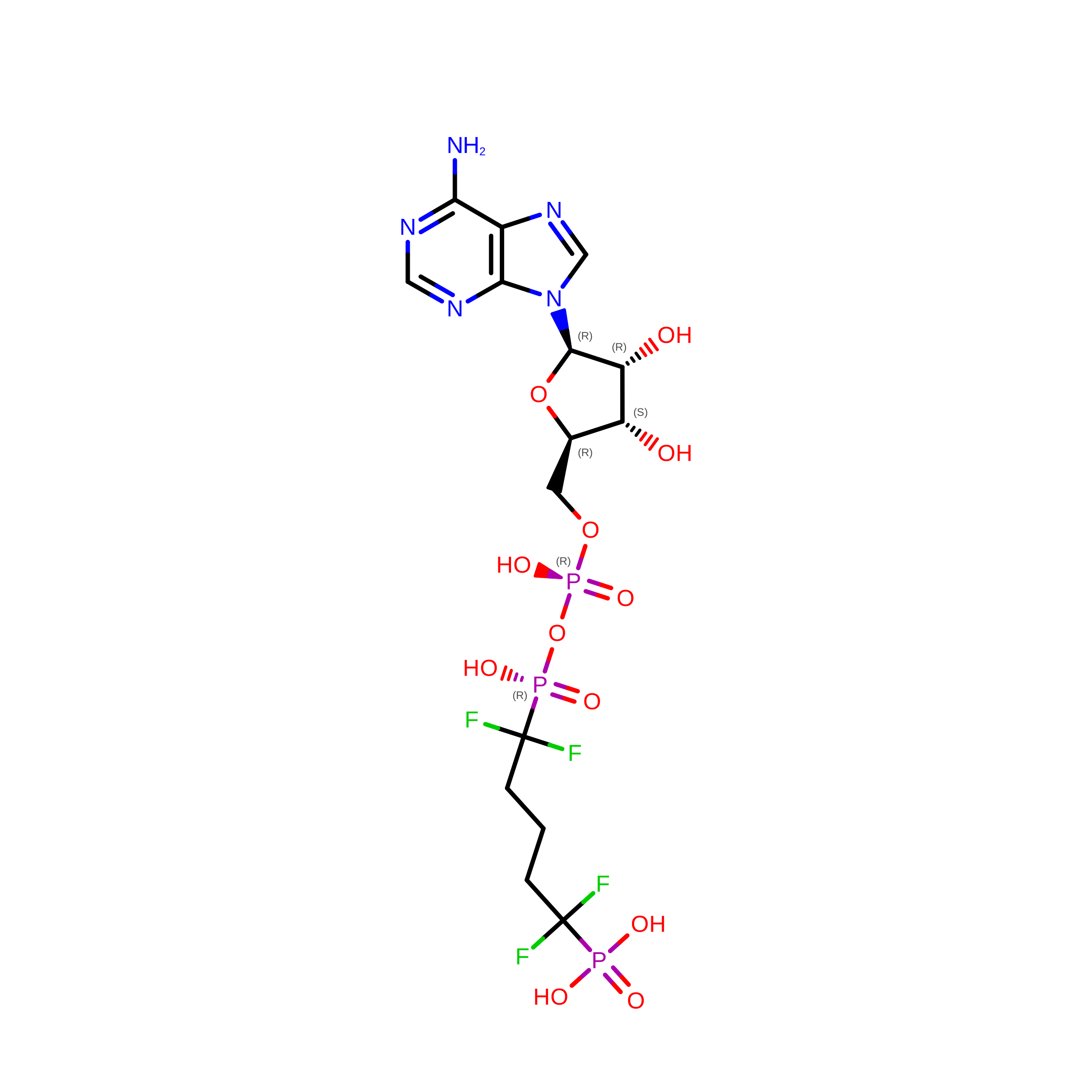
The glycolytic enzyme phosphoglycerate kinase (PGK) catalyzes phosphoryl transfer between 1,3-bis-phosphoglycerate and ADP to form 3-phosphoglycerate and ATP. During catalysis, a major hinge bending motion occurs which brings the N and C-terminal enzyme domains and their bound substrates together and in-line for phosphoryl transfer. We have crystallized Trypanosoma brucei PGK in the presence of the bisubstrate analog, adenylyl 1,1,5,5-tetrafluoropentane-1, 5-bisphosphonate, and solved the structure of this complex in two different crystal forms at 1.6 and 2.0 A resolution, obtained from PEG 8000 and ammonium phosphate solutions, respectively. These high resolution structures of PGK:inhibitor complexes are of particular interest for drug design since Trypanosoma brucei, the causative agent of African sleeping sickness, relies on glycolysis as its sole energy source. In both structures, the inhibitor is bound in a fully extended conformation with its adenosine moiety assuming exactly the same position as in ADP:PGK complexes and with its 5' phosphonate group occupying part of the 1,3-bis-phosphoglycerate binding site. The bisubstrate analog forces PGK to assume a novel, "inhibited" conformation, intermediate in hinge angle between the native structures of open and closed form PGK. These structures of enzyme-inhibitor complexes demonstrate that PGK has two distinct hinge points that can each be independently activated. In the "PEG" structure, the C-terminal hinge is partially activated while the N-terminal hinge point remains in an open state. In the "phosphate" structure, closure of the N-terminal hinge point is also evident. Finally and most unexpectedly, both complex structures also contain a 3 A shift of a helix that lies outside the flexible hinge region. We propose that a transient shift of this helix is a required element of PGK hinge closure during catalysis.
- Departments of Biological Structure and Biochemistry Howard Hughes Medical Institute and Biomolecular Structure Center, University of Washington, Seattle, WA 98195, USA.
Organizational Affiliation: