Download Mendeley
The response regulator BqsR/CarR controls Fe 2+ acquisition in Pseudomonas aeruginosa.
Paredes, A., Hull, M., Singh, H., Greene, D., Tajudeen, A.O., Kubo, A., Patamawenu, S., Kramer, R., Brown, J.B., Chacon, K.N., Patrauchan, M.A., Smith, A.T.(2026) Nat Commun 17
- PubMed: 42660922 Search on PubMedSearch on PubMed Central
- DOI: https://doi.org/10.1038/s41467-026-76130-1
- Primary Citation Related Structures:
9YFA - PubMed Abstract:
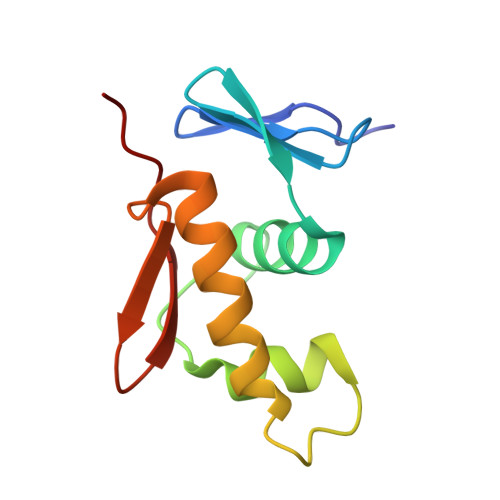
Pseudomonas aeruginosa is a ubiquitous, Gram-negative bacterium that forms biofilms and is responsible for antibiotic-resistant hospital-acquired infections in humans. The P. aeruginosa BqsRS two-component system regulates biofilm formation and dispersal by sensing extracytoplasmic Fe 2+ , but the mechanistic details of this process are poorly understood. In this work, we report the crystal and solution structures of the PaBqsR response regulator receiver domain, comprising a (βα) 5 response regulator assembly, and the DNA-binding domain, comprising a helix-turn-helix motif. Consistent with its cognate stimulus being Fe 2+ , we show that PaBqsR binds directly to the promoter region of the feo operon that encodes the bacterial Fe 2+ transport system FeoABC. Corroborating these in vitro results, transcriptional studies show that PaBqsR is a global regulator controlling many important genes in PAO1, including the feo operon. Intriguingly, promoter-based assays reveal that PaBqsR is a dynamic regulator that responds to bioavailable Fe 2+ , likely through the ability of PaBqsR to bind Fe 2+ directly via a His-rich motif, independent of the PaBqsS membrane His kinase. To our knowledge, this mode of regulation has not been reported previously among OmpR-like response regulators but represents an important level of control over Fe 2+ acquisition in P. aeruginosa that could be an attractive therapeutic target to treat hospital-acquired infections.
- Department of Chemistry and Biochemistry, University of Maryland, Baltimore County, Baltimore, MD, USA.
Organizational Affiliation: