9WHY | pdb_00009why

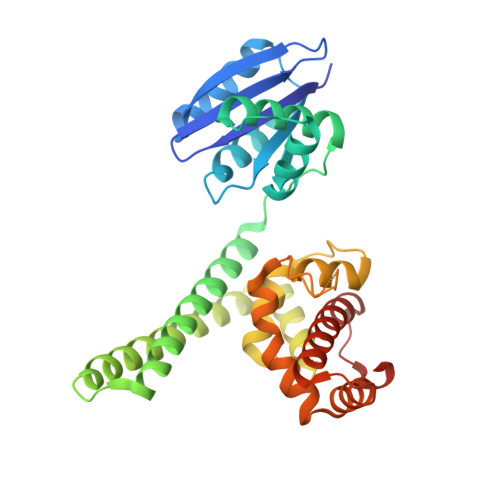
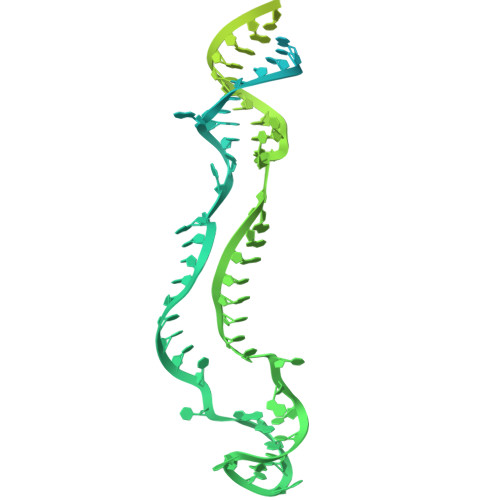
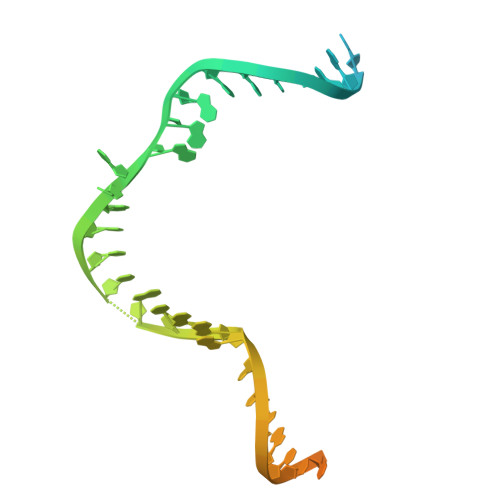
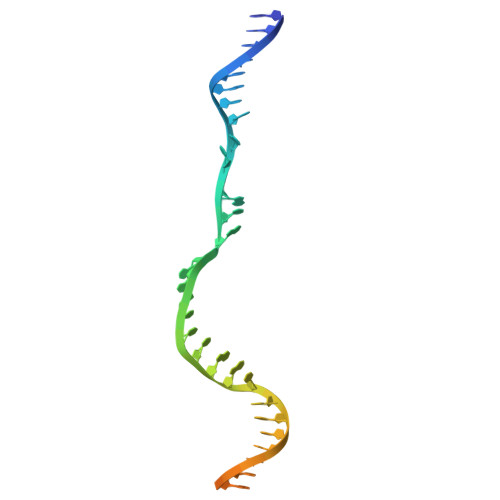
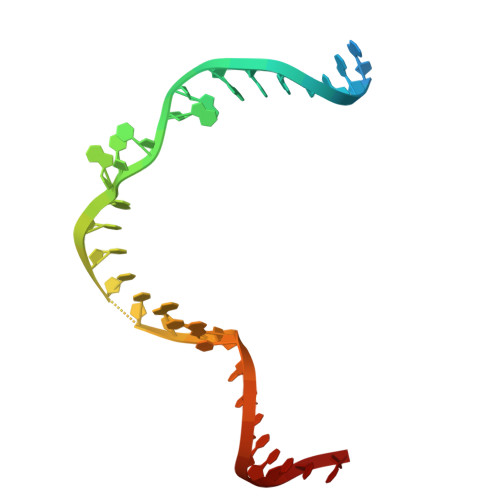
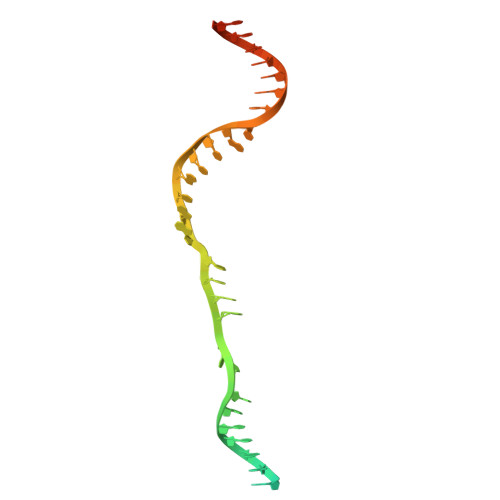
Cryo-EM structure of the IS621 recombinase in complex with bridge RNA, left-half DNA, and right-half DNA in the post-strand exchange state


Experimental Data Snapshot

  • Method: ELECTRON MICROSCOPY
  • Resolution: 2.60 Å
  • Aggregation State: PARTICLE 
  • Reconstruction Method: SINGLE PARTICLE 

wwPDB Validation 3D Report Full Report

Validation slider image for 9WHY

This is version 1.1 of the entry. See complete history

Literature

Structural mechanism governing the directionality of bridge recombination.

Hiraizumi, M.Athukoralage, J.S.Perry, N.T.Tsujimoto, E.Shiojiri, N.Nagahata, N.Lee, L.Sun, G.Durrant, M.G.Chandrasekaran, S.S.Konermann, S.Yamashita, K.Hsu, P.D.Nishimasu, H.

(2026) Nature 

  • DOI: https://doi.org/10.1038/s41586-026-10903-y
  • Primary Citation Related Structures: 
    9WHX, 9WHY

  • PubMed Abstract: 

    Bridge recombinases from the IS110 family of transposons, such as IS621, associate with a bridge RNA (bRNA) to mediate programmable recombination between donor DNA and target DNA 1,2 . Although insertion is mediated by the recombinase-bRNA complex, it remains unknown how IS621 elements are excised from host genomes to form the circular DNA intermediates required for transposition. Here we show that bRNA is weakly expressed from IS621 loci in the Escherichia coli genome and that the IS621 recombinase-bRNA complex mediates excision less efficiently than insertion. Furthermore, we present the cryo-electron microscopy structures of the IS621 recombinase-bRNA complex bound to excision DNA substrates, providing mechanistic insights into the excision reaction. Similar to the previously reported donor- and target-bound insertion complex 2 , the excision complex comprises two recombinase dimers, each accommodating the target- and donor-binding loops of the bRNA. However, DNA recognition differs notably between the two complexes. Although the donor and target DNAs form a bent U-shape during insertion 2 , the excision substrates adopt linear conformations and bind across both bRNA loops, forming an X-shaped structure. This geometry reduces the efficiency of top-strand exchange and contributes to the naturally observed bias favouring insertion over excision. Despite these differences, the efficiencies of both reactions are similarly modulated by base pairing between specific dinucleotides in the bRNA, termed handshake guides, and the top strands of the DNA substrates. Overall, this study provides mechanistic insights into the complete IS110 transposition cycle and facilitates the optimal design of programmable bridge-editing applications.


  • Organizational Affiliation
    • Department of Chemistry and Biotechnology, Graduate School of Engineering, The University of Tokyo, Tokyo, Japan.

Macromolecule Content 

  • Total Structure Weight: 312.79 kDa 
  • Atom Count: 14,860 
  • Modeled Residue Count: 1,489 
  • Deposited Residue Count: 1,836 
  • Unique protein chains: 1
  • Unique nucleic acid chains: 5

Macromolecules


Find similar proteins by:|  3D Structure
Entity ID: 1
MoleculeChains  Sequence LengthOrganismDetailsImage
IS621 transposase
A, B, C, D
328Escherichia coliMutation(s): 0 
Gene Names: O3K_03330O3K_03970O3K_05990O3K_07835O3K_09380O3K_16710O3K_17245O3K_20600O3K_22425
UniProt
Find proteins for A0A0E0Y1P1 (Escherichia coli O104:H4 (strain 2011C-3493))
Explore A0A0E0Y1P1 
Go to UniProtKB:  A0A0E0Y1P1
Entity Groups
Sequence Clusters30% Identity50% Identity70% Identity90% Identity95% Identity100% Identity
UniProt GroupA0A0E0Y1P1
Sequence Annotations
Expand
Reference Sequence
Find similar nucleic acids by:  (by identity cutoff) 
Entity ID: 2
MoleculeChains LengthOrganismImage
bridge RNA
E, F
180Escherichia coli
Sequence Annotations
Expand
Reference Sequence
Find similar nucleic acids by:  (by identity cutoff) 
Entity ID: 3
MoleculeChains LengthOrganismImage
LH/RH, top strand49Escherichia coli
Sequence Annotations
Expand
Reference Sequence
Find similar nucleic acids by:  (by identity cutoff) 
Entity ID: 4
MoleculeChains LengthOrganismImage
LH, bottom strand38Escherichia coli
Sequence Annotations
Expand
Reference Sequence
Find similar nucleic acids by:  (by identity cutoff) 
Entity ID: 5
MoleculeChains LengthOrganismImage
RH/LH, top strand33Escherichia coli
Sequence Annotations
Expand
Reference Sequence
Find similar nucleic acids by:  (by identity cutoff) 
Entity ID: 6
MoleculeChains LengthOrganismImage
RH, bottom strand44Escherichia coli
Sequence Annotations
Expand
Reference Sequence

Experimental Data & Validation

Experimental Data

  • Method: ELECTRON MICROSCOPY
  • Resolution: 2.60 Å
  • Aggregation State: PARTICLE 
  • Reconstruction Method: SINGLE PARTICLE 
EM Software:
TaskSoftware PackageVersion
MODEL REFINEMENTServalcat
RECONSTRUCTIONcryoSPARC

Structure Validation

View Full Validation Report


Entry History 

& Funding Information

Deposition Data


Funding OrganizationLocationGrant Number
Japan Science and TechnologyJapanJPMJCR23B6
Other privateInamori Foundation

Revision History  (Full details and data files)

  • Version 1.0: 2026-08-12
    Type: Initial release
  • Version 1.1: 2026-08-26
    Changes: Data collection, Database references