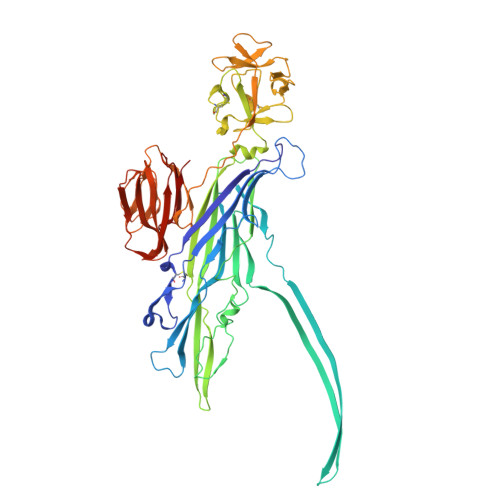
9UE9 | pdb_00009ue9

Heptameric pore structure of Vibrio cholerae Cytolysin (VCC) embedded in lipid bilayer

  • Classification: TOXIN
  • Organism(s): Vibrio cholerae
  • Expression System: Escherichia coli
  • Mutation(s): No 

  • Deposited: 2025-04-08 Released: 2025-05-21 
  • Deposition Author(s): Dutta, S., Chatterjee, A.
  • Funding Organization(s): Science and Engineering Research Board (SERB), Department of Biotechnology (DBT, India), Department of Science & Technology (DST, India), Council of Scientific & Industrial Research (CSIR)

Experimental Data Snapshot

  • Method: ELECTRON MICROSCOPY
  • Resolution: 4.00 Å
  • Aggregation State: PARTICLE 
  • Reconstruction Method: SINGLE PARTICLE 

wwPDB Validation   3D Report Full Report


This is version 1.2 of the entry. See complete history


Literature

Cradle loop regulates beta-barrel pore-formation mechanism of Vibrio cholerae cytolysin.

Singh, M.Chatterjee, A.Nayak, A.Naskar, P.Kaur, G.Mondal, J.Dutta, S.Chattopadhyay, K.

(2025) Structure 

  • DOI: https://doi.org/10.1016/j.str.2025.10.013
  • Primary Citation of Related Structures:  
    9LH3, 9LH7, 9UE9

  • PubMed Abstract: 

    Vibrio cholerae cytolysin (VCC) is a β-barrel pore-forming toxin (β-PFT). The membrane insertion of its pore-forming "pre-stem" motif is the most crucial step in the pore-formation mechanism. In the soluble monomeric form, pre-stem remains clamped against the central cytolysin domain by the so-called cradle loop. In the course of oligomeric pore-formation in the target membranes, the cradle loop gets detached from the pre-stem and reorients, thus allowing the pre-stem to extend and insert into the membrane. Here, we show that the specific cradle loop residue(s) play crucial roles in governing the pore-formation mechanism of VCC by establishing decisive interactions with the neighboring structural domains/modules. The alteration of the cradle loop residue, Y194 in particular, compromises the membrane-insertion of the pre-stem, and tends to arrest the membrane-bound toxin in the pre-pore-like oligomeric states. Our study suggests that the native cradle loop architecture, with its intact contacts with the surrounding interaction partners, is essential for VCC pore-formation.


  • Organizational Affiliation
    • Department of Biological Sciences, Indian Institute of Science Education and Research Mohali, Sector 81, SAS Nagar, Manauli, Mohali, Punjab 140306, India.

Macromolecules
Find similar proteins by:  (by identity cutoff)  |  3D Structure
Entity ID: 1
MoleculeChains Sequence LengthOrganismDetailsImage
HlyA
A, B, C, D, E
A, B, C, D, E, F, G
581Vibrio choleraeMutation(s): 0 
UniProt
Find proteins for P09545 (Vibrio cholerae serotype O1 (strain ATCC 39315 / El Tor Inaba N16961))
Explore P09545 
Go to UniProtKB:  P09545
Entity Groups  
Sequence Clusters30% Identity50% Identity70% Identity90% Identity95% Identity100% Identity
UniProt GroupP09545
Sequence Annotations
Expand
  • Reference Sequence
Experimental Data & Validation

Experimental Data

  • Method: ELECTRON MICROSCOPY
  • Resolution: 4.00 Å
  • Aggregation State: PARTICLE 
  • Reconstruction Method: SINGLE PARTICLE 
EM Software:
TaskSoftware PackageVersion
MODEL REFINEMENTPHENIX1.19.2_4158

Structure Validation

View Full Validation Report


Entry History & Funding Information

Deposition Data


Funding OrganizationLocationGrant Number
Science and Engineering Research Board (SERB)IndiaCRG/2022/002674
Department of Biotechnology (DBT, India)IndiaBT/INF/22/SP22844/2017
Department of Science & Technology (DST, India)IndiaSR/FST/LSII-039/2015
Council of Scientific & Industrial Research (CSIR)India09/0079(13652)/2022-EMR-I

Revision History  (Full details and data files)

  • Version 1.0: 2025-05-21
    Type: Initial release
  • Version 1.1: 2025-06-11
    Changes: Source and taxonomy
  • Version 1.2: 2025-12-03
    Changes: Database references