Download Mendeley
An N-acetylated daropeptide modulates nematode development.
Ma, S., Li, R., Gao, X., Gemmell, E., Guo, S., Chen, H., Huang, X., Capper, M., Liu, Z., Deng, Z., Ding, W., Kohnke, J., Wang, X., Zhang, Q.(2026) Proc Natl Acad Sci U S A 123: e2617449123-e2617449123
- PubMed: 42555644 Search on PubMed
- DOI: https://doi.org/10.1073/pnas.2617449123
- Primary Citation Related Structures:
43CP - PubMed Abstract:
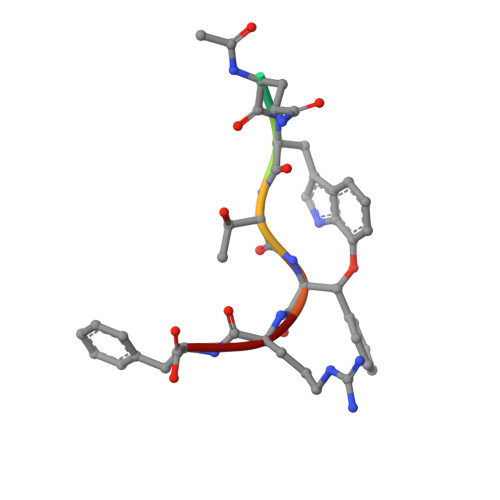
The symbiotic bacterium Photorhabdus is a rich source of bioactive secondary metabolites that mediate tripartite interactions with nematodes and insect hosts. However, natural products of ribosomal origin remain largely underexplored within this ecological niche. Here, we report the identification of aphotorhaptin A, a darobactin-like peptide (daropeptide) natural product from Photorhabdus asymbiotica , which structurally features an ether crosslink and an N-terminal acetyl unit. Biosynthetic investigation uncovers aphotorhaptin A is matured via an unexpected leader cleavage step, and the subsequent N-terminal acetylation confers metabolic stability that maintains the hexapeptide scaffold integrity. Biochemical and structural studies demonstrate the acetyltransferase PasC exhibits remarkable substrate promiscuity, facilitated by an expansive active-site cavity that accommodates diverse acyl-CoA donors and peptide substrates. Unlike the antimicrobial darobactin, aphotorhaptin A appears to lack antibacterial activity but modulates nematode development, and this activity requires the ether crosslink and the N-terminal acetyl group in the hexapeptide scaffold. These findings expand the chemical and biosynthetic space of ribosomal peptide family and establish its link with nematode development and reproduction.
- National Engineering Research Center for Carbohydrate Synthesis, College of Chemistry and Materials, Jiangxi Normal University, Nanchang 330022, China.
Organizational Affiliation: