Download Mendeley
ZNFX1, an immunoregulatory RNA helicase and E3 ubiquitin ligase, assembles into pleiomorphic polymers.
Naydenova, K., Mund, T., Yip, M.C.J., Harper, C.M., Leigh, K.E., Hankinson, J., Boyle, K.B., Heatley, A., Otten, E.G., Lulla, V., Modis, Y., Randow, F.(2026) Mol Cell 86: 4018-4031.e4
- PubMed: 42822417 Search on PubMed
- DOI: https://doi.org/10.1016/j.molcel.2026.09.002
- Primary Citation Related Structures:
32UL, 32UM, 32UN - PubMed Abstract:
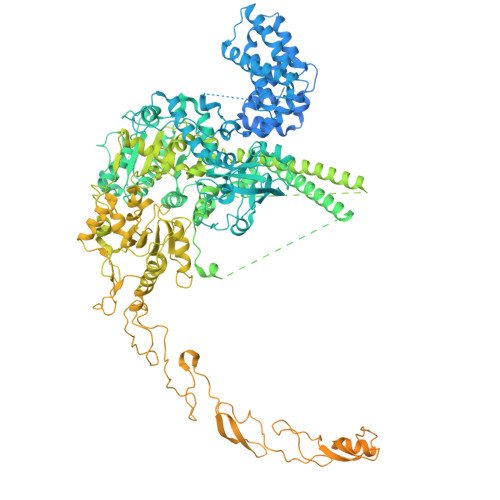
NFX1-type zinc-finger-containing 1 (ZNFX1) is an SF1-family RNA helicase essential for innate immunity. Patients with ZNFX1 mutations experience recurrent infections, yet the underlying mechanism remains unclear. We determined cryo-electron microscopy (cryo-EM) structures of RNA-bound and RNA-free ZNFX1 and revealed auto-inhibition of the helicase-associated ATPase through a regulatory insertion occluding the RNA-binding groove. ZNFX1 also functions as a bi-catalytic E3 ubiquitin ligase, containing an RZ finger homologous to RNF213 and a previously unidentified Miz-like domain, which cooperate in catalyzing ubiquitylation. Ubiquitin chains enhance E3 activity further. Patient mutations demonstrate that the helicase/ATPase, E3 ligase, and the rigid zinc-finger stalk connecting them are required for function. ZNFX1 can assemble into structured, pleiomorphic polymers fostering trans-auto-ubiquitylation; understanding this reveals a mechanism that controls ZNFX1 stability and may facilitate RNA sequestration in stress granules and antiviral activity. These findings establish ZNFX1 as a multifunctional enzyme in immunity that couples RNA sensing to ubiquitin signaling and assembles into higher-order structures for signal amplification.
- Protein and Nucleic Acid Chemistry Division, MRC Laboratory of Molecular Biology, Francis Crick Avenue, Cambridge CB2 0QH, UK.
Organizational Affiliation: