Find PDB structures and Computed Structure Models (CSM) by combining queries from tools in this suite: Attribute Search, Sequence Similarity, Sequence Motif, 3D Similarity, and 3D Motif with 'AND' logic.
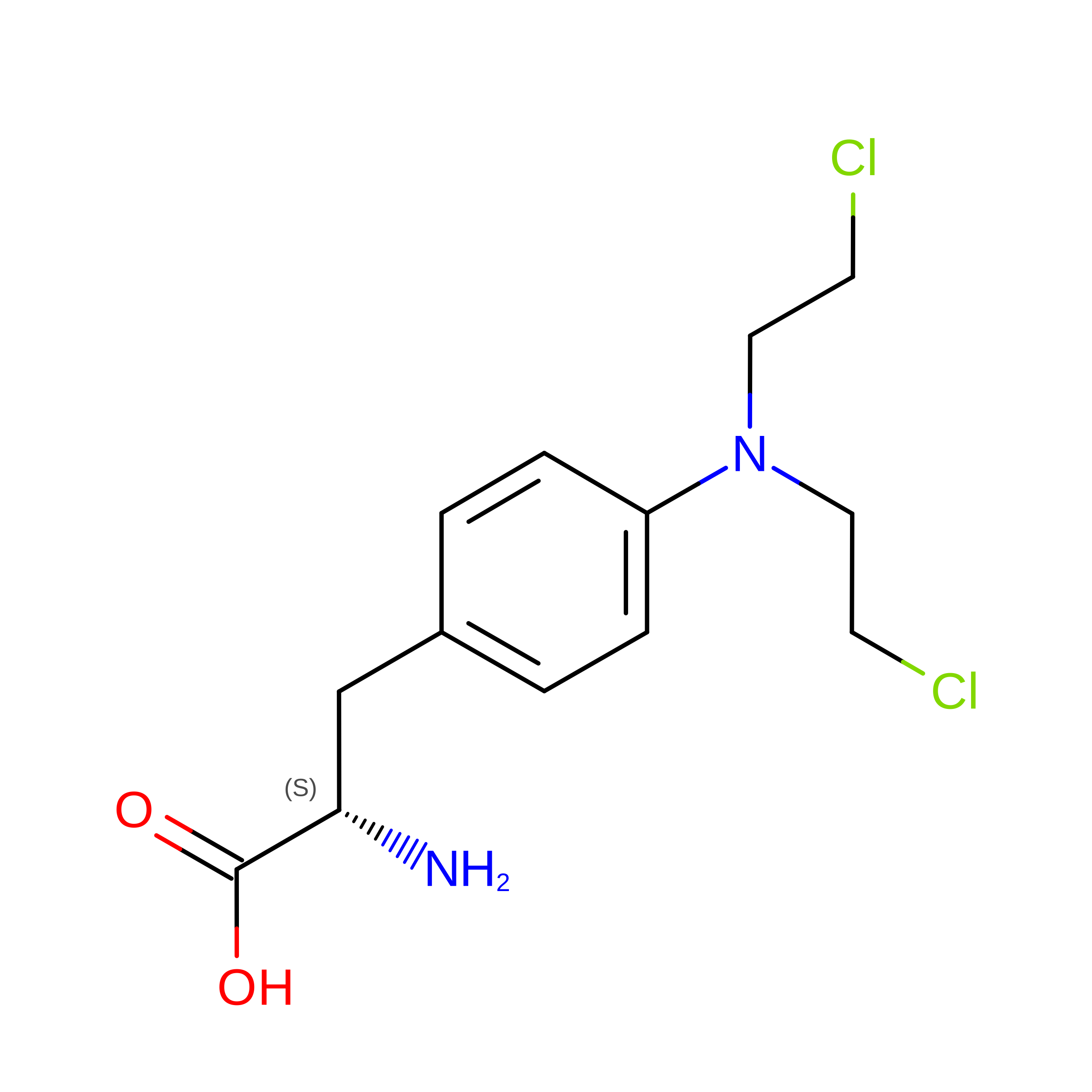
Melphalan is a nitrogen mustard or bischloroethylamine type alkylating agent.[L40928] It was first synthesized in the early 1950s by substituting L-phenylalanine for the methyl group on nitrogen mustard.[A261150, A261155] Melphalan is used in the treatment of multiple myeloma and ovarian carcinoma.[L40928] It is also used for high-conditioning before hematopoietic stem cell transplant.[L47890] It is also used to treat uveal melanoma with unresectable hepatic metastases.[L47895]
Synonyms
Alanine Nitrogen Mustard
Melphalan hydrochloride
Melphalanum
L-Sarcolysin Phenylalanine mustard
p-N-Bis(2-chloroethyl)amino-L-phenylalanine
4-[bis(2-chloroethyl)amino]-L-phenylalanine
Melfalano
L-Sarcolysin
Melphalan
4-(Bis(2-chloroethyl)amino)-L-phenylalanine
L-Sarcolysine
p-L-Sarcolysin
p-Di-(2-chloroethyl)amino-L-phenylalanine
3-p-(Di(2-chloroethyl)amino)-phenyl-L-alanine
L-PAM
Sarcoclorin
Phenylalanine nitrogen mustard
L-3-(p-(Bis(2-chloroethyl)amino)phenyl)alanine
p-N,N-bis(2-chloroethyl)amino-L-phenylalanine
Melfalan
p-Bis(beta-chloroethyl)aminophenylalanine
L-Phenylalanine mustard
Phenylalanine mustard
3-(p-(Bis(2-chloroethyl)amino)phenyl)-L-alanine
Brand Names
Melphalan hydrochloride
Melphalan for Injection
Ivra
Evomela
Phelinun
Taro-melphalan
Hepzato Kit
Alkeran
Melphalan Hydrochloride
Melphalan
Indication
Melphalan is indicated for use as a high-dose conditioning treatment prior to hematopoietic stem cell transplantation in patients with multiple myeloma.[L47890] It is also indicated for the palliative treatment of multiple myeloma and for the palliation of non-resectable epithelial carcinoma of the ovary.[L40928] Melphalan is a component of HEPZATO KIT, a liver-directed therapy indicated for the treatment of adults with uveal melanoma with unresectable hepatic metastases affecting less than 50% of the liver and no extrahepatic disease or extrahepatic disease limited to the bone, lymph nodes, subcutaneous tissues, or lung that is amenable to resection or radiation.[L47895]
Drug Info/Drug Targets: DrugBank 3.0: a comprehensive resource for 'omics' research on drugs. Knox C, Law V, Jewison
T, Liu P, Ly S, Frolkis A, Pon A, Banco K, Mak C, Neveu V, Djoumbou Y, Eisner R, Guo AC, Wishart DS.
Nucleic Acids Res. 2011 Jan; 39 (Database issue):D1035-41. | PMID:21059682