Find PDB structures and Computed Structure Models (CSM) by combining queries from tools in this suite: Attribute Search, Sequence Similarity, Sequence Motif, 3D Similarity, and 3D Motif with 'AND' logic.
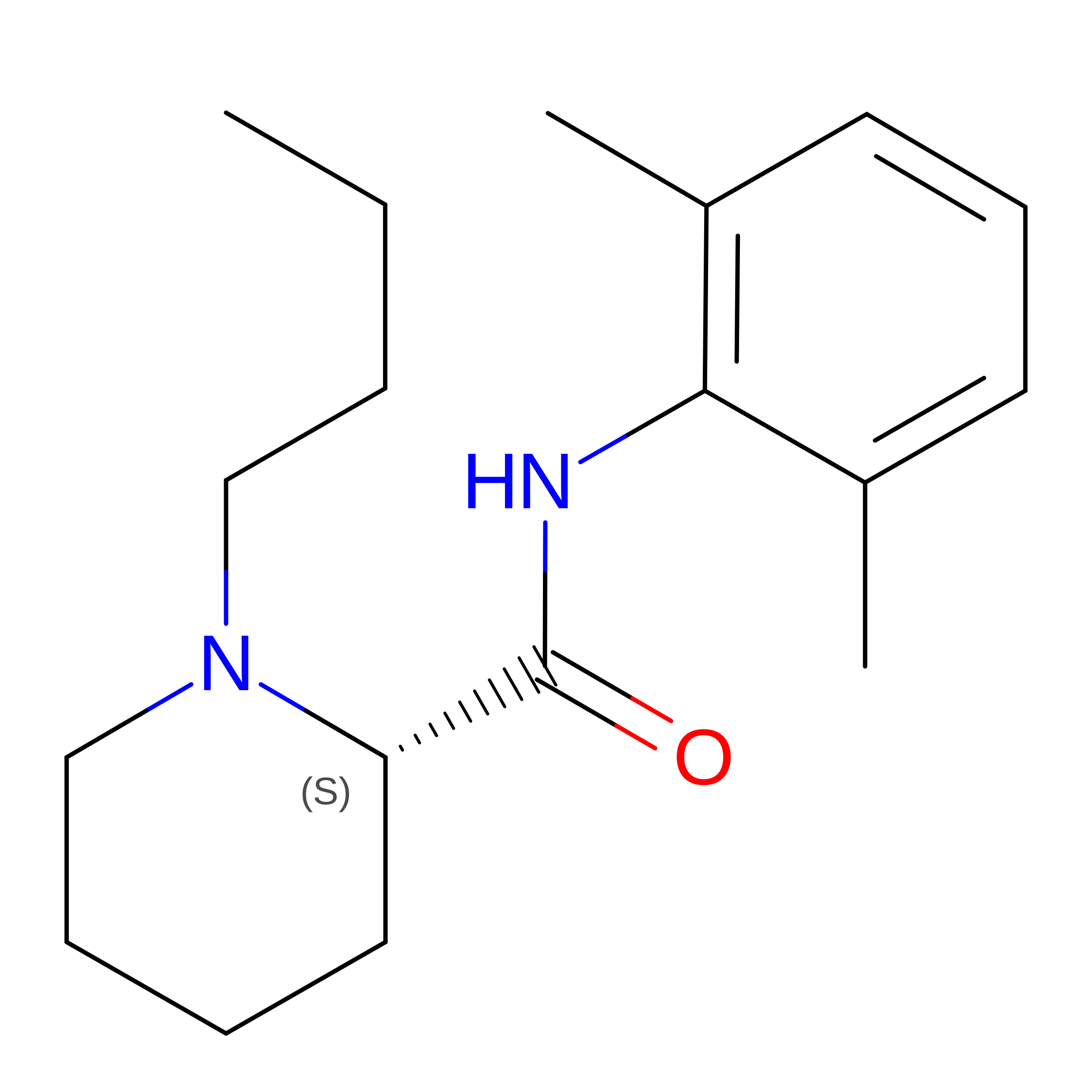
Levobupivacaine is an amino-amide local anaesthetic drug belonging to the family of n-alkylsubstituted pipecoloxylidide. It is the S-enantiomer of bupivacaine. Levobupivacaine hydrochloride is commonly marketed by AstraZeneca under the trade name Chirocaine. In particular, the specific levobupivacaine enantiomer is a worthwhile pursuit because it demonstrates less vasodilation and possesses a greater length of action in comparison to bupivacaine. It is approximately 13 per cent less potent (by molarity) than racemic bupivacaine.Levobupivacaine is indicated for local anaesthesia including infiltration, nerve block, ophthalmic, epidural and intrathecal anaesthesia in adults; and infiltration analgesia in children. When administered appropriately, the occurrence of adverse effects is not anticipated much if at all. In general, the majority of potential adverse effects are predominantly associated with inappropriate administration methods that may cause systemic exposure and/or toxicity associated with overexposure to an anesthetic. Regardless, allergic reactions may also occur - although only rarely.
Synonyms
Levobupivacaïne
L-(−)-bupivacaine
L-(-)-1-Butyl-2',6'-pipecoloxylidide
(-)-bupivacaine
levo-bupivacaine
(S)-bupivacaine
Levobupivacaína
Levobupivacaine hydrochloride
(S)-1-butyl-2',6'-pipecoloxylidide
L-BUPIVACAINE
Levobupivacaine
Indication
For the production of local or regional anesthesia for surgery and obstetrics, and for post-operative pain management
Drug Info/Drug Targets: DrugBank 3.0: a comprehensive resource for 'omics' research on drugs. Knox C, Law V, Jewison
T, Liu P, Ly S, Frolkis A, Pon A, Banco K, Mak C, Neveu V, Djoumbou Y, Eisner R, Guo AC, Wishart DS.
Nucleic Acids Res. 2011 Jan; 39 (Database issue):D1035-41. | PMID:21059682