Download Mendeley
Nitrile-Based Inhibitors Targeting both SARS-CoV‐2 Main Protease and Human Cathepsin L.
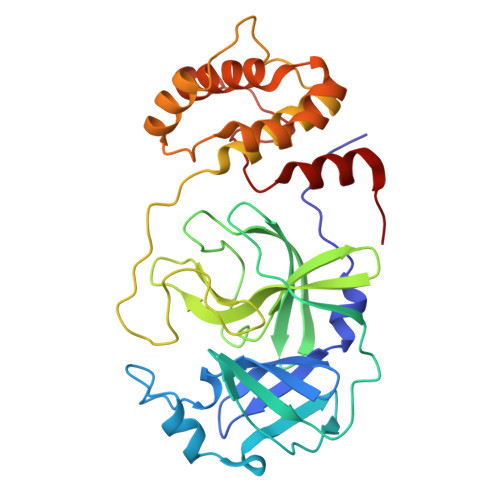
Barasa, L., Chen, Y., Shaqra, A.M., Adnan, S.F.Z., Intravaia, L.E., Huchaiah, S., Allabaji, A., S, K.K., Vidadala, S.R., Patil, S.N., Hale, J., Schiffer, C.A., Fitzgerald, K.A., Thompson, P.R.(2026) ACS Med Chem Lett 17: 1956-1965
- PubMed: 42741323 Search on PubMedSearch on PubMed Central
- DOI: https://doi.org/10.1021/acsmedchemlett.6c00236
- Primary Citation Related Structures:
11RO, 12AF - PubMed Abstract:
The SARS-CoV-2 main protease (M pro ) and host cysteine protease cathepsin L (CatL) are both attractive targets for antiviral intervention. Herein we describe the rational design and synthesis of dual M pro /CatL inhibitors derived from the previously reported leads SM141 and SM142 . Optimization focused on replacement of the acrylate ester warhead in SM141 and SM142 with a nitrile, modifying the P2, P3, and P4 capping groups, and variation of the P1 lactam ring size. In addition, conformational restriction was achieved through macrocyclization between the P1 and P4 side chains to enhance binding affinity. These efforts identified multiple dual-target inhibitors with nanomolar potency against both M pro and CatL and potent antiviral activity as well as selective M pro inhibitors with strong enzymatic activity. Targeting both a viral protease and a host factor may provide more durable antiviral efficacy by reducing susceptibility to resistance arising from viral evolution of M pro .
- Program in Chemical Biology, University of Massachusetts Chan Medical School, 364 Plantation Street, Worcester, Massachusetts 01605, United States.
Organizational Affiliation: