Download Mendeley
Leveraging bioorthogonal conjugation for alpha synuclein fibril surveillance.
Jenkins, R.A., Wu, S., Fujimura, G., Heredia, A., Flowers, C.W., Sun, C., Sawaya, M.R., Loo, J.A., Rodriguez, J.A.(2025) bioRxiv
- PubMed: 41000844 Search on PubMedSearch on PubMed Central
- DOI: https://doi.org/10.1101/2025.09.12.675751
- Primary Citation Related Structures:
9Y0S - PubMed Abstract:
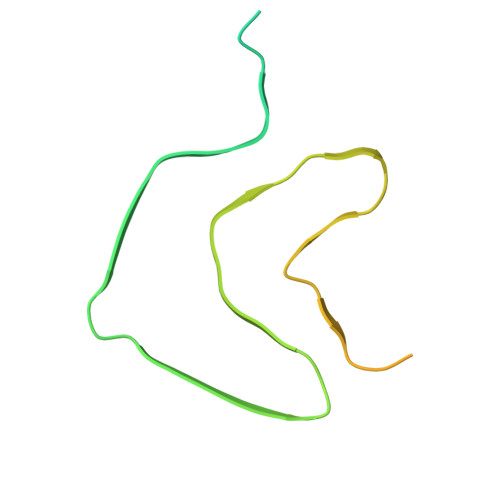
Alpha synuclein (α-syn) amyloid fibrils are associated with various neurodegenerative diseases. To better understand the molecular and cellular basis for α-syn fibril persistence and spread, we implemented a fluorophore labeling strategy to surveil pre-formed α-syn fibrils in solution and in cells. We leveraged amber codon mediated incorporation of a tetrazine-based artificial amino acid (TetV2.0) to install a cyclooctene-conjugated Janeliaflour, JF549, at four sites on human α-syn: residues 4, 60, 96 and 136. Fast coupling occurred under mild buffer conditions and in the presence of the disease-associated cofactor and cytotoxic lipid, psychosine. Labeled fibrils retained their polymorphic features, seeded the growth of new fibrils in vitro , and induced the seeding of positive puncta in α-syn FRET biosensor HEK293T cells. This allowed simultaneous tracking of exogenous and endogenous α-syn aggregates in biosensor cells, and their localization within the cells. In doing so, our approach facilitates more detailed mechanistic investigation of α-syn aggregates.
- Department of Chemistry and Biochemistry; UCLA-DOE Institute for Genomics and Proteomics; STROBE, NSF Science and Technology Center; University of California, Los Angeles (UCLA); Los Angeles, CA 90095, USA.
Organizational Affiliation: