Download Mendeley
The chromatin reader ZMYND8 recruits the NuRD component GATAD2A through its MYND domain to regulate MAPT213 long noncoding RNA transcription.
Srivastava, D.K., Nandi, S., Karmakar, A., Das, C., Roy, S.(2026) J Biol Chem 302: 111463-111463
- PubMed: 41999894 Search on PubMedSearch on PubMed Central
- DOI: https://doi.org/10.1016/j.jbc.2026.111463
- Primary Citation Related Structures:
9WV4 - PubMed Abstract:
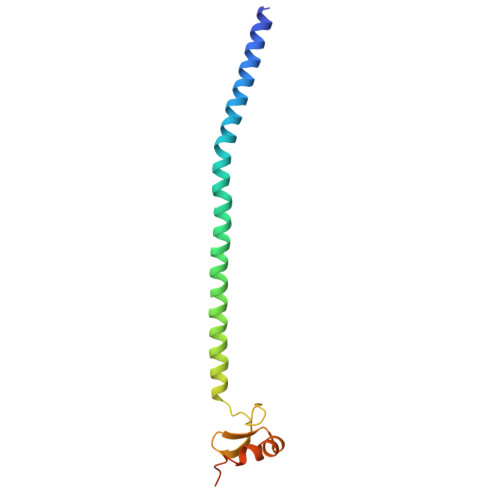
The zinc finger MYND-type containing eight protein (ZMYND8) is a chromatin reader that regulates neuronal gene expression by controlling the microtubule-associated protein tau (MAPT) locus. Here, we investigate how ZMYND8 regulates expression of the long non-coding RNA MAPT213 through its interaction with GATA zinc finger domain containing 2A (GATAD2A), a component of the Nucleosome Remodelling and Deacetylase complex. ZMYND8 exhibits opposite regulatory effects on protein-coding MAPT and non-coding MAPT213 transcripts in a manner dependent on its MYND domain, promoting MAPT expression while suppressing MAPT213 levels. Chromatin immunoprecipitation experiments demonstrated that ZMYND8 specifically recruits GATAD2A to the MAPT213 internal regulatory region, establishing a direct link between protein binding and transcriptional control. We determined the crystal structure of the ZMYND8 coiled-coil MYND domain at high resolution, revealing a homodimeric architecture. The MYND domain specifically recognizes GATAD2A through direct interaction with proline-rich motifs in GATAD2A's central region. Structure-function analysis identified critical binding interface residues, while quantitative measurements revealed moderate-affinity interactions enhanced through multivalent binding mechanisms. These findings establish the molecular basis for ZMYND8-mediated recruitment of chromatin remodeling complexes to specific genomic loci and provide a structural framework for understanding transcriptional regulation of MAPT213.
- Structural Biology and Bio-Informatics Division, Council of Scientific & Industrial Research-Indian Institute of Chemical Biology, Kolkata, India.
Organizational Affiliation: