Download Mendeley
Enzymatic properties and potential for agro-food byproduct upcycling of xylanase TcrXyn10A expressed in Escherichia coli.
Kim, K.M., Han, D.G., Kim, B.S., Kim, S.R., Nam, K.H., Kim, I.J.(2025) Int J Biol Macromol 329: 147880-147880
- PubMed: 41005418 Search on PubMed
- DOI: https://doi.org/10.1016/j.ijbiomac.2025.147880
- Primary Citation Related Structures:
9VK4 - PubMed Abstract:
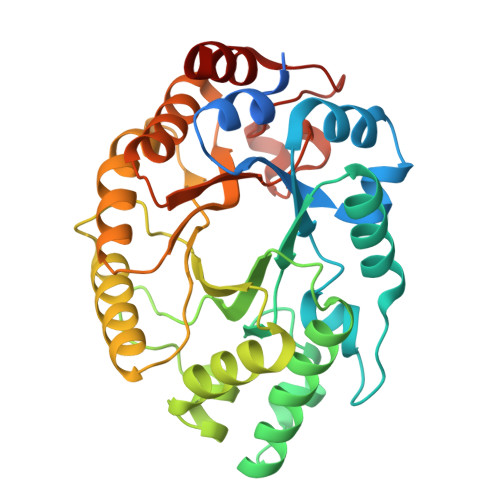
Xylanases play a crucial role in xylan degradation by cleaving its backbone and releasing xylooligosaccharides (XOSs) or xylose, which are compounds widely used in the food, paper, feed, and fuel industries. A xylanase from Thermoascus crustaceus (TcrXyn10A) exhibits high activity suitable for industrial use when expressed in Pichia pastoris; however, the high cost of this enzyme precludes its economic use. To improve economic feasibility, we expressed TcrXyn10A in Escherichia coli with a level of >30 mg per liter of culture, and the enzyme displayed optimal hydrolytic activity against beechwood xylan at pH 5.0 and 50-60 °C with a specific activity of 525.8 U/mg. The crystal structure of TcrXyn10A was determined at 2.1 Å resolution, revealing that Trp300 in the β8-α13 loop adopts a distinct conformation from that in homologous GH10 xylanases. TcrXyn10A expressed in E. coli did not form a disulfide bond between Cys280 and Cys286, which may have contributed to its different enzymatic properties from those of TcrXyn10A expressed in P. pastoris. TcrXyn10A expressed in E. coli efficiently produced XOSs from xylan extracted from agricultural byproducts, including corncobs and perilla stalks, suggesting its potential for industrial applications. These findings expand our knowledge of the molecular properties of TcrXyn10A and provide insights into its potential industrial use in biomass degradation.
- Division of Applied Life Sciences, Institute of Agriculture and Life Science, Gyeongsang National University, Jinju 52828, Republic of Korea.
Organizational Affiliation: