Download Mendeley
Structural insights into the adenosylcobinamide-phosphate guanylyltransferase activity of CobU from Akkermansia muciniphila.
Jiang, M., Kong, C., Wei, Q., Guo, S., Chen, X., Li, Q., Wang, M.(2025) Int J Biol Macromol 329: 147810-147810
- PubMed: 40976292 Search on PubMed
- DOI: https://doi.org/10.1016/j.ijbiomac.2025.147810
- Primary Citation Related Structures:
9VIO, 9VIP, 9VIS, 9VIT - PubMed Abstract:
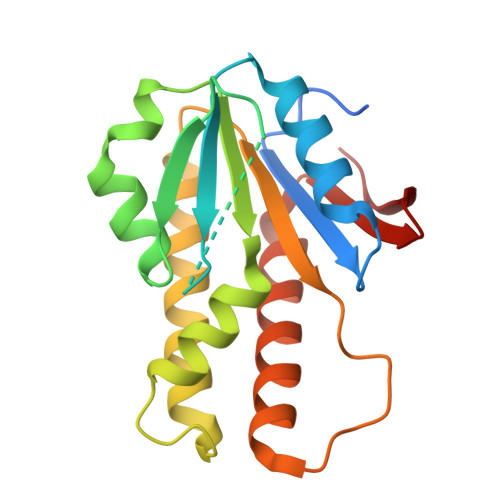
Cobamides are a family of complex nutrients that are essential for animals and some bacteria and archaea. The intestinal probiotic Akkermansia muciniphila cannot synthesize cobamide de novo, but was reported to synthesize cobamide through a salvage pathway starting with the generation of cobamide precursor AdoCbi-P by CbiR. However, the downstream of this pathway remains unclear. In this work, we demonstrated that AmCobU possesses AdoCbi-P guanylyltransferase activity, which implied that AdoCbi-P can be activated to AdoCbi-GDP, an intermediate that can incorporate new lower ligands, in A. muciniphila. Further, we determined the crystal structures of AmCobU and its complex with the product AdoCbi-GDP, as well as its H49A mutant in complex with the substrate GTP. The structural results revealed that GTP binds in a pocket formed by helix α2, the core β-sheets, and the P-loop, and AdoCbi-P binds in a pocket involving the trimerization interface, suggesting that trimerization is essential for CobU activity. In addition, we found a significant positional variation of α2 in the GTP complex and the AdoCbi-GDP complex structures, suggesting a conformational change of α2 during the catalytic process. Our findings improved the understanding of the cobamide synthesis pathway in A. muciniphila, as well as the catalytic mechanism of the AdoCbi-P guanylyltransferase activity of CobU.
- School of Life Sciences, Anhui University, Hefei, 230601, Anhui, China; Institute of Health Sciences and Technology, Anhui University, Hefei, 230601, Anhui, China.
Organizational Affiliation: