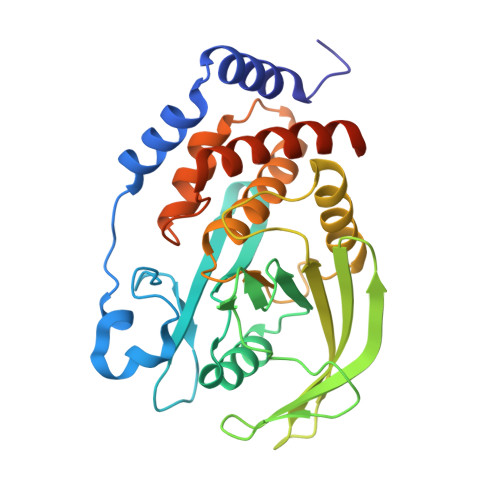
9UZT | pdb_00009uzt

Crystal structure of human PTPN2 with inhibitor K-38


Experimental Data Snapshot

  • Method: X-RAY DIFFRACTION
  • Resolution: 2.17 Å
  • R-Value Free: 
    0.213 (Depositor), 0.214 (DCC) 
  • R-Value Work: 
    0.182 (Depositor), 0.183 (DCC) 
  • R-Value Observed: 
    0.184 (Depositor) 

Starting Model: experimental
View more details

wwPDB Validation   3D Report Full Report


Ligand Structure Quality Assessment 


This is version 1.0 of the entry. See complete history


Literature

Targeting Protein Tyrosine Phosphatase Nonreceptor Type 2 with a Novel Inhibitor for the Treatment of Melanoma.

Kuang, W.Li, Q.Wang, W.Wang, D.Tong, C.Song, M.Han, K.Liu, J.Chen, A.Chen, Y.Wang, L.Hao, H.Wang, X.Xiao, Y.Yang, P.

(2025) J Med Chem 68: 24649-24671

  • DOI: https://doi.org/10.1021/acs.jmedchem.5c02622
  • Primary Citation of Related Structures:  
    9UZT

  • PubMed Abstract: 

    Melanoma is a highly aggressive skin cancer with strong metastatic potential, posing significant clinical challenges. Currently, melanoma treatment commonly includes chemotherapy and immunotherapy; nevertheless, the treatment modalities have specific limitations. PTPN2 (protein tyrosine phosphatase nonreceptor type 2) has emerged as a promising therapeutic target. Through rational drug design, we identified compound K-38 , a potent PTPN2 inhibitor (IC 50 = 7.05 nM) with high safety (hERG IC 50 > 40 μM) and excellent liver metabolic stability ( T 1/2 = 408 min). Compound K-38 also showed improved oral bioavailability ( F = 10.46%) over AC-484 ( F = 1.40%) (Zheng European Journal of Medicinal Chemistry 2024, 270, 116390, ). In vivo, compound K-38 significantly suppressed melanoma growth, especially when combined with anti-PD-1 therapy, outperforming AC-484 . It enhanced lymphocyte infiltration into tumors and modulated IFN-γ signaling pathways. These findings indicate that compound K-38 is a potent small molecule inhibitor of PTPN2, laying the groundwork for the future development of PTPN2-targeted therapeutics.


  • Organizational Affiliation
    • State Key Laboratory of Natural Medicines and Jiangsu Key Laboratory of Drug Design and Optimization, China Pharmaceutical University, Nanjing 210009, China.

Macromolecules
Find similar proteins by:  (by identity cutoff)  |  3D Structure
Entity ID: 1
MoleculeChains Sequence LengthOrganismDetailsImage
Tyrosine-protein phosphatase non-receptor type 2A [auth B]300Homo sapiensMutation(s): 0 
Gene Names: PTPN2PTPT
EC: 3.1.3.48
UniProt & NIH Common Fund Data Resources
Find proteins for P17706 (Homo sapiens)
Explore P17706 
Go to UniProtKB:  P17706
PHAROS:  P17706
GTEx:  ENSG00000175354 
Entity Groups  
Sequence Clusters30% Identity50% Identity70% Identity90% Identity95% Identity100% Identity
UniProt GroupP17706
Sequence Annotations
Expand
  • Reference Sequence
Small Molecules
Ligands 1 Unique
IDChains Name / Formula / InChI Key2D Diagram3D Interactions
A1EQR (Subject of Investigation/LOI)
Query on A1EQR

Download Ideal Coordinates CCD File 
B
~{N}-cycloheptyl-4-[3-fluoranyl-5-oxidanyl-4-[1,1,4-tris(oxidanylidene)-1,2,5-thiadiazolidin-2-yl]phenyl]-1~{H}-imidazole-2-carboxamide
C19 H22 F N5 O5 S
RYAIQNKSHNFQJM-UHFFFAOYSA-N
Experimental Data & Validation

Experimental Data

  • Method: X-RAY DIFFRACTION
  • Resolution: 2.17 Å
  • R-Value Free:  0.213 (Depositor), 0.214 (DCC) 
  • R-Value Work:  0.182 (Depositor), 0.183 (DCC) 
  • R-Value Observed: 0.184 (Depositor) 
Space Group: P 32 2 1
Unit Cell:
Length ( Å )Angle ( ˚ )
a = 94.95α = 90
b = 94.95β = 90
c = 100.514γ = 120
Software Package:
Software NamePurpose
PHENIXrefinement
Aimlessdata scaling
PDB_EXTRACTdata extraction
PHENIXphasing

Structure Validation

View Full Validation Report


Ligand Structure Quality Assessment 


Entry History & Funding Information

Deposition Data

  • Released Date: 2025-12-17 
  • Deposition Author(s): Tong, C.

Funding OrganizationLocationGrant Number
National Natural Science Foundation of China (NSFC)China--

Revision History  (Full details and data files)

  • Version 1.0: 2025-12-17
    Type: Initial release