Download Mendeley
Epithelial cell membrane perforation induces allergic airway inflammation.
Shi, K., Lv, Y., Zhao, C., Zeng, H., Wang, Y., Liu, Y., Li, L., Chen, S., Gao, P., Shao, F., Xu, M.(2025) Nature 645: 475-483
- PubMed: 40739348 Search on PubMedSearch on PubMed Central
- DOI: https://doi.org/10.1038/s41586-025-09331-1
- Primary Citation Related Structures:
9UJ0 - PubMed Abstract:
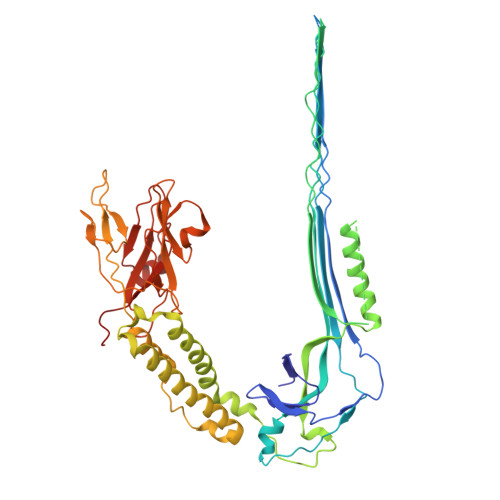
Allergens that induce allergic airway inflammation are highly diverse, but they commonly activate type 2 immune responses 1,2 . Airway epithelial cells are crucial in allergen sensing 3-5 . However, the shared features among diverse allergens that elicit similar innate responses, and their epithelial detection mechanisms, remain poorly defined 1,2,6-9 . Here we identify pore-forming proteins as one of the common stimuli of allergic airway inflammation and reveal their immune-activation mechanisms. Using the prevalent mould allergen Alternaria alternata as a model, we established an in vitro system to investigate type 2 innate immune sensing. A six-step biochemical fractionation identified Aeg-S and Aeg-L as the core immune-stimulatory components. Biochemical reconstitution and cryo-electron microscopy reveal that these proteins form 16- to 20-mer transmembrane pore complexes. Their cooperative perforation acts as a bona fide type 2 immune adjuvant to support antigen-specific T helper 2 and immunoglobulin E responses. Genetically engineered A. alternata strains that lack pore-forming activity do not induce allergic responses in mice. Furthermore, pore-forming proteins from various species, despite structural and membrane target differences, are sufficient to trigger respiratory allergies. Perforations in airway epithelial cells initiate allergic responses through two mechanisms: one triggers IL-33 release, and the other involves Ca 2+ influx, which activates MAPK signalling and type 2 inflammatory gene expression. These findings provide insight into how type 2 immune responses detect common perturbations caused by structurally diverse stimuli. Targeting downstream signalling of epithelial perforation may open new avenues for treating respiratory allergies.
- School of Life Sciences, Beijing Normal University, Beijing, China.
Organizational Affiliation: