Download Mendeley
Human Schlafen 14 Cleavage of Short Double-Stranded RNAs Underpins its Antiviral Activity.
Li, M., Sun, D., Hao, W., Fu, H., Zhang, Y., Li, Z., Qin, B., Wang, Y., Cui, S.(2025) Adv Sci (Weinh) 12: e01727-e01727
- PubMed: 40642785 Search on PubMedSearch on PubMed Central
- DOI: https://doi.org/10.1002/advs.202501727
- Primary Citation Related Structures:
9JR9, 9UIE - PubMed Abstract:
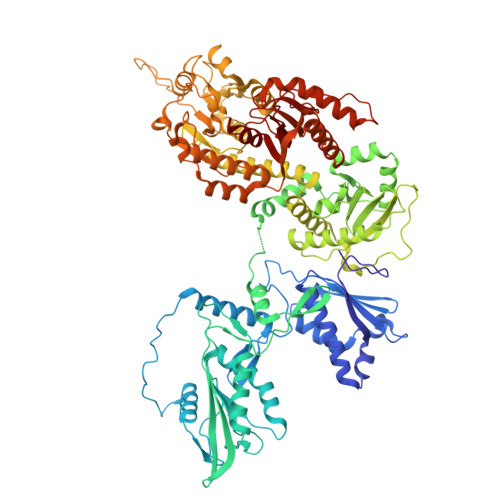
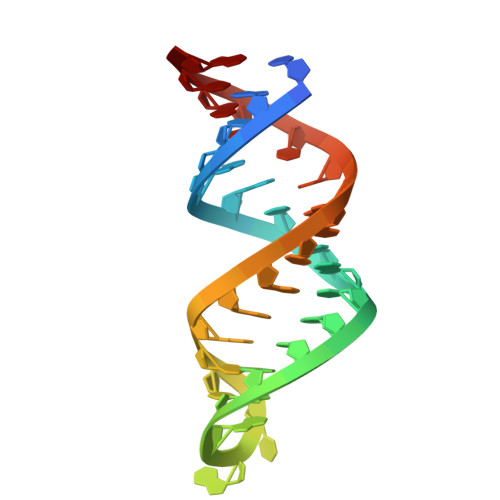
The Schlafen (SLFN) genes are induced by interferons, underscoring their roles in the immune response and viral replication inhibition. SLFN14, a member of SLFN family, is associated with multiple human diseases; however, neither its functions nor its disease mechanisms are fully understood. Herein, human SLFN14 biochemically is characterized, demonstrating that it specifically cleaves RNAs containing short duplex regions, such as hairpin RNAs and tRNAs, but does not have ATPase or helicase activity. Cryogenic electron microscopy structures of SLFN14 apoenzyme (2.84 Å) and SLFN14-hairpin RNA complex (2.88 Å) are determined, revealing that SLFN14 assembles into a ring-like dimer and dimerization is mainly mediated by hydrophobic contacts. Two N-terminal RNase domains of SLFN14 are organized head-to-tail, forming an RNA-binding groove that can accommodate a 12-bp hairpin RNA. The hairpin RNA is recognized mainly through phosphate backbone interactions. Further, SLFN14 is shown to inhibits HIV-1 pseudovirus replication. The anti-HIV-1 activity of SLFN14 is via codon-usage-dependent translational inhibition and impairment of the programmed -1 ribosomal frameshifting, with an efficiency comparable to that of Shiftless. Using tRNA PCR arrays, SLFN14 and SLFN11 are found to decrease both nuclear-encoded and mitochondrial tRNAs in cells. Together, these results provide novel insights into the function of SLFN14 and its role in HIV-1 restriction.
- NHC Key Laboratory of Systems Biology of Pathogens, National Institute of Pathogen Biology, Chinese Academy of Medical Sciences and Peking Union Medical College, Beijing, 100730, P. R. China.
Organizational Affiliation: