9UEV | pdb_00009uev

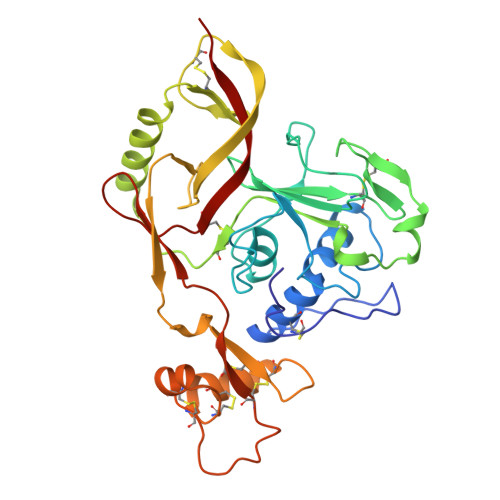
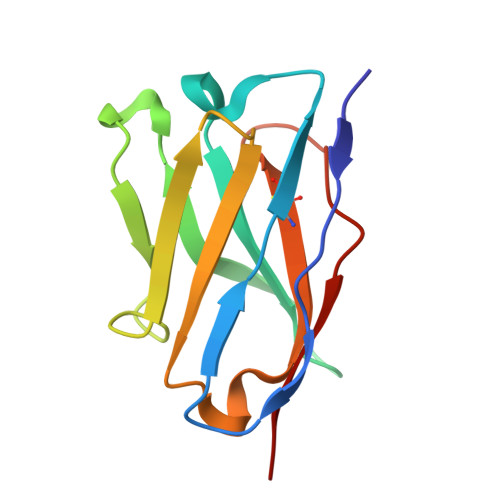
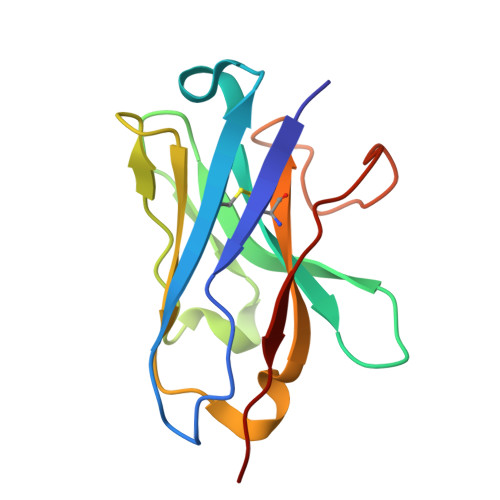
Structure of the SFTSV Gn head protein in complex with Nb261 and Nb318


Experimental Data Snapshot

  • Method: ELECTRON MICROSCOPY
  • Resolution: 3.62 Å
  • Aggregation State: PARTICLE 
  • Reconstruction Method: SINGLE PARTICLE 

wwPDB Validation 3D Report Full Report

Validation slider image for 9UEV

This is version 1.1 of the entry. See complete history

Literature

A rationally designed cocktail of nanobodies elicited by heterologous vaccination confers protection against SFTSV in preclinical models.

Wu, X.Zhu, L.Liang, S.Chang, Z.Wang, Y.Zou, Q.Xu, Z.Zhang, D.Hu, J.Geng, S.Li, Z.Yu, W.Hu, Z.Chen, M.Cao, K.Jia, B.Wei, H.Cai, R.Long, J.Yang, X.Yang, Q.Yu, Z.Shi, L.Xu, B.Zheng, Y.Meng, S.Cai, J.Zhou, G.Zhu, K.Dou, Y.Lou, Z.Li, M.Wu, Y.Wu, Z.

(2025) Sci Transl Med 17: eady9025-eady9025

  • DOI: https://doi.org/10.1126/scitranslmed.ady9025
  • Primary Citation Related Structures: 
    9UB6, 9UEV

  • PubMed Abstract: 

    Severe fever with thrombocytopenia syndrome virus (SFTSV), an emerging tick-borne phlebovirus, poses a growing public health threat, with no approved vaccines or targeted therapies. Its genetic diversity and rapid reassortment have hindered the development of broadly effective interventions. Here, we isolated and characterized broadly neutralizing camelid nanobodies generated by a heterologous immunization strategy. These nanobodies exhibited cross-subtype neutralization and conferred protection against disease in humanized and lethal murine models of SFTSV infection. Structural analysis revealed binding to distinct, nonoverlapping epitopes on the viral glycoprotein complex. A rationally designed cocktail leveraging this epitope diversity achieved complete viral inhibition through synergistic mechanisms. In both murine and immunocompetent ferret models, the cocktail enabled efficient viral clearance and full protection against lethal challenge. These results demonstrate the therapeutic potential of nanobody cocktails for SFTSV infection and establish a generalizable framework for nanobody-based countermeasures against genetically variable emerging viruses, including other members of the Bunyavirales order.


  • Organizational Affiliation
    • Center for Public Health Research, Medical School, Nanjing University, Nanjing 210093, China.

Macromolecule Content 

  • Total Structure Weight: 61.41 kDa 
  • Atom Count: 4,297 
  • Modeled Residue Count: 559 
  • Deposited Residue Count: 559 
  • Unique protein chains: 3

Macromolecules

Find similar proteins by:|  3D Structure
Entity ID: 1
MoleculeChains  Sequence LengthOrganismDetailsImage
SFTSV Gn head321Severe fever with thrombocytopenia syndrome virusMutation(s): 0 
UniProt
Find proteins for A0A8F5LQV3 (Dabie bandavirus)
Explore A0A8F5LQV3 
Go to UniProtKB:  A0A8F5LQV3
Entity Groups
Sequence Clusters30% Identity50% Identity70% Identity90% Identity95% Identity100% Identity
UniProt GroupA0A8F5LQV3
Sequence Annotations
Expand
Reference Sequence
Find similar proteins by:|  3D Structure
Entity ID: 2
MoleculeChains  Sequence LengthOrganismDetailsImage
Nb261115Vicugna pacosMutation(s): 0 
Entity Groups
Sequence Clusters30% Identity50% Identity70% Identity90% Identity95% Identity100% Identity
Sequence Annotations
Expand
Reference Sequence
Find similar proteins by:|  3D Structure
Entity ID: 3
MoleculeChains  Sequence LengthOrganismDetailsImage
Nb318123Vicugna pacosMutation(s): 0 
Entity Groups
Sequence Clusters30% Identity50% Identity70% Identity90% Identity95% Identity100% Identity
Sequence Annotations
Expand
Reference Sequence

Experimental Data & Validation

Experimental Data

  • Method: ELECTRON MICROSCOPY
  • Resolution: 3.62 Å
  • Aggregation State: PARTICLE 
  • Reconstruction Method: SINGLE PARTICLE 
EM Software:
TaskSoftware PackageVersion
MODEL REFINEMENTPHENIX1.20.1_4487

Structure Validation

View Full Validation Report


Entry History 

& Funding Information

Deposition Data


Funding OrganizationLocationGrant Number
National Science Foundation (NSF, China)China--

Revision History  (Full details and data files)

  • Version 1.0: 2025-10-29
    Type: Initial release
  • Version 1.1: 2026-09-09
    Changes: Data collection, Database references