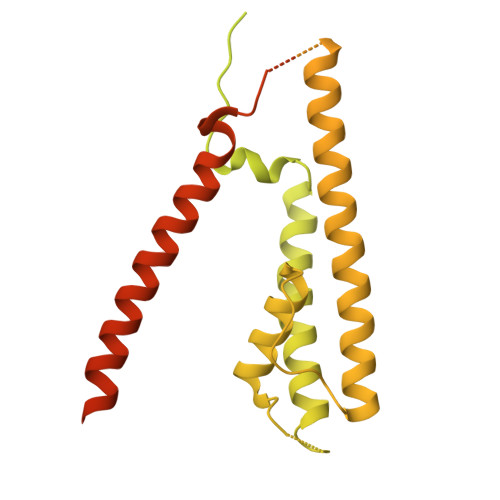
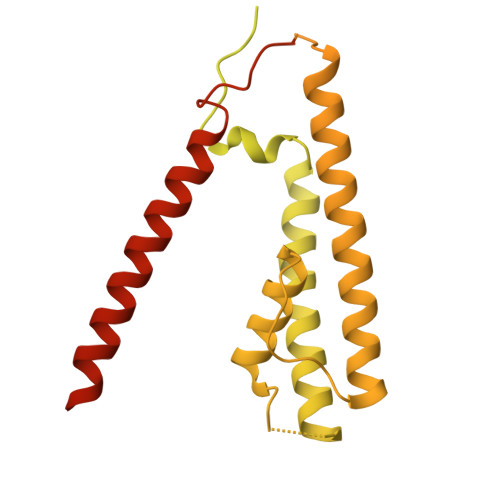
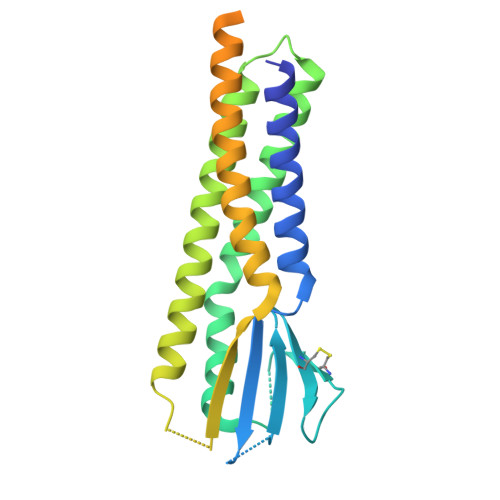
9S41 | pdb_00009s41

Cerebellar GluA1/4 TMD with TARP gamma 7 (focused refinement)


Experimental Data Snapshot

  • Method: ELECTRON MICROSCOPY
  • Resolution: 3.66 Å
  • Aggregation State: PARTICLE 
  • Reconstruction Method: SINGLE PARTICLE 

Starting Models: experimental, in silico
View more details

wwPDB Validation 3D Report Full Report

Validation slider image for 9S41

This is version 1.1 of the entry. See complete history

Literature

Structure and organization of AMPA receptor-TARP complexes in the mammalian cerebellum.

Scrutton, A.M.Sengupta, N.Ivica, J.Stockwell, I.Peak-Chew, S.Singh, B.Suzuki, K.Chang, V.T.McLaughlin, S.H.Krieger, J.M.Aricescu, A.R.Greger, I.H.

(2026) Science 391: 1361-1367

  • DOI: https://doi.org/10.1126/science.aeb3577
  • Primary Citation Related Structures: 
    9S3O, 9S3Q, 9S3Z, 9S41

  • PubMed Abstract: 

    AMPA receptors (AMPARs) are multimodal transducers of glutamatergic signals throughout the brain. Their diversity is exemplified in the cerebellum; at afferent synapses, AMPARs mediate high-frequency excitation, whereas in Bergmann glia (BG) they support calcium transients that modulate synaptic transmission. This spectrum arises from different combinations of core subunits (GluA1-4), auxiliary proteins, and post-transcriptional modifications. Here, using mass-spectrometry, cryo-EM, and electrophysiology, we characterize major cerebellar AMPARs in pig: calcium-impermeable GluA2/A4 heteromers with four TARP subunits, mainly neuronal in origin, and BG-specific calcium-permeable GluA1/A4 heteromers containing two Type-2 TARPs. We also showed that GluA4 receptors consistently exhibit compact N-terminal domains that promote their synaptic delivery. Our study defines the organizational principles of mammalian cerebellar AMPAR complexes and reveals how different receptor subtypes support cell-type specific functions.


  • Organizational Affiliation
    • Neurobiology Division, Medical Research Council (MRC) Laboratory of Molecular Biology, Cambridge, UK.

Macromolecule Content 

  • Total Structure Weight: 455.33 kDa 
  • Atom Count: 6,879 
  • Modeled Residue Count: 914 
  • Deposited Residue Count: 4,052 
  • Unique protein chains: 3

Macromolecules

Find similar proteins by:|  3D Structure
Entity ID: 1
MoleculeChains  Sequence LengthOrganismDetailsImage
Glutamate receptor 1
A, C
888Sus scrofaMutation(s): 0 
UniProt
Find proteins for A0A286ZS63 (Sus scrofa)
Explore A0A286ZS63 
Go to UniProtKB:  A0A286ZS63
Entity Groups
Sequence Clusters30% Identity50% Identity70% Identity90% Identity95% Identity100% Identity
UniProt GroupA0A286ZS63
Sequence Annotations
Expand
Reference Sequence
Find similar proteins by:|  3D Structure
Entity ID: 2
MoleculeChains  Sequence LengthOrganismDetailsImage
Glutamate receptor 4
B, D
863Sus scrofaMutation(s): 0 
UniProt
Find proteins for I3L8N9 (Sus scrofa)
Explore I3L8N9 
Go to UniProtKB:  I3L8N9
Entity Groups
Sequence Clusters30% Identity50% Identity70% Identity90% Identity95% Identity100% Identity
UniProt GroupI3L8N9
Sequence Annotations
Expand
Reference Sequence
Find similar proteins by:|  3D Structure
Entity ID: 3
MoleculeChains  Sequence LengthOrganismDetailsImage
Voltage-dependent calcium channel gamma-7 subunitE [auth I],
F [auth J]
275Sus scrofaMutation(s): 0 
UniProt
Find proteins for F2Z4Y2 (Sus scrofa)
Explore F2Z4Y2 
Go to UniProtKB:  F2Z4Y2
Entity Groups
Sequence Clusters30% Identity50% Identity70% Identity90% Identity95% Identity100% Identity
UniProt GroupF2Z4Y2
Sequence Annotations
Expand
Reference Sequence

Experimental Data & Validation

Experimental Data

  • Method: ELECTRON MICROSCOPY
  • Resolution: 3.66 Å
  • Aggregation State: PARTICLE 
  • Reconstruction Method: SINGLE PARTICLE 
EM Software:
TaskSoftware PackageVersion
RECONSTRUCTIONcryoSPARC
MODEL REFINEMENTPHENIX
MODEL REFINEMENTCoot

Structure Validation

View Full Validation Report


Entry History 

& Funding Information

Deposition Data


Funding OrganizationLocationGrant Number
Medical Research Council (MRC, United Kingdom)United KingdomMC_U105174197
Wellcome TrustUnited Kingdom223194/Z/21/Z

Revision History  (Full details and data files)

  • Version 1.0: 2025-12-24
    Type: Initial release
  • Version 1.1: 2026-04-08
    Changes: Data collection, Database references