Download Mendeley
Synthetic alpha-synuclein fibrils replicate in mice causing MSA-like pathology.
Burger, D., Kashyrina, M., van den Heuvel, L., de La Seigliere, H., Lewis, A.J., De Nuccio, F., Mohammed, I., Verchere, J., Feuillie, C., Berbon, M., Arotcarena, M.L., Retailleau, A., Bezard, E., Canron, M.H., Meissner, W.G., Loquet, A., Bousset, L., Poujol, C., Nilsson, K.P.R., Laferriere, F., Baron, T., Lofrumento, D.D., De Giorgi, F., Stahlberg, H., Ichas, F.(2025) Nature 648: 409-417
- PubMed: 41193804 Search on PubMedSearch on PubMed Central
- DOI: https://doi.org/10.1038/s41586-025-09698-1
- Primary Citation Related Structures:
9EUU, 9RZF - PubMed Abstract:
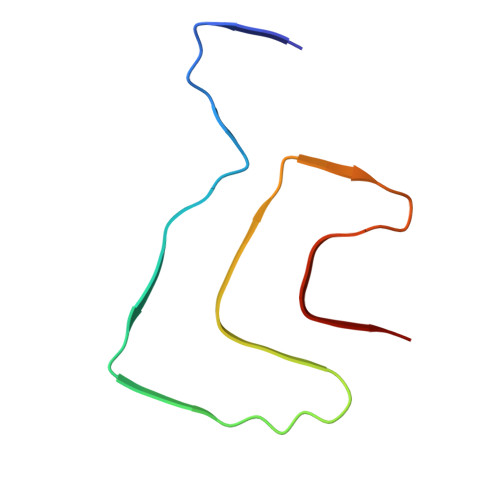
Multiple-system atrophy (MSA) is a rapidly progressive neurodegenerative disease of unknown cause, typically affecting individuals aged 50-60 years and leading to death within a decade 1-3 . It is characterized by glial cytoplasmic inclusions (GCIs) composed of fibrillar α-synuclein (aSyn) 4-8 , the formation of which shows parallels with prion propagation 9,10 . While fibrils extracted from brains of individuals with MSA have been structurally characterized 11 , their ability to replicate in a protein-only manner has been questioned 12 , and their ability to induce GCIs in vivo remains unexplored. By contrast, the synthetic fibril strain 1B 13,14 , assembled from recombinant human aSyn, self-replicates in vitro and induces GCIs in mice 15 -suggesting direct relevance to MSA-but lacks scrutiny at the atomic scale. Here we report high-resolution structural analyses of 1B fibrils and of fibrils extracted from diseased mice injected with 1B that developed GCIs (1B P ). We show in vivo that conformational templating enables fibril strain replication, resulting in MSA-like inclusion pathology. Notably, the structures of 1B and 1B P are highly similar and mimic the fold of aSyn observed in one protofilament of fibrils isolated from patients with MSA 11 . Moreover, reinjection of crude mouse brain homogenates containing 1B P into new mice reproduces the same MSA-like pathology induced by the parent synthetic seed 1B. Our findings identify 1B as a synthetic pathogen capable of self-replication in vivo and reveal structural features of 1B and 1B P that may underlie MSA pathology, offering insights for therapeutic strategies.
- Laboratory of Biological Electron Microscopy, Institute of Physics, School of Basic Science, EPFL, Lausanne, Switzerland.
Organizational Affiliation: