Download Mendeley
Structural and functional dissection of the WH2/DAD motif of INF2, a formin linked to human inherited degenerative disorders.
Labat-de-Hoz, L., Fernandez-Martin, L., Morales, P., Correas, I., Jimenez, M.A., Alonso, M.A.(2026) FEBS J 293: 825-841
- PubMed: 40993919 Search on PubMed
- DOI: https://doi.org/10.1111/febs.70271
- Primary Citation Related Structures:
9G7T, 9RWF - PubMed Abstract:
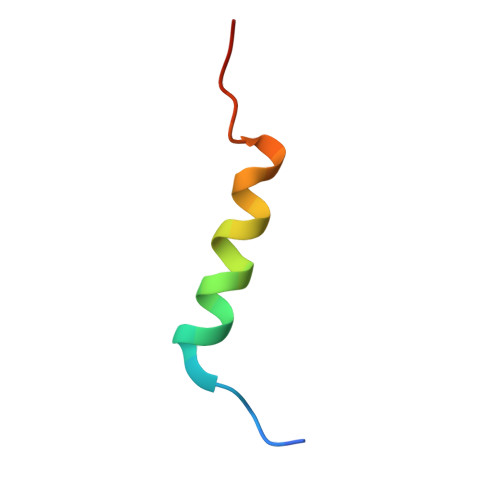
Inverted formin-2 (INF2), a formin linked to inherited renal and neurological disorders, exhibits pathogenic variants that lead to deregulated actin polymerization and nuclear aberrations, ultimately compromising cell viability. Most formins contain a diaphanous autoregulatory domain (DAD) and a diaphanous inhibitory domain (DID), which interact to keep the molecule in an inactive state. The DAD consists of a short sequence with an N-terminal region rich in hydrophobic residues and a C-terminal segment abundant in basic residues, resembling WASP homology 2 (WH2) actin-binding domains. Based on its sequence and actin-binding ability, the DAD of INF2 qualifies as a WH2 motif. In this study, we investigated the structure of the INF2 WH2/DAD by nuclear magnetic resonance (NMR) and explored its functional role. Our analysis revealed that the WH2/DAD forms a single α-helix in both H 2 O and 30% 2,2,2-trifluoroethanol that differs from the conformations observed in WH2-actin and DAD-DID crystal structures. Cells expressing INF2 containing only the hydrophobic region of the WH2/DAD exhibited higher F-actin levels and frequencies of nuclear abnormalities, phenocopying the effect of pathogenic INF2 DID variants. In contrast, deletion of the entire WH2/DAD, or of the hydrophobic region alone, abolishes INF2 activity. Neither these deletions nor WH2/DAD variants carrying naturally occurring missense mutations induced any detectable nuclear effects. These findings suggest that the WH2/DAD undergoes a conformational change to facilitate actin binding and that the hydrophobic region is essential for INF2-mediated actin polymerization. INF2 WH2/DAD variants with deleterious cellular effects appear to be rare in, or absent from, the human population.
- Centro de Biología Molecular Severo Ochoa (CBMSO), Consejo Superior de Investigaciones Científicas (CSIC) and Universidad Autónoma de Madrid (UAM), Spain.
Organizational Affiliation: