Download Mendeley
Two folds, many faces: The Magnaporthe oryzae MAX effector AVR-Pia targets novel rice HMA domain-containing proteins.
Maidment, J.H.R., Saile, S.C., Bocquet, A., Thivolle, C., Bourcet, L., Planel, L.F., Gelin, M., Kroj, T., Padilla, A., de Guillen, K., Cesari, S.(2026) PLoS Pathog 22: e1014382-e1014382
- PubMed: 42441725 Search on PubMedSearch on PubMed Central
- DOI: https://doi.org/10.1371/journal.ppat.1014382
- Primary Citation Related Structures:
9RSV - PubMed Abstract:
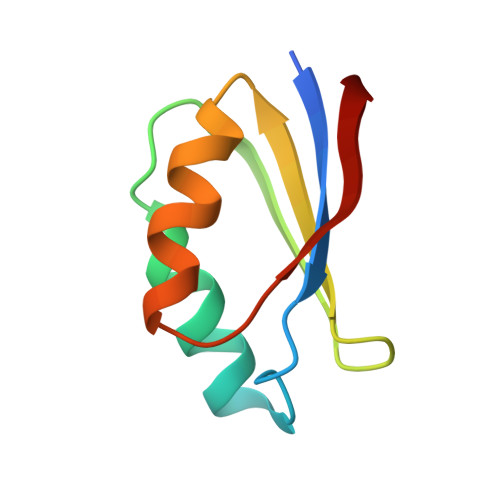
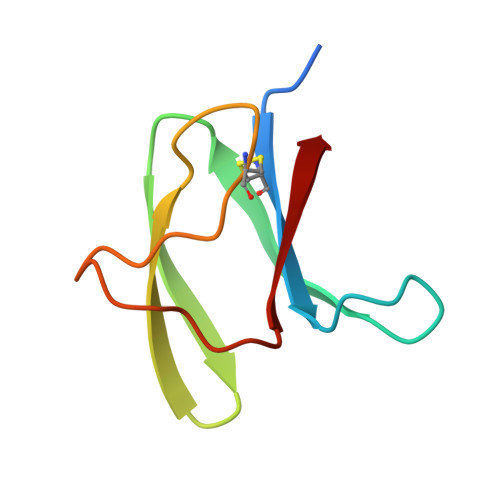
Phytopathogenic fungi secrete effector proteins to promote virulence. The MAX (Magnaporthe Avrs and ToxB-like) effectors form a structurally conserved family despite significant sequence diversity. AVR-Pia, a MAX effector from the rice blast fungus Magnaporthe oryzae, is recognised by the model rice nucleotide-binding leucine-rich repeat (NLR) receptor pair OsRGA4/OsRGA5 via direct binding to a heavy metal-associated (HMA) integrated domain (ID) in OsRGA5. While the structural basis of AVR-Pia recognition is well defined, the role of this effector in promoting virulence has remained elusive. Here, we reveal that AVR-Pia specifically interacts with four previously uncharacterised rice HMA domain-containing proteins, three HMA Plant Proteins (OsHPP09, OsHPP10 and OsHPP11), and one HMA Isoprenylated Plant Protein (OsHIPP21). AVR-Pia binds these proteins in vitro and in planta, engaging their HMA domains with differential affinities. Notably, AVR-Pia binds OsHPP09-HMA with considerably higher affinity than the HMA-ID of OsRGA5. By solving the crystal structure of the AVR-Pia/OsHPP09-HMA complex, we identified additional molecular contacts at the interface which underpin high affinity binding. Importantly, the H(I)PPs identified as AVR-Pia interactors are distinct from those bound by the MAX effectors AVR-Pik and Pwl2, underscoring target specialisation within the MAX effector family. Further, structural analyses of the AVR-Pia/OsHPP09-HMA complex revealed a markedly different interface compared to other MAX effector/H(I)PP complexes. Finally, structure-guided mutagenesis of OsHPP09 identified a single residue that is critical for AVR-Pia binding. This work provides structural insight into how distinct MAX effectors exploit HMA domain-containing proteins and offers a foundation towards targeted modification of HMA domains to disrupt effector binding and enhance cereal resistance to blast disease.
- PHIM Plant Health Institute, Univ Montpellier, INRAE, CIRAD, Institut Agro, IRD, Montpellier, France.
Organizational Affiliation: