Download Mendeley
Widespread deployment of the human CD38 ADP-ribosyl cyclase fold in antibacterial and anti-eukaryotic polymorphic toxins.
Martinkus, J., Terradot, L., Jurenas, D., Cascales, E.(2025) J Biol Chem 301: 110775-110775
- PubMed: 41022325 Search on PubMedSearch on PubMed Central
- DOI: https://doi.org/10.1016/j.jbc.2025.110775
- Primary Citation Related Structures:
9RO8 - PubMed Abstract:
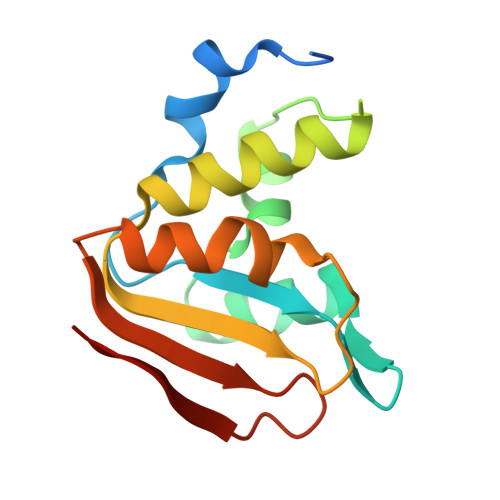
Bacterial polymorphic toxins are modular weapons that mediate intermicrobial competition and host interactions by delivering diverse cytotoxic domains through specialized secretion systems. Here, we identify and characterize a novel toxin domain in Pantoea ananatis that displays remarkable structural and functional conservation with the human enzyme CD38. This bacterial toxin, fused to a type VI secretion system (T6SS) PAAR domain, harbors a C-terminal ADP-ribosyl cyclase (ARC) domain that hydrolyzes NAD + and NADP + in vitro and in vivo, leading to growth inhibition in both bacterial and eukaryotic cells. The 1.6-Å resolution structure of ARC reveals that it adopts a globular fold nearly identical to the human CD38 ADP-ribosyl cyclase, with key catalytic residues conserved. Comparative genomics reveals that CD38-like ARC domains are widespread in bacteria, fused to diverse delivery modules including T6SS, T7SS, and CDI systems. Functional assays demonstrate that these domains act as NAD-depleting toxins, with cross-immunity observed between non-cognate toxin-immunity pairs. Taken together, our findings identify a bacterial NAD + hydrolase fold with strong similarity to human CD38 and define a novel class of metabolic toxins, expanding the functional scope of polymorphic effectors and illustrating how enzymes can be co-opted for microbial warfare.
- Laboratoire d'Ingénierie des Systèmes Macromoléculaires (LISM), Aix-Marseille Université, CNRS, UMR 7255, Marseille, France.
Organizational Affiliation: