9RIS | pdb_00009ris

Crystal structure of human IDO1 in complex with iDeg-1


Experimental Data Snapshot

  • Method: X-RAY DIFFRACTION
  • Resolution: 2.10 Å
  • R-Value Free: 
    0.236 (Depositor), 0.236 (DCC) 
  • R-Value Work: 
    0.207 (Depositor), 0.206 (DCC) 
  • R-Value Observed: 
    0.208 (Depositor) 

Starting Model: experimental
View more details

wwPDB Validation   3D Report Full Report


Ligand Structure Quality Assessment 


This is version 1.1 of the entry. See complete history


Literature

Monovalent pseudo-natural products supercharge degradation of IDO1 by its native E3 KLHDC3.

Hennes, E.Lucas, B.Scholes, N.S.Cheng, X.F.Scott, D.C.Bischoff, M.Reich, K.Gasper, R.Lucas, M.Xu, T.T.Rossini, S.Pulvermacher, L.M.Dotsch, L.Imrichova, H.Brause, A.Fuhrer, S.Naredla, K.R.Sievers, S.Kumar, K.Janning, P.Orabona, C.Gersch, M.Murray, P.J.Schulman, B.A.Winter, G.E.Ziegler, S.Waldmann, H.

(2026) Nat Chem 

  • DOI: https://doi.org/10.1038/s41557-025-02021-5
  • Primary Citation of Related Structures:  
    9FOH, 9RIS

  • PubMed Abstract: 

    Targeted protein degradation modulates protein function beyond the inhibition of enzyme activity or protein-protein interactions. Most degrader drugs function by directly mediating the proximity between a neosubstrate and a hijacked E3 ligase. Here we identify pseudo-natural products derived from (-)-myrtanol, termed iDegs, that inhibit and induce degradation of the immunomodulatory enzyme indoleamine-2,3-dioxygenase 1 (IDO1) by a distinct mechanism. iDegs boost IDO1 ubiquitination and degradation by the cullin-RING E3 ligase CRL2 KLHDC3 , which we identified to natively mediate ubiquitin-mediated degradation of IDO1. Therefore, iDegs increase IDO1 turnover using the native proteolytic pathway. In contrast to clinically explored IDO1 inhibitors, iDegs reduce the formation of kynurenine by both inhibition and induced degradation of the enzyme and thus also modulate the non-enzymatic functions of IDO1. This unique mechanism of action may open up alternative therapeutic opportunities for the treatment of cancer beyond classical inhibition of IDO1.


  • Organizational Affiliation
    • Max-Planck-Institut für Molekulare Physiologie, Abteilung Chemische Biologie, Dortmund, Germany.

Macromolecules
Find similar proteins by:  (by identity cutoff)  |  3D Structure
Entity ID: 1
MoleculeChains Sequence LengthOrganismDetailsImage
Indoleamine 2,3-dioxygenase 1404Homo sapiensMutation(s): 0 
Gene Names: IDO1IDOINDO
EC: 1.13.11.52
UniProt & NIH Common Fund Data Resources
Find proteins for P14902 (Homo sapiens)
Explore P14902 
Go to UniProtKB:  P14902
PHAROS:  P14902
GTEx:  ENSG00000131203 
Entity Groups  
Sequence Clusters30% Identity50% Identity70% Identity90% Identity95% Identity100% Identity
UniProt GroupP14902
Sequence Annotations
Expand
  • Reference Sequence
Small Molecules
Ligands 2 Unique
IDChains Name / Formula / InChI Key2D Diagram3D Interactions
A1JGL (Subject of Investigation/LOI)
Query on A1JGL

Download Ideal Coordinates CCD File 
D [auth A][(1~{R},2~{S},6~{S},8~{R})-4-(4-~{tert}-butylphenyl)sulfonyl-9,9-dimethyl-4-azatricyclo[6.1.1.0^{2,6}]decan-2-yl]methyl ~{N}-(4-methylphenyl)carbamate
C30 H40 N2 O4 S
WZIVXKXJEWHYHH-RCLWPAGBSA-N
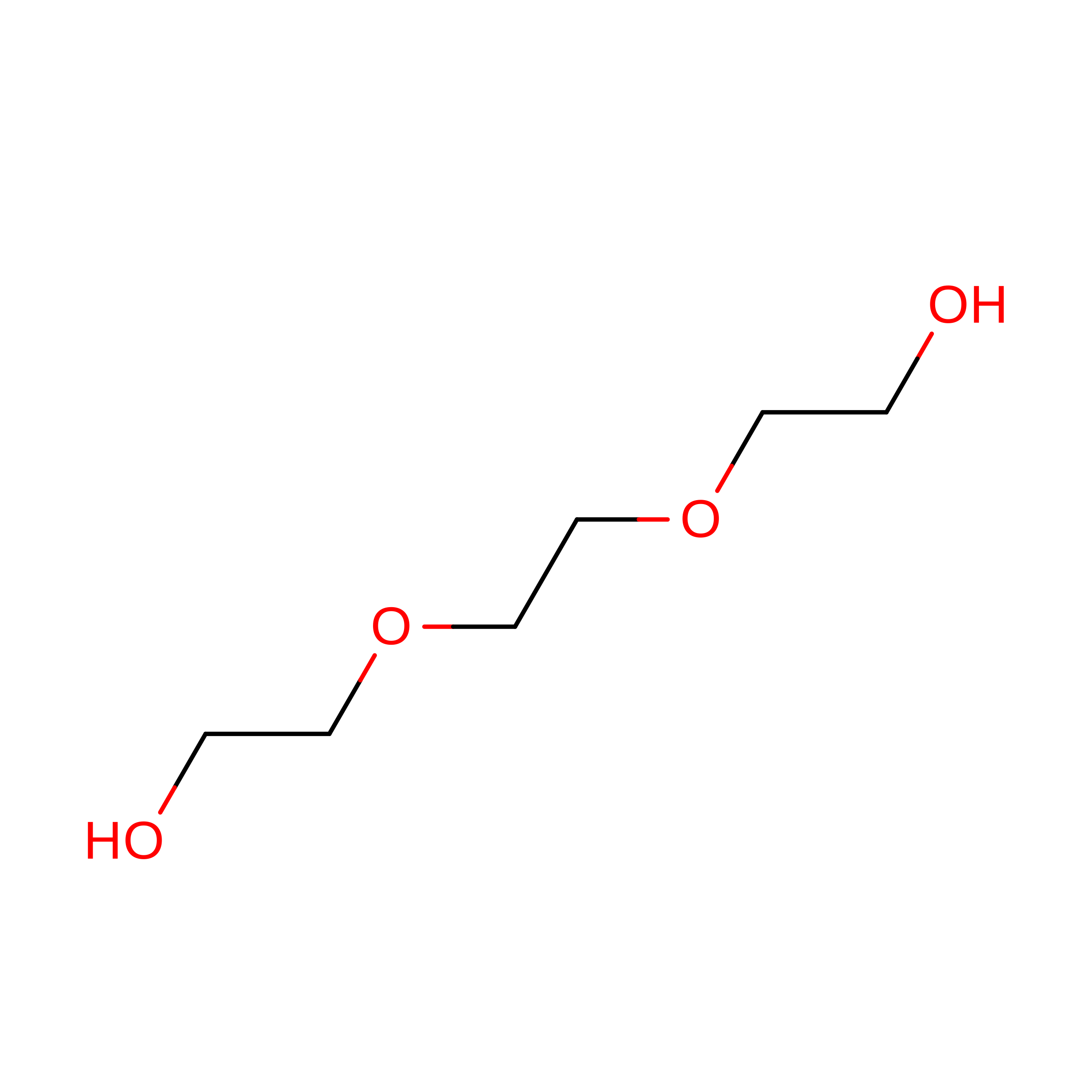
PGE
Query on PGE

Download Ideal Coordinates CCD File 
B [auth A],
C [auth A]
TRIETHYLENE GLYCOL
C6 H14 O4
ZIBGPFATKBEMQZ-UHFFFAOYSA-N
Experimental Data & Validation

Experimental Data

  • Method: X-RAY DIFFRACTION
  • Resolution: 2.10 Å
  • R-Value Free:  0.236 (Depositor), 0.236 (DCC) 
  • R-Value Work:  0.207 (Depositor), 0.206 (DCC) 
  • R-Value Observed: 0.208 (Depositor) 
Space Group: P 21 21 2
Unit Cell:
Length ( Å )Angle ( ˚ )
a = 105.27α = 90
b = 110.17β = 90
c = 36.14γ = 90
Software Package:
Software NamePurpose
PHENIXrefinement
XSCALEdata scaling
XDSdata reduction
PHASERphasing
PDB_EXTRACTdata extraction

Structure Validation

View Full Validation Report


Ligand Structure Quality Assessment 


Entry History & Funding Information

Deposition Data


Funding OrganizationLocationGrant Number
Max Planck SocietyGermany--

Revision History  (Full details and data files)

  • Version 1.0: 2025-10-01
    Type: Initial release
  • Version 1.1: 2026-01-21
    Changes: Database references