9QPR | pdb_00009qpr

Single particle cryo-EM structure of the multidrug efflux pump MdtF from Escherichia coli


Experimental Data Snapshot

  • Method: ELECTRON MICROSCOPY
  • Resolution: 3.56 Å
  • Aggregation State: PARTICLE 
  • Reconstruction Method: SINGLE PARTICLE 

Starting Model: in silico
View more details

wwPDB Validation   3D Report Full Report


This is version 1.1 of the entry. See complete history


Literature

Molecular basis for multidrug efflux by an anaerobic-associated RND transporter.

Lawrence, R.Athar, M.Uddin, M.R.Adams, C.Sousa, J.S.Durrant, O.Lellman, S.Sutton, L.Keevil, C.W.Patel, N.Prosser, C.E.McMillan, D.Zgurskaya, H.I.Vargiu, A.V.Ahdash, Z.Reading, E.

(2025) Nat Commun 16: 10601-10601

  • DOI: https://doi.org/10.1038/s41467-025-65565-7
  • Primary Citation Related Structures: 
    9QPR, 9QPS, 9QPT

  • PubMed Abstract: 

    Bacteria can resist antibiotics and toxic substances within demanding ecological settings, such as low oxygen, extreme acid, and during nutrient starvation. MdtEF, a proton motive force-driven efflux pump from the resistance-nodulation-cell division (RND) superfamily, is upregulated in these conditions but its molecular mechanism is unknown. Here, we report cryo-electron microscopy structures of Escherichia coli multidrug transporter MdtF within native-lipid nanodiscs, including a single-point mutant with an altered multidrug phenotype and associated substrate-bound form. Drug binding domain and channel conformational plasticity likely governs substrate polyspecificity, analogous to closely related, constitutively expressed counterpart, AcrB. Whereas we discover distinct transmembrane state transitions within MdtF, which create a more engaged proton relay network, altered drug transport allostery and an acid-responsive increase in efflux efficiency. Our findings provide mechanistic insights necessary to understand bacterial xenobiotic and toxin removal by MdtF and its role within nutrient-depleted and acid stress settings, as endured in the gastrointestinal tract.


  • Organizational Affiliation
    • School of Biological Sciences, University of Southampton, Southampton, UK.

Macromolecules
Find similar proteins by:  (by identity cutoff)  |  3D Structure
Entity ID: 1
MoleculeChains Sequence LengthOrganismDetailsImage
Multidrug resistance protein MdtFA [auth C],
B [auth A],
C [auth B]
1,055Escherichia coli K-12Mutation(s): 0 
Gene Names: mdtFyhiVb3514JW3482
Membrane Entity: Yes 
UniProt
Find proteins for P37637 (Escherichia coli (strain K12))
Explore P37637 
Go to UniProtKB:  P37637
Entity Groups  
Sequence Clusters30% Identity50% Identity70% Identity90% Identity95% Identity100% Identity
UniProt GroupP37637
Sequence Annotations
Expand
  • Reference Sequence
Small Molecules
Ligands 2 Unique
IDChains Name / Formula / InChI Key2D Diagram3D Interactions
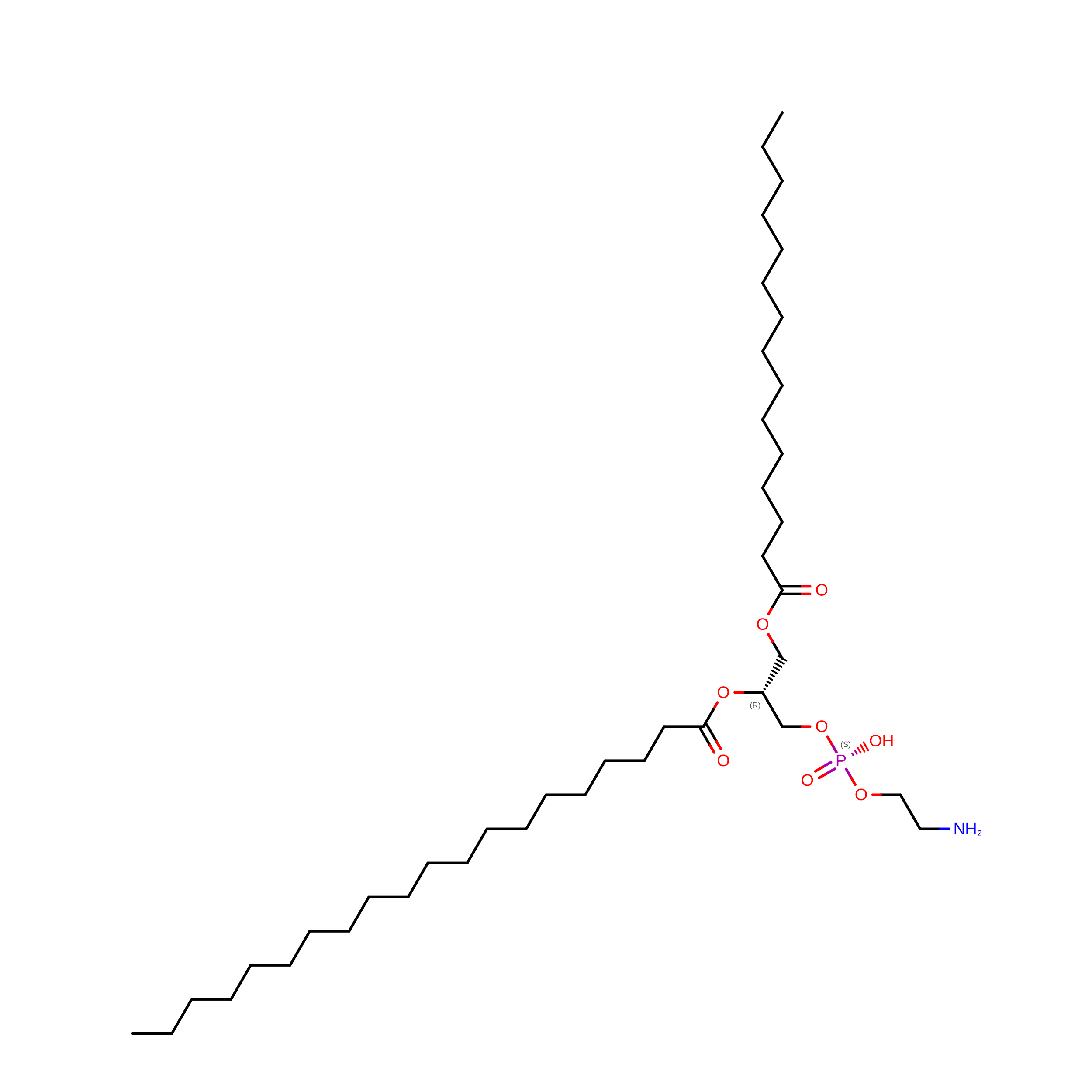
PTY
Query on PTY

Download Ideal Coordinates CCD File 
AA [auth B]
CA [auth B]
D [auth C]
DA [auth B]
E [auth C]
AA [auth B],
CA [auth B],
D [auth C],
DA [auth B],
E [auth C],
EA [auth B],
F [auth C],
G [auth C],
J [auth C],
K [auth C],
L [auth C],
M [auth A],
N [auth A],
P [auth A],
Q [auth A],
R [auth A],
S [auth A],
U [auth A],
V [auth B],
W [auth B],
X [auth B]
PHOSPHATIDYLETHANOLAMINE
C40 H80 N O8 P
NJGIRBISCGPRPF-KXQOOQHDSA-N
D12
Query on D12

Download Ideal Coordinates CCD File 
BA [auth B]
H [auth C]
I [auth C]
O [auth A]
T [auth A]
BA [auth B],
H [auth C],
I [auth C],
O [auth A],
T [auth A],
Y [auth B],
Z [auth B]
DODECANE
C12 H26
SNRUBQQJIBEYMU-UHFFFAOYSA-N
Experimental Data & Validation

Experimental Data

  • Method: ELECTRON MICROSCOPY
  • Resolution: 3.56 Å
  • Aggregation State: PARTICLE 
  • Reconstruction Method: SINGLE PARTICLE 
EM Software:
TaskSoftware PackageVersion
MODEL REFINEMENTPHENIX
RECONSTRUCTIONRELION4.0

Structure Validation

View Full Validation Report


Entry History & Funding Information

Deposition Data


Funding OrganizationLocationGrant Number
Biotechnology and Biological Sciences Research Council (BBSRC)United KingdomBB/T008709/1

Revision History  (Full details and data files)

  • Version 1.0: 2025-05-14
    Type: Initial release
  • Version 1.1: 2026-04-22
    Changes: Data collection, Database references