9QOF | pdb_00009qof

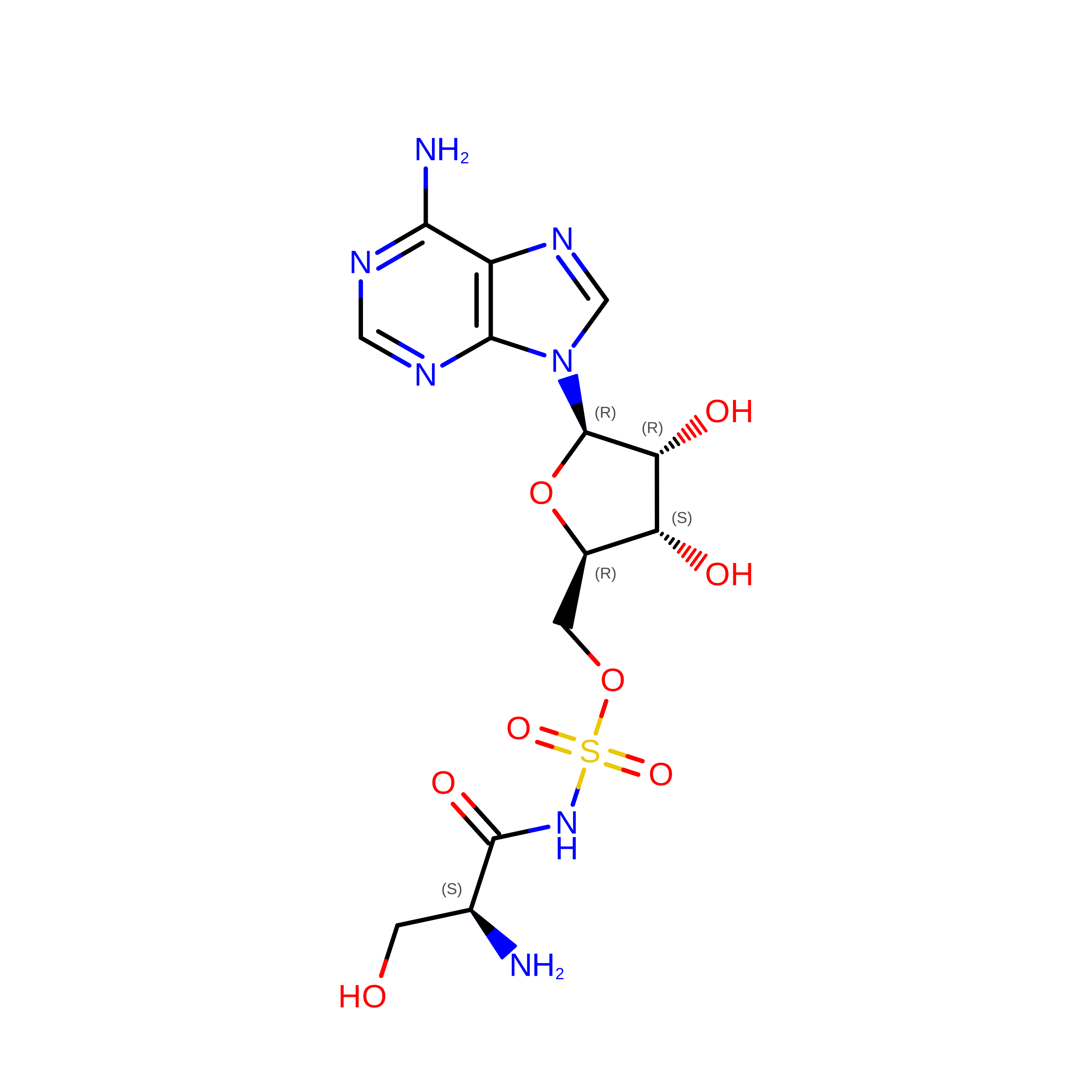
E.coli seryl-tRNA synthetase (Arm deletion mutant) bound to sulphamoyl seryl-adenylate analogue


Experimental Data Snapshot

  • Method: X-RAY DIFFRACTION
  • Resolution: 2.32 Å
  • R-Value Free: 
    0.163 (Depositor), 0.163 (DCC) 
  • R-Value Work: 
    0.130 (Depositor), 0.130 (DCC) 
  • R-Value Observed: 
    0.131 (Depositor) 

Starting Model: experimental
View more details

wwPDB Validation 3D Report Full Report

Validation slider image for 9QOF

Ligand Structure Quality Assessment 


This is version 1.0 of the entry. See complete history

Literature

Seryl-tRNA synthetase from Escherichia coli,implication of its N-terminal domain in aminoacylation activity and specificity.

Borel, F.Vincent, C.Leberman, R.Hartlein, M.

(1994) Nucleic Acids Res 22: 2963-2969

  • DOI: https://doi.org/10.1093/nar/22.15.2963
  • Primary Citation Related Structures: 
    9QOF

  • PubMed Abstract: 

    Escherichia coli seryl-tRNA synthetase (SerRS) a dimeric class II aminoacyl-tRNA synthetase with two structural domains charges specifically the five iso-acceptor tRNA(ser) as well as the tRNA(sec) (selC product) of E. coli. The N-terminal domain is a 60 A long arm-like coiled coil structure built of 2 long antiparallel a-h helices, whereas the C-terminal domain is a alpha-beta structure. A deletion of the N-terminal arm of the enzyme does not affect the amino acid activation step of the reaction, but reduces dramatically amino-acylation activity. The Kcat/Km value for the mutant enzyme is reduced by more than 4 orders of magnitude, with a nearly 30 fold increased Km value for tRNA(ser). An only slightly truncated mutant form (16 amino acids of the tip of the arm replaced by a glycine) has an intermediate aminoacylation activity. Both mutant synthetases have lost their specificity for tRNA(ser) and charge also non-cognate type 1 tRNA(s). Our results support the hypothesis that class II synthetases have evolved from an ancestral catalytic core enzyme by adding non-catalytic N-terminal or C-terminal tRNA binding (specificity) domains which act as determinants for cognate and anti-determinants for non-cognate tRNAs.


  • Organizational Affiliation
    • European Molecular Biology Laboratory, Grenoble, France.

Macromolecule Content 

  • Total Structure Weight: 83.96 kDa 
  • Atom Count: 6,128 
  • Modeled Residue Count: 727 
  • Deposited Residue Count: 736 
  • Unique protein chains: 1

Macromolecules

Find similar proteins by:|  3D Structure
Entity ID: 1
MoleculeChains  Sequence LengthOrganismDetailsImage
Serine--tRNA ligase
A, B
368Escherichia coli K-12Mutation(s): 0 
Gene Names: serSb0893JW0876
EC: 6.1.1.11
UniProt
Find proteins for P0A8L1 (Escherichia coli (strain K12))
Explore P0A8L1 
Go to UniProtKB:  P0A8L1
Entity Groups
Sequence Clusters30% Identity50% Identity70% Identity90% Identity95% Identity100% Identity
UniProt GroupP0A8L1
Sequence Annotations
Expand
Reference Sequence

Experimental Data & Validation

Experimental Data

  • Method: X-RAY DIFFRACTION
  • Resolution: 2.32 Å
  • R-Value Free:  0.163 (Depositor), 0.163 (DCC) 
  • R-Value Work:  0.130 (Depositor), 0.130 (DCC) 
  • R-Value Observed: 0.131 (Depositor) 
Space Group: C 2 2 21
Unit Cell:
Length ( Å )Angle ( ˚ )
a = 132.615α = 90
b = 92.901β = 90
c = 171.691γ = 90
Software Package:
Software NamePurpose
PHENIXrefinement
MOSFLMdata reduction
SCALAdata scaling
MOLREPphasing

Structure Validation

View Full Validation Report


Ligand Structure Quality Assessment 


Entry History 

& Funding Information

Deposition Data


Funding OrganizationLocationGrant Number
Not funded--

Revision History  (Full details and data files)

  • Version 1.0: 2025-05-14
    Type: Initial release