Download Mendeley
Fusion Protein-Assisted Crystallization of Human SUMO1.
Mishra, A., Goffinont, S., Coste, F., Cisse, E.H., Mance, L., Castaing, B., Suskiewicz, M.J.(2025) Proteins 93: 1767-1779
- PubMed: 40406964 Search on PubMed
- DOI: https://doi.org/10.1002/prot.26838
- Primary Citation Related Structures:
9Q9E - PubMed Abstract:
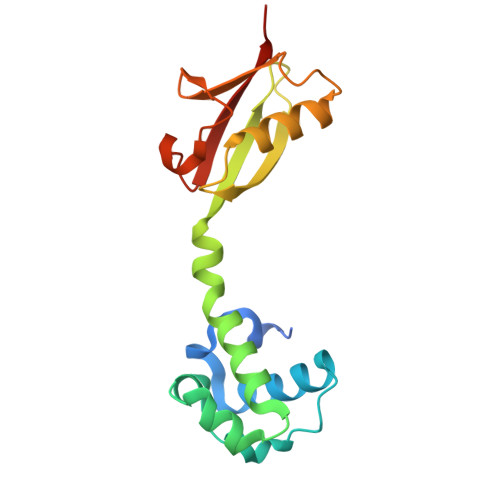
In this study, we employed a fusion protein-assisted approach to crystallize human SUMO1, an essential covalent protein modifier that also interacts noncovalently with specific linear protein motifs called SUMO-interacting motifs (SIMs). SUMO1 has been crystallized previously as part of various complexes but never in isolation. Our strategy involved fusing a variant of a known crystallization facilitator, the TELSAM domain, upstream of the folded part of the SUMO1 protein (residues 18-97). Following a simple purification strategy, we obtained a 2.05-Å crystal structure of apo TELSAM-SUMO1, with three distinct SUMO1 chains per asymmetric unit, two of which have an accessible pocket for binding to a SIM. The crystal structure is composed of the expected left-handed helical filaments formed by TELSAM domains, with protruding SUMO1 molecules mediating connections within and between these filaments to stabilize a three-dimensional lattice. Since the TELSAM fusion does not affect the SUMO:SIM interaction, as confirmed in solution, our construct may potentially be used to structurally characterize complexes formed between SUMO and SIM-containing peptides. Neither does the TELSAM fusion interfere with the attachment of SUMO1 to substrates, potentially allowing for the creation of SUMOylated protein forms with improved crystallizability. The study represents a novel application of TELSAM-assisted crystallization to a small protein of major biological relevance.
- Centre de biophysique moléculaire (CBM), UPR 4301, CNRS, Orléans, France.
Organizational Affiliation: