Download Mendeley
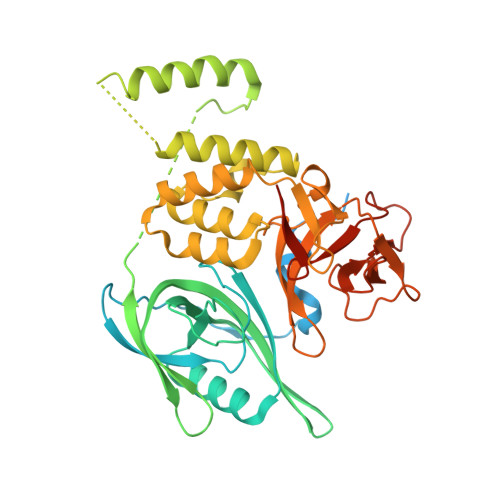
Discovery of Potent and Selective BCL6 Ligand-Directed Degrader (LDD), BCL6-760.
Shunatona, H.P., Holmberg Douglas, N., Rhodes, J., Thomas, W., Da Silva, D., Gamez, J., Groza, M., Christoforou, A., Zhu, J., Johnson, S., Dodd, D., Huang, D., Griffin, J., Miseo, G., Whitefield, B., Weiss, D., Rader, J., Kuzu, E., Leisten, J., Del Rosario, J., Shi, L., Matyskiela, M., Chamberlain, P.P., Belmont, P., Alexander, M., Zapf, C.W., Groocock, L., Mortensen, D.S.(2025) J Med Chem 68: 21502-21519
- PubMed: 41055242 Search on PubMed
- DOI: https://doi.org/10.1021/acs.jmedchem.5c01645
- Primary Citation Related Structures:
9Q03 - PubMed Abstract:
The discovery of a potent and selective BCL6 ligand-directed degrader (LDD), BCL6-760 ( 45 ) is described. Through structure-activity relationships, the most potent heterobifunctional degraders of BCL6 were found to be those containing short aminopiperidine linkers in combination with an indazole-based cereblon (CRBN)-binding moiety (CBM). In vitro ADME profiling of potent molecules identified BCL6-760 as an ideal molecule for use in in vivo experiments due to its good passive permeability, solubility, and microsomal stability. Mechanistic studies confirmed that BCL6 degradation is CRBN mediated, and proteomic assessment indicates a clean and selective degradation profile. BCL6-760 exhibited good oral mouse PK and was capable of penetrant and sustained PD effects. At 60 mg/kg BID dosing, BCL6-760 achieves >90% BCL6 reduction and leads to an overall 64% tumor volume reduction in an OCI-LY-1 mouse xenograft efficacy model.
- Bristol Myers Squibb, 10300 Campus Point Dr. Suite 100, San Diego, California 92121, United States.
Organizational Affiliation: