Download Mendeley
Enhancing enzymatic bioconjugation efficiency via installation of a substrate recruitment domain.
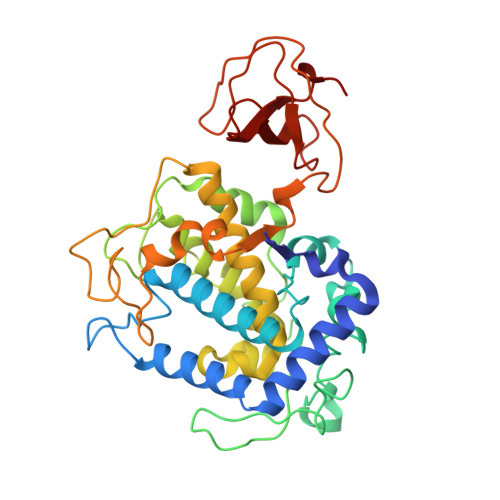
Shelby, C., Kuzelka, K.P., Ellis, J.M., Yao, Z., McCue, A.C., Park, R., Nair, S.K., Bowers, A., Kuhlman, B.(2025) bioRxiv
- PubMed: 41279480 Search on PubMedSearch on PubMed Central
- DOI: https://doi.org/10.1101/2025.10.27.684804
- Primary Citation Related Structures:
9PGZ - PubMed Abstract:
Enzyme mediated bioconjugation provides a method for easy and rapid formation of protein-protein and protein-small molecule conjugates under mild conditions. Promiscuous enzymes are of particular interest because they can catalyze conjugation reactions on a broad set of substrates. However, this promiscuity carries the risk of undesirable off-target modifications. To mitigate this effect, we used computational design to install a substrate recruitment domain (SRD) onto the promiscuous enzyme, tyrosinase. The redesigned tyrosinase, called D42, preferentially modifies tyrosine residues within the peptide core (core) linked to a 6-amino acid recognition motif/sequence (RS) specific for the SRD. Incorporation of the recognition sequence along with a neighboring tyrosine in peptides or proteins allows for rapid D42-mediated conversion of the tyrosine to an orthoquinone, which can be selectively modified with a variety of nucleophiles. We demonstrate the utility of our design system by rapidly installing cytotoxic molecules on a monoclonal antibody.