Download Mendeley
Repetitive proteins that undergo large conformational changes evade structural prediction algorithms.
Chang, M.P., Jin, T., Gudinas, A.P., Fernandez, D., Alexander-Katz, A., Matsui, T., Mai, D.J.(2025) J Chem Phys 163
- PubMed: 41379425 Search on PubMed
- DOI: https://doi.org/10.1063/5.0304777
- Primary Citation Related Structures:
9P6C - PubMed Abstract:
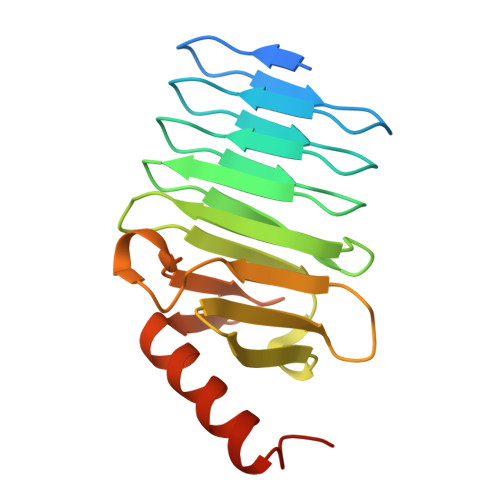
Protein structure prediction algorithms, such as AlphaFold, have accelerated protein design and advanced the understanding of the relationship between amino acid sequence and protein structure. However, these algorithms are limited in their ability to predict the structures of conformationally dynamic, intrinsically disordered, and stimuli-responsive proteins. To evaluate sequence-to-structure predictions of such challenging proteins, we explored a class of conformationally dynamic, repeats-in-toxin (RTX) proteins. RTX proteins adopt intrinsically disordered conformations in the absence of calcium and undergo reversible folding into β-roll structures upon binding to calcium. RTX proteins are characterized by tandem repeats of the sequence GGXGXDXUX, in which X can be any amino acid and U is an aliphatic amino acid. We designed RTX sequence variants with global substitutions of nonconserved amino acids, tandem repeats of consensus sequences GGAGXDTLY, and tandem repeats of scrambled sequences GGAGXDTYL. AlphaFold2 and AlphaFold3 predicted that all of these RTX variants adopt β-roll structures, characteristic of wild-type RTX bound to calcium. However, modeling the predicted structures with molecular dynamics simulations and characterizing the protein variants with circular dichroism spectroscopy, small-angle x-ray scattering, and x-ray crystallography revealed that variants adopt diverse, sequence-dependent structures in the absence and presence of calcium. To better design proteins for applications in biotechnology and sustainability, it is critical to build predictive tools that consider intrinsically disordered protein states and validate these tools with multi-mode, multi-scale experimental data.
- Department of Materials Science and Engineering, Stanford University, Stanford, California 94305, USA.
Organizational Affiliation: