Download Mendeley
Ancestral Sequence Reconstruction of the Ethylene-Forming Enzyme.
Chatterjee, S., Rankin, J.A., Farrugia, M.A., Delaney, B.J., Pascual, N.S., VanAntwerp, J., Woldring, D.R., Hu, J., Hausinger, R.P.(2025) Biochemistry 64: 3432-3445
- PubMed: 40761003 Search on PubMedSearch on PubMed Central
- DOI: https://doi.org/10.1021/acs.biochem.5c00334
- Primary Citation Related Structures:
9OVH - PubMed Abstract:
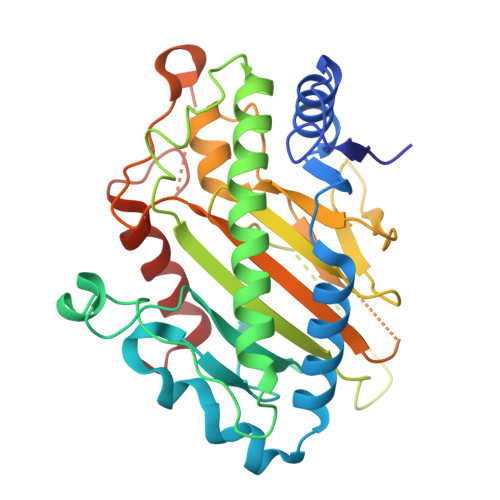
The ethylene-forming enzyme (EFE) catalyzes two main reactions: the conversion of 2-oxoglutarate (2OG) to ethylene plus CO 2 and the oxidative decarboxylation of 2OG coupled to the C5 hydroxylation of l-arginine (l-Arg). EFE also facilitates two minor reactions: the uncoupled oxidative decarboxylation of 2OG and the generation of 3-hydroxypropionate (3HP) from 2OG. To better understand the evolution of this enzyme's diverse activities, we demonstrated that two distantly related extant enzymes produce trace levels of ethylene and 3HP, and we examined the reactivities of 11 reconstructed ancestors. The structure of one ancestral protein was resolved by X-ray crystallography, while the others were modeled with AlphaFold2. These studies highlight the importance of residues located at the 2OG and l-Arg binding pockets for the varied activities. For example, effective formation of ethylene requires that the 2OG binding pocket be hydrophobic except for interactions with the substrate carboxylates. Newly identified changes near the l-Arg binding site exhibit significant effects on the reactivities of the enzyme's reactions. Analysis of the reconstructed ancestors suggests that the primordial enzyme exhibited both ethylene-forming and l-Arg hydroxylation activities with partition ratios like the extant examples; i.e., an enzyme capable of catalyzing predominantly one of these reactions did not subsequently develop the ability to affect the secondary reaction.
- Department of Microbiology, Genetics, and Immunology, Michigan State University, East Lansing, Michigan 48824, United States.
Organizational Affiliation: