Download Mendeley
The Discovery of RP-2119: A Potent, Selective, and Orally Bioavailable Pol theta ATPase Inhibitor.
Mochirian, P., Papp, R., Mathieu, M.C., Ferraro, G.B., Dietrich, E., Liu, B., Bendahan, D., Perryman, A.L., Surprenant, S., Fournier, S., Barzili, B.L., Bonneau-Fortin, A., Yin, S.Y., Leclaire, M.E., Patel, C., Poirier, H., Save, S., Mathieu, Y., Morin, N., Godbout, C., Burston, H.E., Zahn, K.E., Attia, M.A., Pinter, T., Barabe, F., Parikh, P., Jagani, C., Kang, G., Scapin, G., Mamane, Y., Sfeir, A., Mader, P., Sicheri, F., Zimmermann, M., Roulston, A., Morris, S.J., Black, W.C., Gallant, M.(2025) J Med Chem 68: 19726-19745
- PubMed: 40920169 Search on PubMed
- DOI: https://doi.org/10.1021/acs.jmedchem.5c02103
- Primary Citation Related Structures:
9OSW, 9OSY - PubMed Abstract:
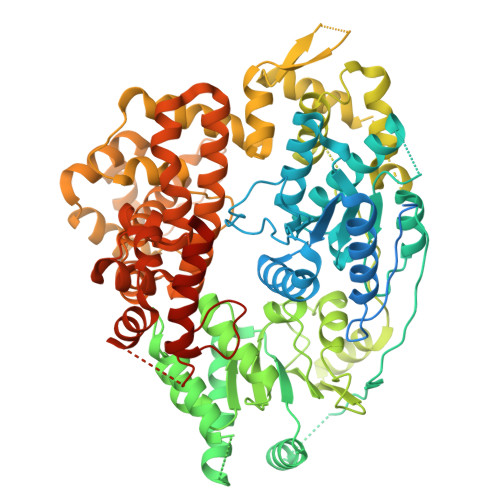
DNA polymerase theta (Polθ) plays a critical role in repairing DNA double-strand breaks through microhomology-mediated end joining (MMEJ) and has emerged as a key synthetic lethal drug target in cancers with homologous recombination (HR) deficiencies. Its inhibition has shown a strong potential to synergize with PARP inhibitors, particularly in tumors with deleterious BRCA1 or BRCA2 mutations. Here, we describe the discovery and preclinical development of RP-2119, a selective, potent, and bioavailable Polθ ATPase inhibitor. Starting from a high-throughput ATPase screen combined with literature insights, key vectors for enhancing potency were identified by structural studies using single-particle cryo-electron microscopy (cryo-EM) that revealed the inhibitor binding site. Further optimization of potency and ADME properties led to the identification of RP-2119 with robust in vitro cellular activity in a wide range of HR-deficient cancer cell lines. In HR-deficient cell line- and patient-derived mouse xenografts, RP-2119 demonstrated strong synergy with the PARP inhibitor, olaparib, without exacerbating its hematological toxicity.
- Repare Therapeutics, 7171 Frederick-Banting, Building 2, H4S 1Z9 Montréal, Québec, Canada.
Organizational Affiliation: