Download Mendeley
Nickel Binding to the c-Src SH3 Domain Facilitates Crystallization.
Calicdan, X., Fisher, O.S., Ha, B.H., Boggon, T.J., Stiegler, A.L.(2025) Protein Pept Lett 32: 679-692
- PubMed: 41088944 Search on PubMedSearch on PubMed Central
- DOI: https://doi.org/10.2174/0109298665417324250929120040
- Primary Citation Related Structures:
9OFX - PubMed Abstract:
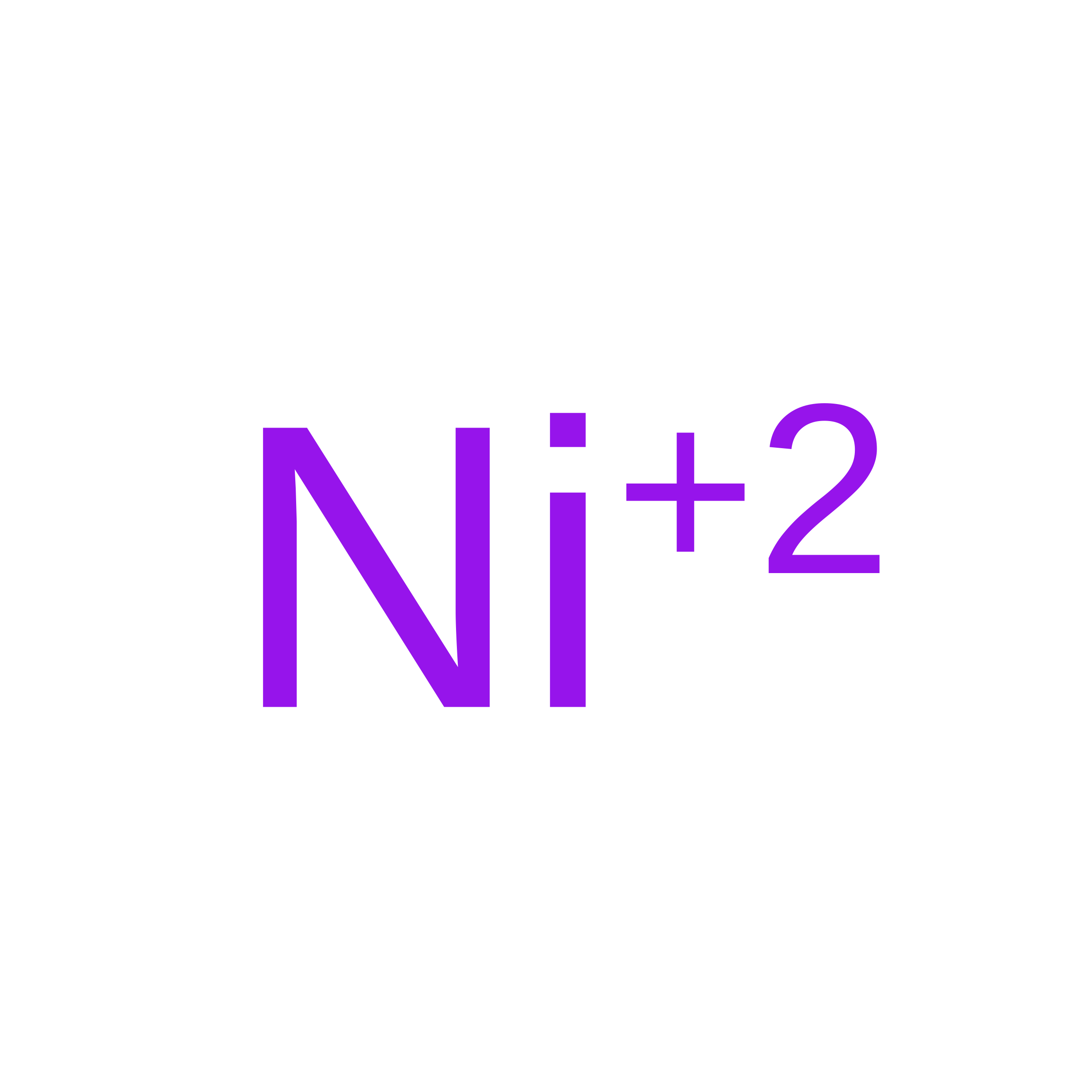
Numerous X-ray crystal structures of the c-Src SH3 domain have provided a large sampling of atomic-level information for this important signaling domain. Multiple crystal forms have been reported, with variable crystal lattice contacts and chemical crystallization conditions. We crystallized the c-Src SH3 domain in a crystallization buffer containing NiCl 2 . A unique crystal structure of the Src SH3 domain in the trigonal space group H32 is determined to 1.45 Å resolution. Crystal packing and anomalous scattering reveal that this crystal form is mediated by two ordered nickel ions provided by the crystallization buffer. Nickel coordination occurs in a 2:2 stoichiometry, which dimerizes two SH3 domain monomers across a pseudo-twofold rotation axis and involves the native N-terminal c-Src SH3 amino acid sequence, a surface-exposed histidine residue, and ordered water molecules. This study provides an example of metal-mediated crystallization and metal binding by N-terminal protein residues, contrasting with the Amino-Terminal Copper and Nickel Binding (ATCUN) motif. Alternative avenues help widen the potential for future crystallography-based studies of the c-Src SH3 domain.
- Department of Molecular, Cellular and Developmental Biology, Yale University, New Haven, CT, USA.
Organizational Affiliation: