Download Mendeley
K294E change in the rotavirus factory forming protein NSP2 stabilizes a rare C-terminal conformation.
Nichols, S.L., Hollis, T., Salsbury, F.R., Esstman, S.M.(2026) J Biomol Struct Dyn 44: 4422-4438
- PubMed: 40999894 Search on PubMed
- DOI: https://doi.org/10.1080/07391102.2025.2563689
- Primary Citation Related Structures:
9OFT, 9OGQ - PubMed Abstract:
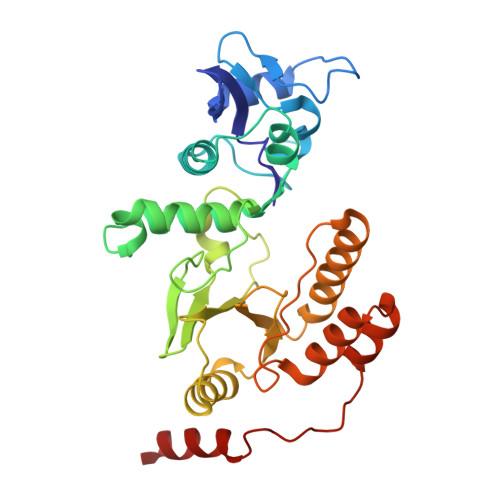
Rotaviruses (RVs) induce the formation of cytoplasmic viral factories, termed viroplasms, which are the sites of early particle assembly and viral RNA synthesis. The RV octameric nonstructural protein 2 (NSP2) plays critical, albeit incompletely understood, roles during viroplasm biogenesis. Previous work by our lab demonstrated that a RV bearing a lysine-to-glutamic acid (K294E) change in the flexible C-terminus of NSP2 exhibits defects in viral replication and induces smaller, more numerous viroplasms as compared to the wildtype (WT) virus. In this study, we sought to better understand if/how this K294E amino acid change altered the structure and/or dynamics of the NSP2 protein. We first determined the X-ray crystal structures of untagged, recombinant NSP2 K294E and NSP2 WT . We found that both proteins formed highly similar octamers and crystallized in the I422 space group. To better understand the possible impacts of the K294E change on the conformations and backbone flexibility of NSP2, we performed molecular dynamics simulations. The results showed that NSP2 K294E adopted distinct C-terminal conformations relative to NSP2 WT and had subtle flexibility differences. Most notably, the data suggest that the K294E change stabilized a rare C-terminal conformation that was only infrequently sampled by NSP2 WT . This shift in conformational preference may help explain why NSP2 K294E displayed decreased capacity to mediate robust viroplasm formation during RV infection. These results provide mechanistic insights into how a single amino acid change in the NSP2 C-terminus can have large effects on structural ensemble, shedding light on features of the protein that underpin RV viroplasm formation.
- Department of Biology, Wake Forest University, Winston-Salem, NC, USA.
Organizational Affiliation: