9ODW | pdb_00009odw

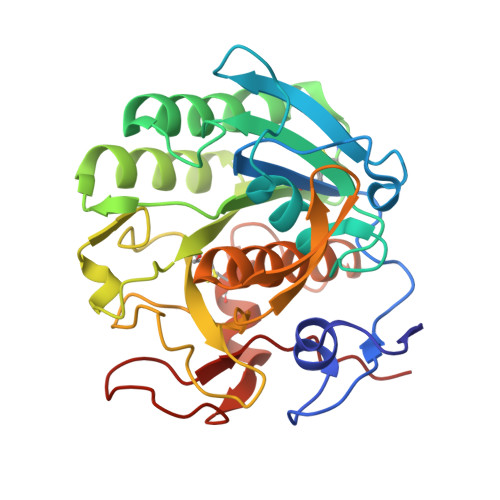
MicroED structure of proteinase K with energy filtering

  • Classification: HYDROLASE
  • Organism(s): Parengyodontium album
  • Expression System: Parengyodontium album
  • Mutation(s): No 

  • Deposited: 2025-04-28 Released: 2025-05-28 
  • Deposition Author(s): Clabbers, M.T.B., Gonen, T.
  • Funding Organization(s): National Institutes of Health/National Institute of General Medical Sciences (NIH/NIGMS), Department of Defense (DOD, United States), Howard Hughes Medical Institute (HHMI)

Experimental Data Snapshot

  • Method: ELECTRON CRYSTALLOGRAPHY
  • Resolution: 1.30 Å
  • R-Value Free: 
    0.228 (Depositor) 
  • R-Value Work: 
    0.189 (Depositor) 
  • R-Value Observed: 
    0.191 (Depositor) 

Starting Model: experimental
View more details

wwPDB Validation   3D Report Full Report


This is version 1.0 of the entry. See complete history


Literature

Recovering high-resolution information using energy filtering in MicroED.

Clabbers, M.T.B.Gonen, T.

(2025) Struct Dyn 12: 034702-034702

  • DOI: https://doi.org/10.1063/4.0000755
  • Primary Citation of Related Structures:  
    9ODV, 9ODW

  • PubMed Abstract: 

    Inelastic scattering poses a significant challenge in electron crystallography by elevating background noise and broadening Bragg peaks, thereby reducing the overall signal-to-noise ratio. This is particularly detrimental to data quality in structural biology, as the diffraction signal is relatively weak. These effects are aggravated even further by the decay of the diffracted intensities as a result of accumulated radiation damage, and rapidly fading high-resolution information can disappear beneath the noise. Loss of high-resolution reflections can partly be mitigated using energy filtering, which removes inelastically scattered electrons and improves data quality and resolution. Here, we systematically compared unfiltered and energy-filtered microcrystal electron diffraction data from proteinase K crystals, first collecting an unfiltered dataset followed directly by a second sweep using the same settings but with the energy filter inserted. Our results show that energy filtering consistently reduces noise, sharpens Bragg peaks, and extends high-resolution information, even though the absorbed dose was doubled for the second pass. Importantly, our results demonstrate that high-resolution information can be recovered by inserting the energy filter slit. Energy-filtered datasets showed improved intensity statistics and better internal consistency, highlighting the effectiveness of energy filtering for improving data quality. These findings underscore its potential to overcome limitations in macromolecular electron crystallography, enabling higher-resolution structures with greater reliability.


Macromolecules
Find similar proteins by:  (by identity cutoff)  |  3D Structure
Entity ID: 1
MoleculeChains Sequence LengthOrganismDetailsImage
Proteinase K279Parengyodontium albumMutation(s): 0 
Gene Names: PROK
EC: 3.4.21.64
UniProt
Find proteins for P06873 (Parengyodontium album)
Explore P06873 
Go to UniProtKB:  P06873
Entity Groups  
Sequence Clusters30% Identity50% Identity70% Identity90% Identity95% Identity100% Identity
UniProt GroupP06873
Sequence Annotations
Expand
  • Reference Sequence
Experimental Data & Validation

Experimental Data

  • Method: ELECTRON CRYSTALLOGRAPHY
  • Resolution: 1.30 Å
  • R-Value Free:  0.228 (Depositor) 
  • R-Value Work:  0.189 (Depositor) 
  • R-Value Observed: 0.191 (Depositor) 
Space Group: P 43 21 2
Unit Cell:
Length ( Å )Angle ( ˚ )
a = 67.64α = 90
b = 67.64β = 90
c = 106.67γ = 90
EM Software:
TaskSoftware PackageVersion
MODEL REFINEMENTPHENIX1.21.1
RECONSTRUCTIONPHENIX1.21.1

Structure Validation

View Full Validation Report


Entry History & Funding Information

Deposition Data


Funding OrganizationLocationGrant Number
National Institutes of Health/National Institute of General Medical Sciences (NIH/NIGMS)United StatesP41GM136508
Department of Defense (DOD, United States)United StatesHDTRA1-21-1-0004
Howard Hughes Medical Institute (HHMI)United States--

Revision History  (Full details and data files)

  • Version 1.0: 2025-05-28
    Type: Initial release