9NS5 | pdb_00009ns5

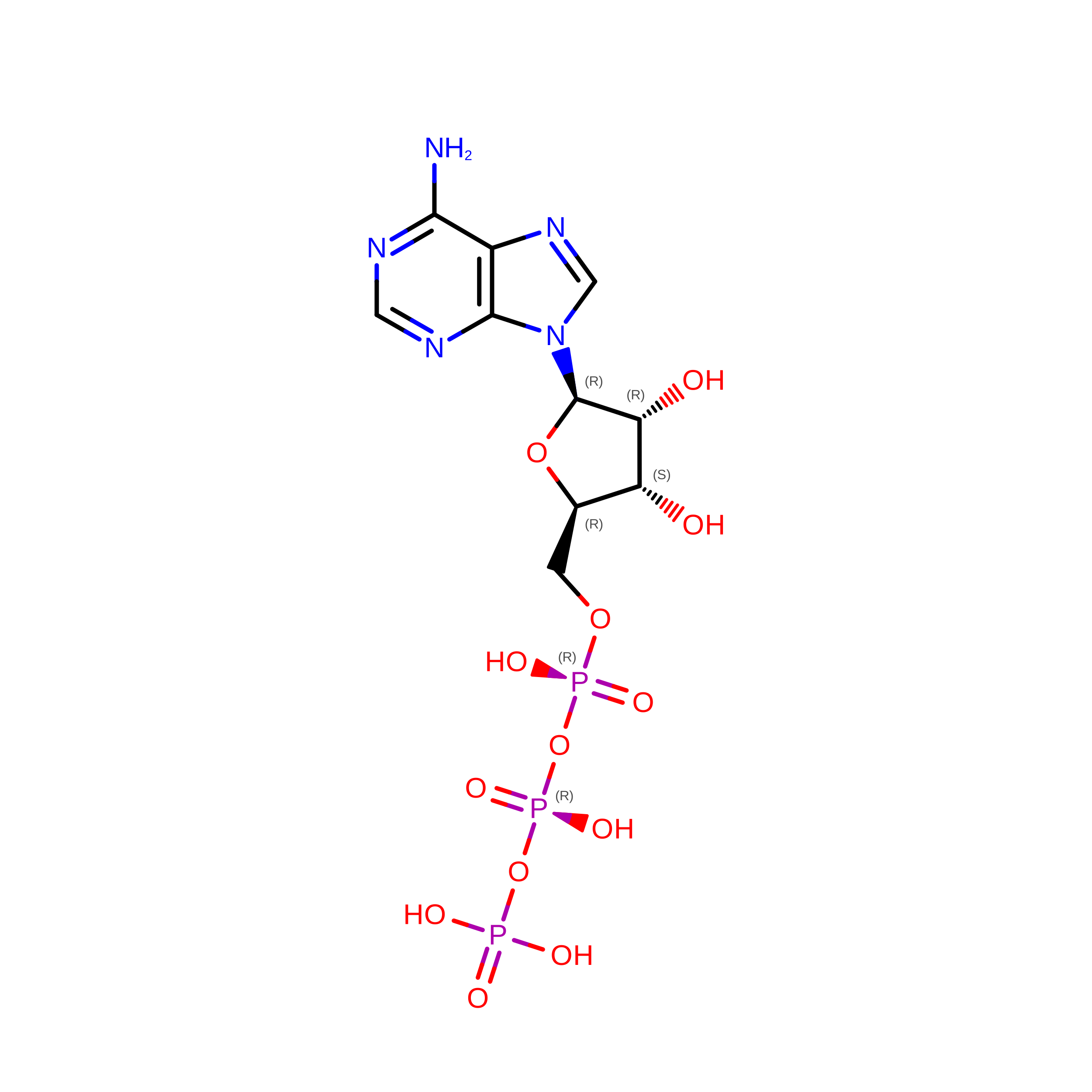
Get3(D57N)-Get4/5 Complex (ATP-bound)


Experimental Data Snapshot

  • Method: ELECTRON MICROSCOPY
  • Resolution: 3.19 Å
  • Aggregation State: PARTICLE 
  • Reconstruction Method: SINGLE PARTICLE 

wwPDB Validation   3D Report Full Report


This is version 1.1 of the entry. See complete history


Literature

Get4/5-mediated remodeling of Get3's substrate-binding chamber: Insights into tail-anchored protein targeting by the GET pathway.

Granados-Villanueva, D.Rossow, A.Kim, K.H.

(2025) J Biological Chem 301: 110667-110667

  • DOI: https://doi.org/10.1016/j.jbc.2025.110667
  • Primary Citation of Related Structures:  
    9NS5

  • PubMed Abstract: 

    The Guided Entry of Tail-Anchored Proteins (GET) pathway ensures accurate targeting of Tail-Anchored proteins (TAs) - a diverse class of membrane proteins - to the endoplasmic reticulum (ER) membrane. In yeast, newly synthesized TAs are captured by Sgt2 and transferred to Get3 for delivery to the ER, where they undergo subsequent membrane insertion. Efficient and protected handoff of hydrophobic TAs from Sgt2 to Get3 is facilitated by the Get4/5 complex, which is thought to act as a scaffold to position TA-bound Sgt2 and Get3 in proximity while trapping Get3 in an ATP-bound conformation necessary for TA binding. To define the molecular basis for this process, we determined the cryo-EM structure of the Saccharomyces cerevisiae Get3-Get4/5 complex at 3.2 Å resolution. Our structure shows that Get4/5 remodels Get3's TA-binding chamber by unfolding helices that form the lateral walls of the chamber. We termed this region the 'lateral gate', as its helix-to-coil transition makes the TA-binding chamber more solvent accessible. Molecular dynamics simulations highlighted the flexibility of the lateral gate, indicating it is structurally dynamic and prone to conformational changes. Mutagenesis studies showed that the lateral gate residues influence both the binding affinity of Get3 for Get4/5 and its ATPase activity. Additionally, our cryo-EM map shows that the Sgt2-binding domain of Get5 is positioned near the lateral gate opening of Get3's TA-binding chamber. Based on these findings, we propose a model in which Get4/5 opens Get3's TA-binding chamber to form a lateral opening, enabling protected, lateral transfer of TAs from Sgt2 to Get3.


  • Organizational Affiliation
    • Department of Biochemistry and Molecular Biology, Michigan State University, East Lansing, MI 48824, USA.

Macromolecules
Find similar proteins by:  (by identity cutoff)  |  3D Structure
Entity ID: 1
MoleculeChains Sequence LengthOrganismDetailsImage
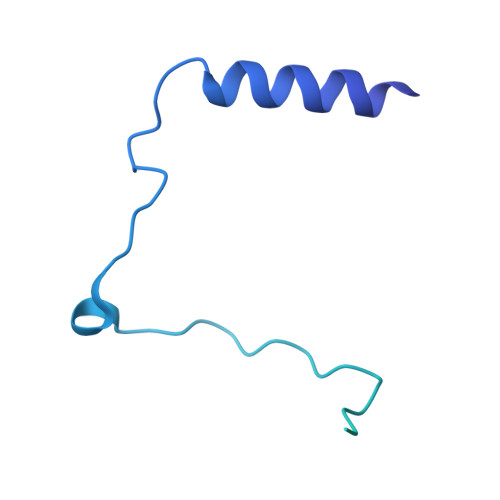
Ubiquitin-like protein MDY2A [auth C],
B [auth F]
212Saccharomyces cerevisiae S288CMutation(s): 0 
Gene Names: MDY2GET5TMA24YOL111C
UniProt
Find proteins for Q12285 (Saccharomyces cerevisiae (strain ATCC 204508 / S288c))
Explore Q12285 
Go to UniProtKB:  Q12285
Entity Groups  
Sequence Clusters30% Identity50% Identity70% Identity90% Identity95% Identity100% Identity
UniProt GroupQ12285
Sequence Annotations
Expand
  • Reference Sequence
Find similar proteins by:  (by identity cutoff)  |  3D Structure
Entity ID: 2
MoleculeChains Sequence LengthOrganismDetailsImage
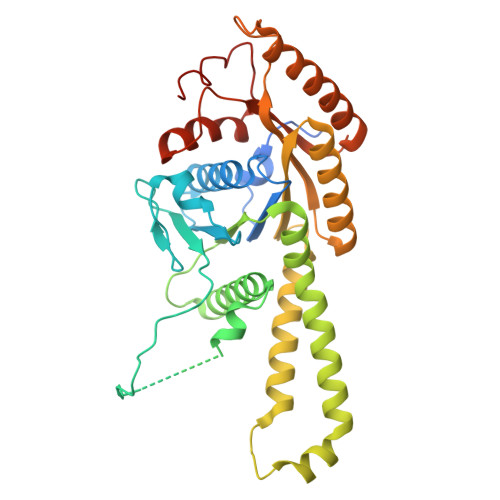
ATPase GET3C [auth A],
E [auth D]
376Saccharomyces cerevisiae S288CMutation(s): 1 
Gene Names: GET3ARR4YDL100CD2371
EC: 3.6
UniProt
Find proteins for Q12154 (Saccharomyces cerevisiae (strain ATCC 204508 / S288c))
Explore Q12154 
Go to UniProtKB:  Q12154
Entity Groups  
Sequence Clusters30% Identity50% Identity70% Identity90% Identity95% Identity100% Identity
UniProt GroupQ12154
Sequence Annotations
Expand
  • Reference Sequence
Find similar proteins by:  (by identity cutoff)  |  3D Structure
Entity ID: 3
MoleculeChains Sequence LengthOrganismDetailsImage
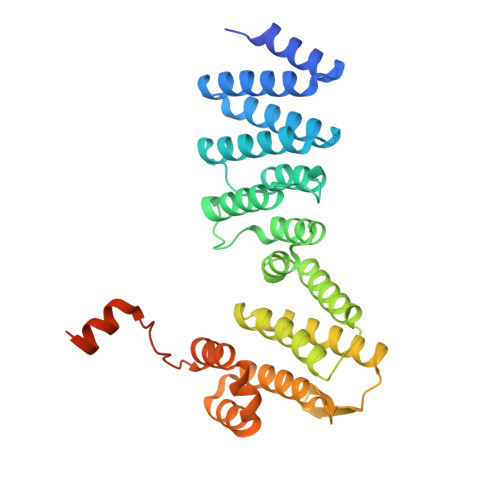
Golgi to ER traffic protein 4D [auth B],
F [auth E]
334Saccharomyces cerevisiae S288CMutation(s): 0 
Gene Names: GET4YOR164CO3580
UniProt
Find proteins for Q12125 (Saccharomyces cerevisiae (strain ATCC 204508 / S288c))
Explore Q12125 
Go to UniProtKB:  Q12125
Entity Groups  
Sequence Clusters30% Identity50% Identity70% Identity90% Identity95% Identity100% Identity
UniProt GroupQ12125
Sequence Annotations
Expand
  • Reference Sequence
Experimental Data & Validation

Experimental Data

  • Method: ELECTRON MICROSCOPY
  • Resolution: 3.19 Å
  • Aggregation State: PARTICLE 
  • Reconstruction Method: SINGLE PARTICLE 

Structure Validation

View Full Validation Report


Entry History & Funding Information

Deposition Data


Funding OrganizationLocationGrant Number
National Institutes of Health/National Institute of General Medical Sciences (NIH/NIGMS)United States--

Revision History  (Full details and data files)

  • Version 1.0: 2025-09-24
    Type: Initial release
  • Version 1.1: 2025-10-08
    Changes: Data collection, Database references