Download Mendeley
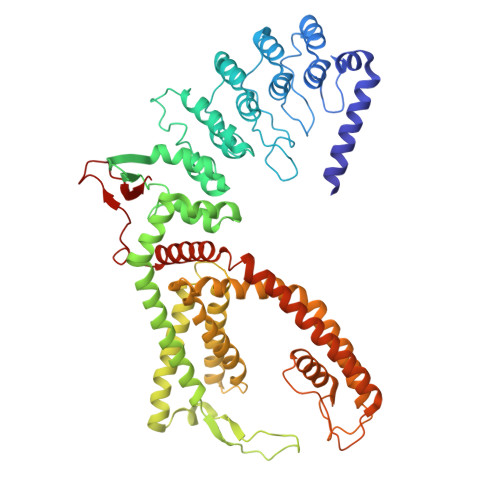
The locking mechanism of human TRPV6 inhibition by intracellular magnesium.
Neuberger, A., Shalygin, A., Veretenenko, I.I., Trofimov, Y.A., Gudermann, T., Chubanov, V., Efremov, R.G., Sobolevsky, A.I.(2025) Nat Commun 16: 9826-9826
- PubMed: 41198662 Search on PubMedSearch on PubMed Central
- DOI: https://doi.org/10.1038/s41467-025-65919-1
- Primary Citation Related Structures:
9NQ9 - PubMed Abstract:
TRPV6 is a member of the vanilloid subfamily of transient receptor potential channels, which serves as the master regulator of Ca 2+ homeostasis. TRPV6 functions as a constitutively active Ca 2+ channel, and emerging evidence indicates that its overactivity underpins the progression of several human diseases, including cancer. Hence, there is a pressing need to identify TRPV6 inhibitors in conjunction with a deep mechanistic understanding of their effects on the channel activity. Here we combine cryo-electron microscopy, mutagenesis, electrophysiology and molecular dynamics modeling to decipher the molecular mechanism of TRPV6 inhibition by intracellular Mg 2+ . Mg 2+ appears to bind to four, one per subunit, sites around the intracellular entrance to the TRPV6 channel pore, contributed by the negatively charged residues, D489 in the transmembrane helix S5 and D580 in S6. When bound to the D489-D580 site, Mg 2+ prevents the α-to-π transition in the middle of S6 that accompanies channel opening, thus maintaining S6 entirely α-helical, locking the channel in the closed state and inhibiting TRPV6-mediated currents. Further exploration of this inhibitory mechanism may help to develop future strategies for the treatment of TRPV6-associated diseases.
- Department of Biochemistry and Molecular Biophysics, Columbia University, New York, NY, USA.
Organizational Affiliation: