9NNK | pdb_00009nnk

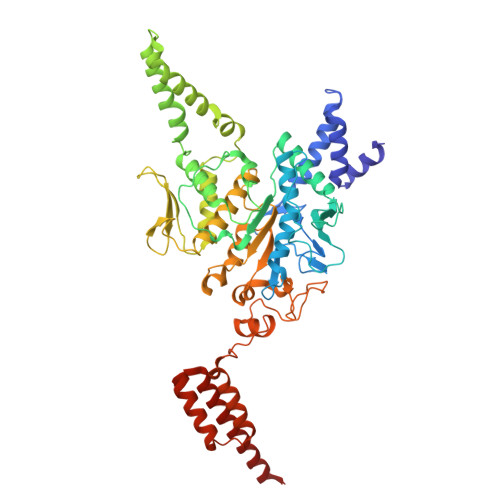
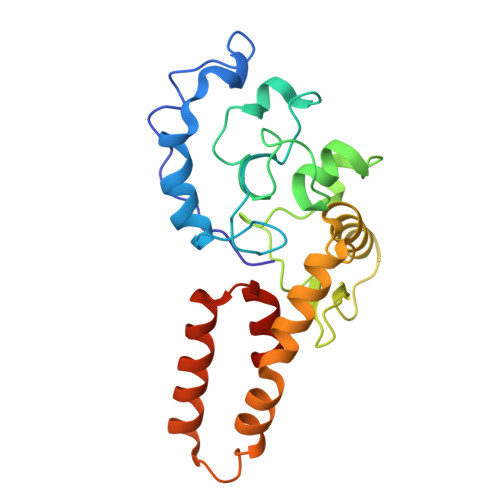
Cryo-EM structure of Retron-displaced free PtuAB complex, PtuA:PtuB (4:2)

  • Classification: TOXIN
  • Organism(s): Escherichia coli
  • Expression System: Escherichia coli
  • Mutation(s): No 

  • Deposited: 2025-03-05 Released: 2025-10-08 
  • Deposition Author(s): Wang, B., Li, H.
  • Funding Organization(s): National Institutes of Health/National Institute of General Medical Sciences (NIH/NIGMS)

Experimental Data Snapshot

  • Method: ELECTRON MICROSCOPY
  • Resolution: 3.15 Å
  • Aggregation State: PARTICLE 
  • Reconstruction Method: SINGLE PARTICLE 

wwPDB Validation   3D Report Full Report


This is version 1.2 of the entry. See complete history


Literature

Structural basis for retron co-option of anti-phage ATPase-nuclease.

Wang, B.Hoffman, R.D.Hou, Y.M.Li, H.

(2025) Nat Struct Mol Biol 

  • DOI: https://doi.org/10.1038/s41594-025-01702-6
  • Primary Citation of Related Structures:  
    9NNB, 9NNH, 9NNK

  • PubMed Abstract: 

    Retrons have been recently identified as bacterial defense systems that employ a tripartite of reverse transcriptase, non-coding RNA (ncRNA) and its derived multi-copy single stranded DNA (msDNA) to sequester effector activity. Phage invasion activates retrons, triggering effector activity and inducing abortive infection and cell growth arrest. Ec78 differs from other retrons by leveraging the Septu defense system, a stand-alone ATPase-nuclease pair (PtuAB), by reshaping the phage sensing and molecular assembly processes of PtuAB. To elucidate how Ec78 hijacks PtuAB, we determined electron cryomicroscopy structures of Ec78 as well as the retron-displaced PtuAB. We show that the Ec78-associated ATPase, PtuA, acquired unique elements that enable its interactions with the reverse transcriptase and the msDNA, and self-assembly when displaced by the retron. By biochemical and mutational analyses, we also show that the retron-displaced PtuAB forms a tetramer, unlike its stand-alone counterpart, that restricts the host. However, in the presence of the retron, the retron-displaced PtuAB confers a well-controlled immune response, eliciting ATP hydrolysis- and msDNA-regulated targeting to host factors. Our studies reveal an evolutionary principle for retrons to co-opt conserved enzyme modules for defense in response to different cellular needs.


  • Organizational Affiliation
    • Department of Structural Biology, Van Andel Institute, Grand Rapids, MI, USA.

Macromolecules
Find similar proteins by:  (by identity cutoff)  |  3D Structure
Entity ID: 1
MoleculeChains Sequence LengthOrganismDetailsImage
Retreon I-A effector PtuAA [auth C],
B [auth D],
D [auth E],
E [auth F]
550Escherichia coliMutation(s): 0 
Gene Names: Ga0100609_101823
UniProt
Find proteins for P0DV91 (Escherichia coli)
Explore P0DV91 
Go to UniProtKB:  P0DV91
Entity Groups  
Sequence Clusters30% Identity50% Identity70% Identity90% Identity95% Identity100% Identity
UniProt GroupP0DV91
Sequence Annotations
Expand
  • Reference Sequence
Find similar proteins by:  (by identity cutoff)  |  3D Structure
Entity ID: 2
MoleculeChains Sequence LengthOrganismDetailsImage
Retron I-A effector PtuBC [auth J],
F [auth K]
216Escherichia coliMutation(s): 0 
Gene Names: Ga0100609_101824
UniProt
Find proteins for P0DV92 (Escherichia coli)
Explore P0DV92 
Go to UniProtKB:  P0DV92
Entity Groups  
Sequence Clusters30% Identity50% Identity70% Identity90% Identity95% Identity100% Identity
UniProt GroupP0DV92
Sequence Annotations
Expand
  • Reference Sequence
Experimental Data & Validation

Experimental Data

  • Method: ELECTRON MICROSCOPY
  • Resolution: 3.15 Å
  • Aggregation State: PARTICLE 
  • Reconstruction Method: SINGLE PARTICLE 
EM Software:
TaskSoftware PackageVersion
RECONSTRUCTIONcryoSPARC
MODEL REFINEMENTPHENIX1.20.1_4487

Structure Validation

View Full Validation Report


Entry History & Funding Information

Deposition Data


Funding OrganizationLocationGrant Number
National Institutes of Health/National Institute of General Medical Sciences (NIH/NIGMS)United StatesR35

Revision History  (Full details and data files)

  • Version 1.0: 2025-10-08
    Type: Initial release
  • Version 1.1: 2025-11-05
    Changes: Data collection, Database references
  • Version 1.2: 2025-11-12
    Changes: Data collection, Database references