9NJK | pdb_00009njk

The Cryo-EM structure of the yeast Rad51-ssDNA nucleoprotein filament ADP bound state


Experimental Data Snapshot

  • Method: ELECTRON MICROSCOPY
  • Resolution: 3.37 Å
  • Aggregation State: FILAMENT 
  • Reconstruction Method: SINGLE PARTICLE 

wwPDB Validation   3D Report Full Report


This is version 2.1 of the entry. See complete history


Literature

ATP hydrolysis-driven structural transitions within the Saccharomyces cerevisiae Rad51 and Dmc1 nucleoprotein filaments.

Shin, Y.Kim, S.Y.Greene, E.C.

(2025) J Biological Chem 301: 110528-110528

  • DOI: https://doi.org/10.1016/j.jbc.2025.110528
  • Primary Citation of Related Structures:  
    9NJK, 9NJR

  • PubMed Abstract: 

    Homologous recombination (HR) is essential for the maintenance of genome stability and for generating genetic diversity during meiosis. The eukaryotic protein Rad51 is member of the Rad51/RecA family of DNA recombinases and is responsible for guiding the DNA pairing reactions that take place in HR during mitosis. Dmc1 is a meiosis-specific paralog of Rad51 and is responsible for the DNA pairing reactions that take place in HR during meiosis. Rad51 and Dmc1 are both ATP-dependent DNA-binding proteins and both form extended helical filaments on ssDNA, which are key intermediates in HR. The stability of these nucleoprotein filaments is highly regulated and is also tightly coupled to nucleotide binding and hydrolysis. ATP binding promotes filament assembly, whereas the hydrolysis of ATP to ADP reduces filament stability to promote filament disassembly. Here, we present cryo-EM structures of the Saccharomyces cerevisiae recombinases Rad51 and Dmc1 in the ADP-bound states and provide a detailed structural comparison to the ATP-bound filaments. Our findings yield insights into the structural transitions that take place during the hydrolysis of ATP to ADP and suggest a new model for how these structural changes may be linked to nucleoprotein filament disassembly.


  • Organizational Affiliation
    • Department of Biochemistry & Molecular Biophysics, Columbia University Irving Medical Center, New York, New York, USA.

Macromolecules
Find similar proteins by:  (by identity cutoff)  |  3D Structure
Entity ID: 1
MoleculeChains Sequence LengthOrganismDetailsImage
DNA repair protein RAD51400Saccharomyces cerevisiaeMutation(s): 0 
Gene Names: RAD51YER095W
UniProt
Find proteins for P25454 (Saccharomyces cerevisiae (strain ATCC 204508 / S288c))
Explore P25454 
Go to UniProtKB:  P25454
Entity Groups  
Sequence Clusters30% Identity50% Identity70% Identity90% Identity95% Identity100% Identity
UniProt GroupP25454
Sequence Annotations
Expand
  • Reference Sequence
Small Molecules
Ligands 2 Unique
IDChains Name / Formula / InChI Key2D Diagram3D Interactions
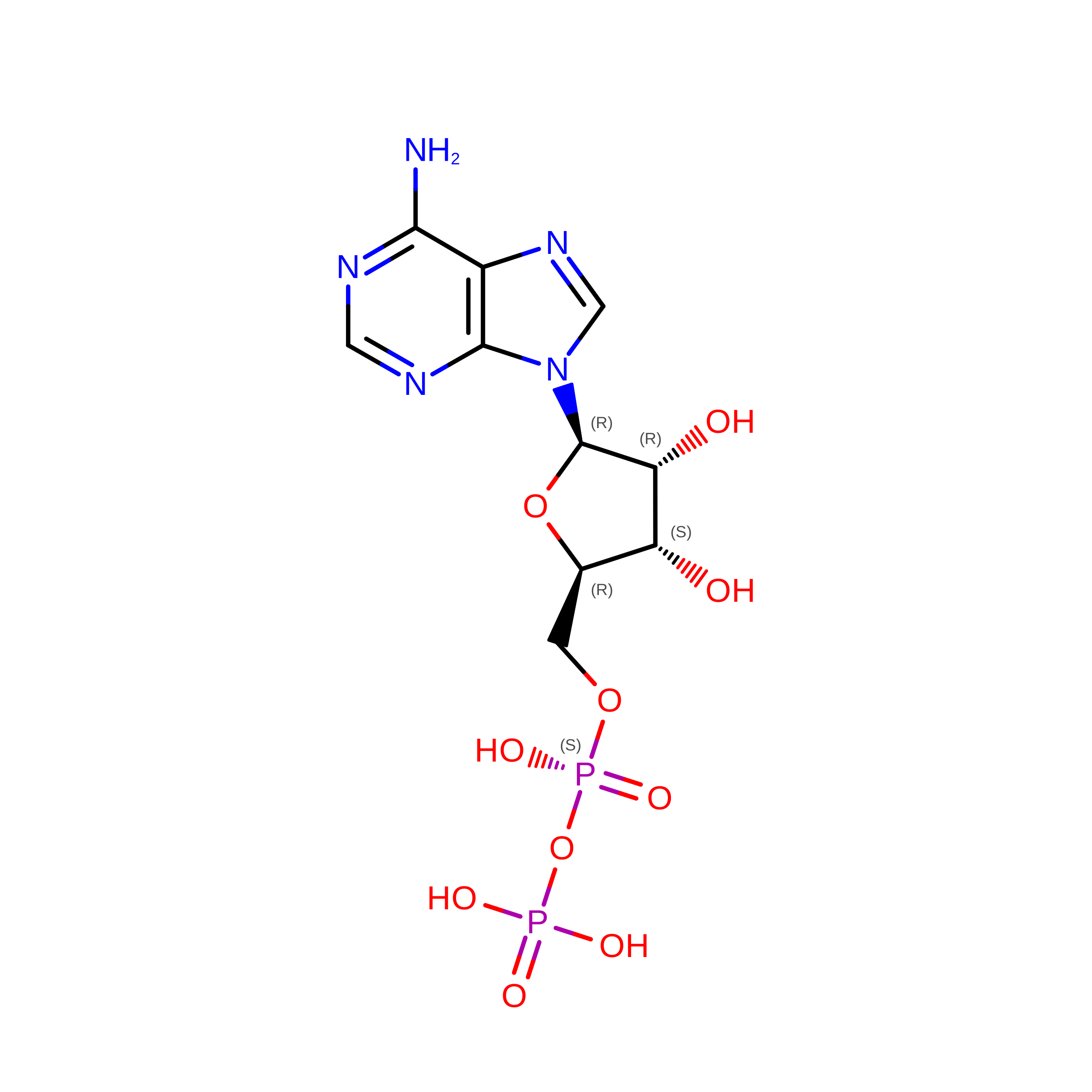
ADP
Query on ADP

Download Ideal Coordinates CCD File 
G [auth D],
I [auth C],
K [auth B],
M [auth A]
ADENOSINE-5'-DIPHOSPHATE
C10 H15 N5 O10 P2
XTWYTFMLZFPYCI-KQYNXXCUSA-N
MG
Query on MG

Download Ideal Coordinates CCD File 
H [auth D],
J [auth C],
L [auth B],
N [auth A]
MAGNESIUM ION
Mg
JLVVSXFLKOJNIY-UHFFFAOYSA-N
Experimental Data & Validation

Experimental Data

  • Method: ELECTRON MICROSCOPY
  • Resolution: 3.37 Å
  • Aggregation State: FILAMENT 
  • Reconstruction Method: SINGLE PARTICLE 

Structure Validation

View Full Validation Report


Entry History & Funding Information

Deposition Data


Funding OrganizationLocationGrant Number
National Science Foundation (NSF, United States)United StatesNSF-MCB1817315

Revision History  (Full details and data files)

  • Version 1.0: 2025-03-19
    Type: Initial release
  • Version 2.0: 2025-09-24
    Type: Coordinate replacement
    Reason: Model orientation/position
    Changes: Advisory, Atomic model, Data collection, Database references, Derived calculations, Refinement description, Structure summary
  • Version 2.1: 2025-10-01
    Changes: Data collection, Database references