Download Mendeley
Nucleotide- and metalloid-driven conformational changes in the arsenite efflux ATPase ArsA.
Mahajan, S., Pall, A.E., Li, Y.E., Stemmler, T.L., Rees, D.C., Clemons Jr., W.M.(2025) Proc Natl Acad Sci U S A 122: e2506440122-e2506440122
- PubMed: 40880530 Search on PubMedSearch on PubMed Central
- DOI: https://doi.org/10.1073/pnas.2506440122
- Primary Citation Related Structures:
9NBL, 9NBM, 9NBO, 9NBW - PubMed Abstract:
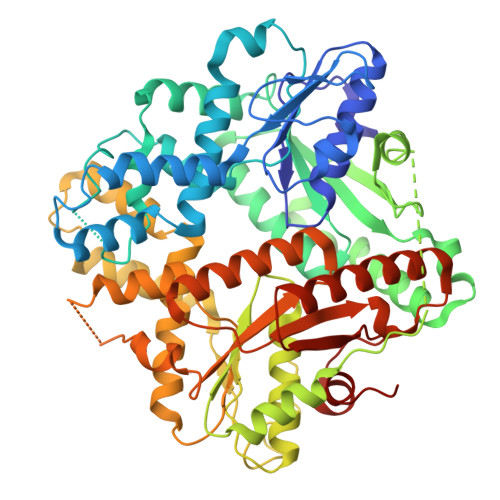
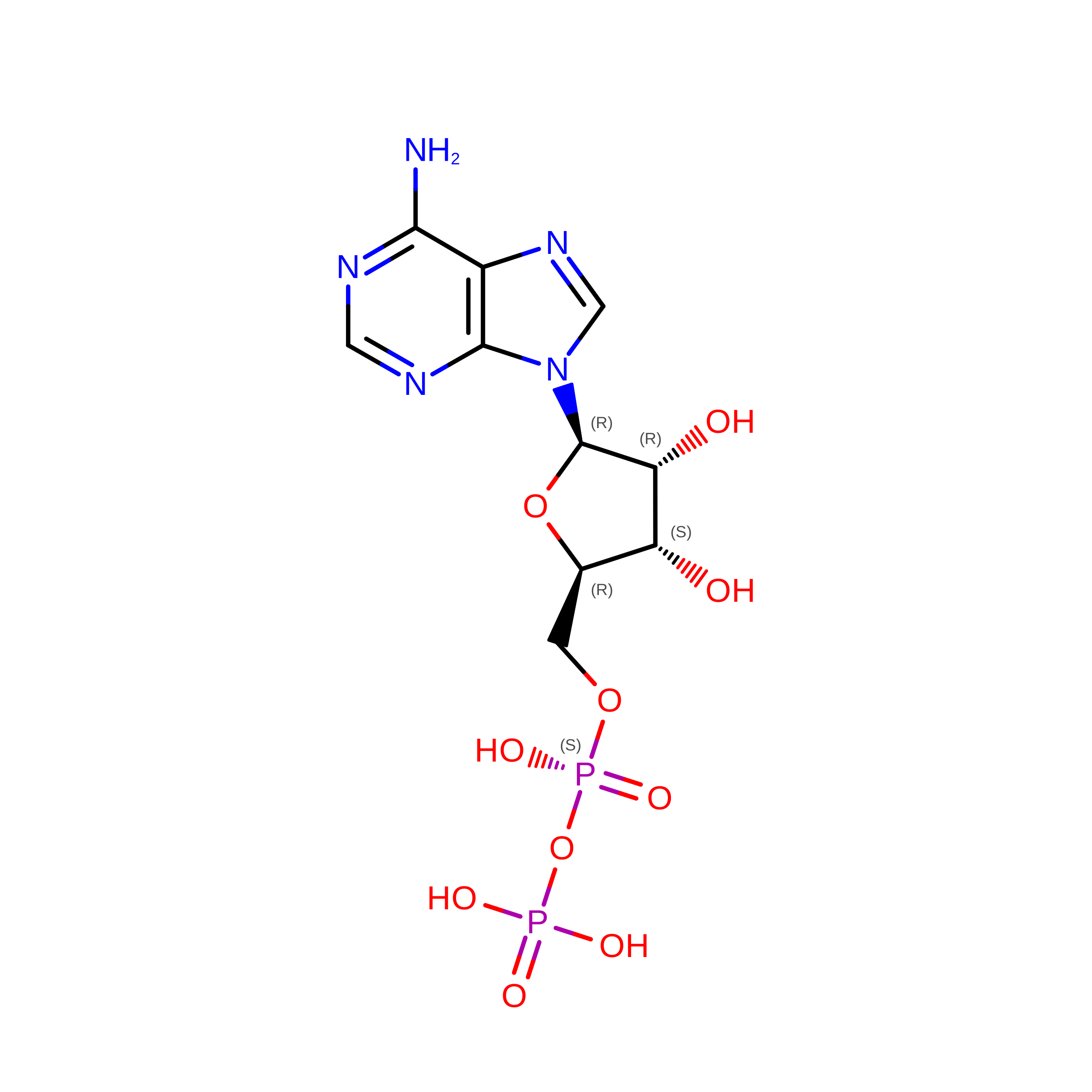
Arsenite (As III ) is toxic to all organisms due to its ability to tightly bind exposed thiols within cells. An important As III resistance mechanism in prokaryotes involves proteins encoded by the ars operon. A central component of the ars operon in many bacteria is the cytoplasmic ATPase, ArsA, which orchestrates a series of nucleotide-dependent handoffs, starting with the capture of As III by the ArsD metallochaperone and culminating in its removal from the cell by the ArsB efflux pump. Although the mechanism of ArsA has been widely studied, the molecular details of how nucleotide hydrolysis modulates these events remain unclear. ArsA is an archetypal member of the intradimeric Walker A (IWA) family of ATPases, implicated in a diversity of complex biological functions. Conformational changes typical of IWA ATPases have been postulated to drive these molecular events but have not been demonstrated. We report cryogenic electron microscopy (cryo-EM) structures of ArsA in MgADP-bound and MgATP-bound open states, as well as a distinct closed MgATP-bound state liganded to As III . X-ray absorption spectroscopy (XAS) confirmed three-coordinate binding of As III to the conserved cysteines at the metalloid-binding site of the closed state. Coupled with biochemical characterization, our cryo-EM structures reveal key conformational changes in the ArsA catalytic cycle consistent with other IWA ATPases and provide the structural basis for allosteric activation of nucleotide hydrolysis by As III . This work establishes how the nucleotide state of ArsA transiently creates a high-affinity binding site that can sequester metalloid within the cell, followed by a nucleotide-driven handoff to ArsB for efflux.
- Division of Chemistry and Chemical Engineering, California Institute of Technology, Pasadena, CA 91125.
Organizational Affiliation: